Key points
- Spotty brood is a symptom, not a disease: find the cause before replacing the queen.
- Open empty and suspect cells: dead larvae and sunken or perforated cappings point to a brood disease.
- A US study showed that a spotty brood pattern is not a reliable indicator of queen quality.
- Sunken, dark, perforated cappings with a ropy larva: suspect American foulbrood and report it to the DDPP.
- Varroa, pollen shortage, inbreeding and residues in the comb can also leave gaps in the brood.
A healthy brood frame is recognisable at a glance: a compact slab of capped cells of the same age, surrounded by a ring of larvae, then pollen and honey. When this slab is riddled with holes, with empty cells and larvae and pupae of different ages mixed together, beekeepers speak of spotty brood (also called shotgun brood). The queen often gets the blame, but spotty brood is a symptom, which can just as well reflect a brood disease, varroa, a nutritional shortage or a genetic problem.
This factsheet follows a decision tree: what to observe, the possible causes, how to tell them apart, then what to do.
Normal brood or spotty brood: what to observe
In workers, the egg hatches after three days, the larva is capped around day nine and the adult bee emerges around day twenty-one. A healthy queen lays in a spiral, cell after cell, producing patches of uniform age. A few empty cells are normal: non-viable eggs, larvae removed by house bees, cells filled with pollen or nectar.
In a US study, brood with fewer than 80% capped cells over an area of about 100 cells was classed as “poor”1: this is a benchmark, not an official standard.
Before looking for a cause, answer a few questions:
- Are the empty cells really empty? Look at the bottom: an egg, a very young larva, pollen or nectar completely change the interpretation.
- What do the abnormal cells contain? Slumped, yellowed or brown larvae, white or black mummies, sac-shaped larvae, dead pupae?
- What do the cappings look like? Domed and even, or sunken, dark, pierced with small holes, chewed?
- Are there eggs, and how many per cell? One egg centred at the bottom, or several eggs stuck to the cell walls?
- Are the drones in the right place? Domed drone cappings in the middle of worker brood are a warning sign.
- What is the context? Season, stores, age of the queen, latest mite count, number of colonies affected.
Photograph the frame held flat, in natural light.
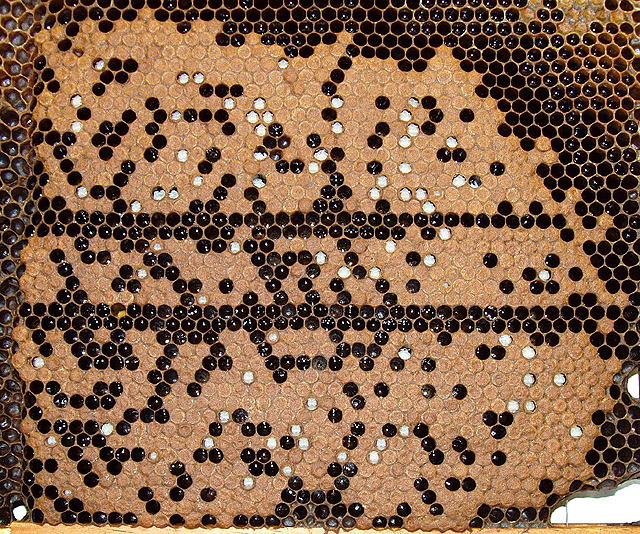
Why is the brood spotty? The possible causes
The order below is only indicative, as precise statistics are lacking: from the more common causes to the rarer ones. Several causes can combine.
1. A failing, old or poorly mated queen
A queen that is ageing, that met too few drones on her mating flights or that has been damaged (transport, cold, handling) may lay irregularly, skip cells or lay unfertilised eggs. A queen running out of sperm eventually lays drones in worker cells: the cappings become domed, bullet-shaped, in the middle of the flat brood13. She has become a drone-laying queen.
This scenario is real, but overrated. In the US study cited above (2016 and 2017), the queens from colonies with “poor” brood did not differ from the others in size, sperm count or pathogens. After the queens were swapped between colonies, the brood of the “poor” queens improved markedly within 21 days, and vice versa1. The appearance of the brood is therefore not enough to judge a queen: the colony’s environment matters just as much.
2. Inbreeding and diploid drones
In the honey bee, sex is determined by a single gene, the csd gene. A larva carrying two different versions of this gene becomes a female; a larva from a fertilised egg but carrying two identical versions becomes a diploid drone3. Workers detect and eat these larvae within hours of hatching2. An empty cell is left behind, which the queen may lay in again later: hence a patchy brood of mixed ages.
This problem arises when the queen has mated with related drones: rearing from a single line, an isolated apiary. The cells are empty, with no diseased larva. The remedy is requeening with a queen of different genetic origin.
3. Varroa and hygienic behaviour
Varroa reproduces in capped brood. Parasitised pupae emerge weakened, sometimes with deformed wings, or die in their cells11. Many colonies detect these pupae, uncap the cells and clear them out. Bees selected for this behaviour, known as VSH (Varroa Sensitive Hygiene), mainly remove parasitised pupae capped for five days or less6. The result is a spotty pattern, with perforated or removed cappings and white-eyed or pink-eyed pupae exposed.
Spotty brood in late summer should therefore always prompt a mite count. The same logic applies to Tropilaelaps, an exotic mite that is notifiable in France.
4. Brood diseases
Diseases kill larvae or pupae here and there. House bees remove the corpses, leaving empty cells among the healthy ones7. Open the suspect cells: their contents make the diagnosis.
- American foulbrood: sunken, dark, greasy cappings, often perforated; the larva turns into a brown, ropy mass (rope test, using a matchstick), then into a scale that sticks firmly to the cell; sometimes a marked smell. It affects capped brood8. This is the cause not to miss: it is notifiable.
- European foulbrood: uncapped larvae twisted in their cells, yellowish then brown, looking melted; the scale is easy to remove9.
- Chalkbrood: mummified, hard larvae, white to black, often at the edge of the brood; mummies on the floor and in front of the entrance10.
- Sacbrood: larva shaped like a fluid-filled sac, with a raised, darkened head, like a “gondola”.
- Black queen cell virus and other viral diseases: pupae dead in their cells, sometimes with no visible lesion.
5. Pollen shortage and lack of food
Pollen supplies the protein essential for brood rearing. A colony that lacks it keeps rearing brood only for a short time: it eats some of its young larvae to recover their protein and feed the older ones, then reduces or stops laying4. You then see eggs but few young larvae, scattered empty cells and almost no pollen around the brood. This happens in a wet spring, during a drought or in an environment poor in flowers.
6. A honey-bound brood nest
During a strong nectar flow, when there is no room left in the supers, foragers store nectar in the cells vacated by emerging bees. The queen can no longer find anywhere to lay and the brood breaks up: the brood nest is backfilled. The “empty” cells actually contain nectar that glistens in the light. This is a lack of space, not a disease.
7. Pesticides and residues in the comb
Bees reared in comb rich in pesticide residues develop more slowly and live on average four days less. These residues migrate from one comb to another, and contaminated clean combs showed more brood mortality and delayed emergence5. In the queen study, the wax of colonies with poor brood contained a greater number of different residues in 2016, with only a trend in 20171. See the Pesticide poisoning factsheet.
8. Chilled brood
When the cluster contracts during a cold snap or after a heavy loss of bees, the outer brood is no longer covered. The larvae die, turn yellowish to brown and can resemble European foulbrood, but the rope test remains negative13. The damage lies at the edge of the brood, not in the centre.
9. Laying workers
In a colony that has been queenless for a long time, some workers start laying several eggs per cell, often stuck to the cell walls13. They produce only drones, with scattered domed cappings.
10. Rare causes
Wax moth larvae tunnel under the cappings and leave lines of exposed pupae. A misused medicine can kill brood. Finally, a young queen who has just started laying takes a few weeks to produce an even brood pattern.
How to tell the causes of spotty brood apart
| What you see | Typical context | Most likely cause |
|---|---|---|
| Clean empty cells, no diseased larva, normal cappings | Queen from a local line with little diversity | Inbreeding, poorly mated queen |
| Domed drone cappings in the middle of worker brood, one egg per cell | Old queen | Failing, drone-laying queen |
| Several eggs per cell, stuck to the walls | Colony queenless for weeks | Laying workers |
| Perforated cappings, pink-eyed pupae removed | Late summer, high mite count | Varroa and hygienic behaviour |
| Sunken, dark, perforated cappings; brown ropy larva | Any season | American foulbrood |
| Uncapped larvae twisted, yellowish, melted | Spring, rapid build-up | European foulbrood |
| Hard mummies, white to black | Damp spring | Chalkbrood |
| Few young larvae, no pollen | Dearth, bad weather | Pollen shortage |
| Cells full of glistening nectar | Nectar flow, full supers | Honey-bound brood nest |
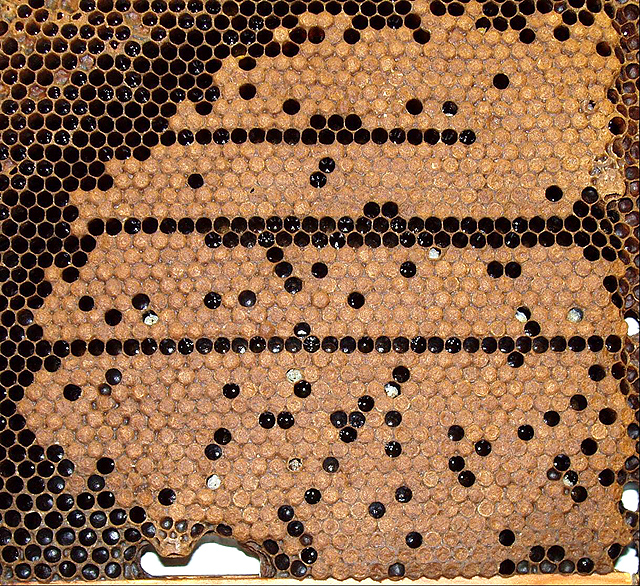
Spotty brood: what to do, step by step
- Examine several frames from the centre of the brood nest.
- Look at the bottom of the cells and open a dozen suspect cells with a toothpick.
- Do the rope test on any brown or slumped larva: if the mass stretches into a thread, suspect American foulbrood, do not swap any frames and call the DDPP or your vet.
- Count mites by a wash or an icing sugar roll.
- Check the stores: pollen, honey, room for laying.
- Compare with the other colonies: a queen-related cause affects one colony; a shortage or pesticides often affect several.
- Deal with the cause, then re-examine the brood three weeks later.
- Requeen as a last resort, once the other causes have been ruled out.
One test helps to decide: give the colony a frame of young, healthy brood from another colony. If the larvae are reared normally, the problem more likely lies with the laying. Never do this if a contagious disease is suspected.
Laboratory diagnosis
A piece of comb containing suspect larvae allows the laboratory to test for foulbrood, fungal diseases and viruses; your vet, your bee health organisation or the DDPP will tell you where and how to send it. A wax analysis looks for pesticide residues. Inbreeding is not confirmed by routine testing: it is inferred by elimination.
Regulations
What follows applies to France; rules vary between countries, so check those that apply where you keep bees.
- Spotty brood is not a disease: it is not reported as such.
- Any suspicion of American foulbrood, Nosema apis, Aethina tumida or Tropilaelaps must be reported to the DDPP (departmental veterinary services)12. For American foulbrood, the report is made without delay, directly or through your vet.
- Any treatment uses a medicine authorised for bees, following the package leaflet, and is recorded in the apiary medicine register.
In practice: what beekeepers actually do
Faced with spotty brood, most beekeepers resist the urge to replace the queen straight away: they look inside the cells first, then rule out the causes one by one.
Practical habits
- Read the brood on every spring inspection: most beekeepers spot a spotty pattern by comparing the central frames from one inspection to the next.
- Open a few cells with a toothpick rather than relying on the overall appearance.
- Always keep the rope test in mind when faced with a brown larva or a sunken capping.
Common strategies
- Many beekeepers note on their inspection record the appearance of the brood and the presence of eggs and pollen.
- They regularly replace old brood combs to limit residues and pathogens.
- They diversify the genetic origin of their queens to avoid inbreeding.
Kit to keep ready
- Toothpicks or fine tweezers, a head torch or magnifying glass to see the bottom of the cells.
- Mite-counting equipment.
- Brown paper and cardboard to send a comb sample to the laboratory.
- The DDPP’s and your vet’s phone numbers.
Checklist
- Eggs present, one per cell, well centred?
- Contents of empty cells: nothing, nectar, pollen?
- Dead larvae or pupae, sunken or perforated cappings?
- Rope test on any suspect larva.
- Mite count, stores, number of colonies affected.
The most common mistakes
- Replacing the queen at first glance, without opening a single cell: foulbrood, varroa or a shortage remain in place and the new queen will do no better.
- Judging from a single frame at the edge of the nest.
- Ignoring a ropy larva: moving frames from a colony with American foulbrood spreads the disease.
- Forgetting varroa in late summer, when the removal of parasitised pupae is a classic cause of spotty brood.
- Mistaking nectar-filled cells for empty ones during a nectar flow.
Frequently asked questions
Does spotty brood mean the queen is bad? Not necessarily. A US study showed that queens from colonies with irregular brood laid markedly better once placed in another colony. Before replacing the queen, rule out brood diseases, varroa, pollen shortage and lack of space.
How can I tell whether spotty brood is caused by a disease? Open the suspect cells. Dead, deformed or discoloured larvae, mummies, and sunken, dark or perforated cappings indicate a disease. Clean empty cells with no diseased larva point rather to the queen, inbreeding or a shortage.
Can varroa cause spotty brood? Yes. Parasitised pupae die or are removed by the workers, leaving empty cells and perforated cappings. This is common in late summer: a mite count is essential.
What should I do if I suspect American foulbrood? Do not move any frames, close the hive, disinfect your equipment and report the suspicion without delay to the DDPP, directly or through your vet. See the American foulbrood factsheet.
References
- Lee K.V., Goblirsch M., McDermott E., Tarpy D.R., Spivak M. (2019). Is the brood pattern within a honey bee colony a reliable indicator of queen quality? Insects 10(1): 12. doi.org
- Woyke J. (1963). What happens to diploid drone larvae in a honeybee colony. Journal of Apicultural Research 2: 73-75.
- Beye M., Hasselmann M., Fondrk M.K., Page R.E. Jr., Omholt S.W. (2003). The gene csd is the primary signal for sexual development in the honeybee and encodes an SR-type protein. Cell 114(4): 419-429. doi.org
- Brodschneider R., Crailsheim K. (2010). Nutrition and health in honey bees. Apidologie 41(3): 278-294. doi.org
- Wu J.Y., Anelli C.M., Sheppard W.S. (2011). Sub-lethal effects of pesticide residues in brood comb on worker honey bee (Apis mellifera) development and longevity. PLoS ONE 6(2): e14720. doi.org
- Harris J.W. (2007). Bees with Varroa Sensitive Hygiene preferentially remove mite infested pupae aged ≤ five days post capping. Journal of Apicultural Research 46(3): 134-139. ars.usda.gov
- Spivak M., Gilliam M. (1998). Hygienic behaviour of honey bees and its application for control of brood diseases and varroa. Part I. Hygienic behaviour and resistance to American foulbrood. Bee World 79(3): 124-134. doi.org
- Genersch E. (2010). American Foulbrood in honeybees and its causative agent, Paenibacillus larvae. Journal of Invertebrate Pathology 103: S10-S19. doi.org
- Forsgren E. (2010). European foulbrood in honey bees. Journal of Invertebrate Pathology 103: S5-S9. doi.org
- Aronstein K.A., Murray K.D. (2010). Chalkbrood disease in honey bees. Journal of Invertebrate Pathology 103: S20-S29. doi.org
- Rosenkranz P., Aumeier P., Ziegelmann B. (2010). Biology and control of Varroa destructor. Journal of Invertebrate Pathology 103: S96-S119. doi.org
- French Ministry of Agriculture, DGAL (2018). Note de service DGAL/SASPP/2018-444: surveillance des mortalités massives aiguës d'abeilles adultes avec hypothèse d'intoxication. draaf.bretagne.agriculture.gouv.fr
- University of Georgia, CAES Bee Program. Honey bee disorders: non-infectious diseases and pests. bees.caes.uga.edu
- Public domain photographs: USDA ARS, Jeffrey Harris, images D214-1 and D214-2 (ARS Image Gallery). ars.usda.gov