Key points
- Warning sign: many dead or trembling bees outside several hives at once, within a few days.
- Bees are exposed through nectar, pollen, water, guttation drops, seed-drilling dust and wax.
- At low doses, some insecticides disorient foragers without killing them outright.
- Act within 48 hours: photos, frozen bee samples, an official report.
- In France, spraying in bloom is only allowed around sunset, with an authorised product.
A colony commonly forages within two to three kilometres of the hive, sometimes further. It therefore “samples” hundreds of hectares of crops, gardens and hedgerows: any product applied over that area can end up in the nectar, pollen or water carried back to the hive, and from there in the stores and the wax.
Poisoning takes two forms. Acute poisoning is dramatic: thousands of dead bees within a few days, often across several colonies. Chronic, or sublethal, poisoning is quiet: foragers that get lost, brood that develops poorly, colonies that decline for no obvious reason.
How bees are exposed
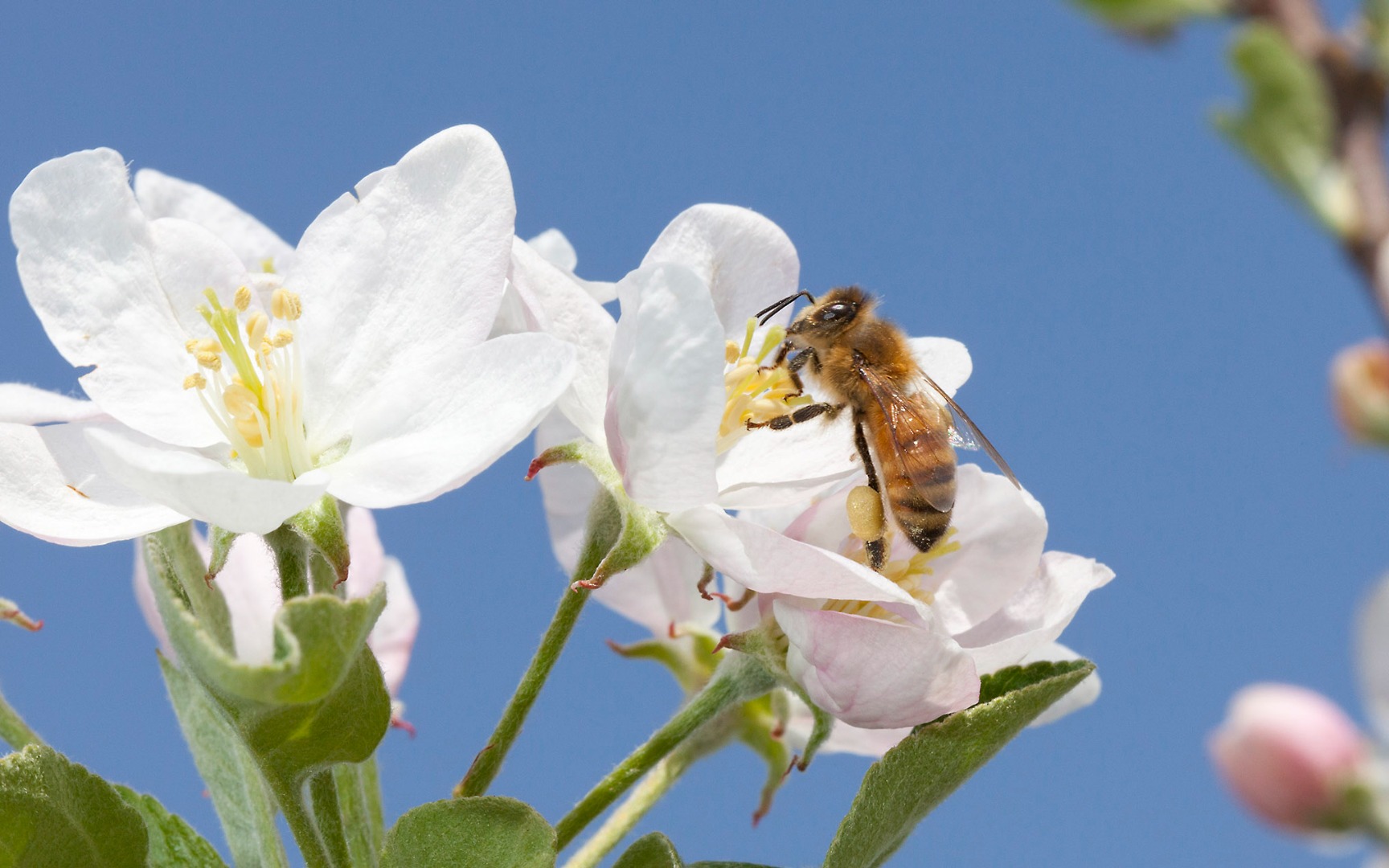
Nectar and pollen
This is the main route. An insecticide sprayed on a flowering crop hits foragers directly and contaminates the flowers. Systemic products, which move in the plant sap, can pass into nectar and pollen even when only the seed was treated. Stored as bee bread, contaminated pollen exposes the brood weeks later.
Guttation
Some plants, young maize seedlings in particular, exude droplets of water along their leaf edges in the morning. When the seed was coated with a neonicotinoid, these drops can contain the insecticide at high concentrations, enough to kill a bee that drinks from them5.
Seed-drilling dust
When coated seed is sown with pneumatic drills, abrasion of the coating releases insecticide-laden dust that reaches bees in flight and the flowers along field margins6. A study near maize fields also found neonicotinoids in the soil, in weeds and in dead bees outside the hives7.
Water
Puddles, ditches and drainage water near treated fields can contain residues. In summer, bees carry large amounts of water to cool the hive, so exposure is repeated.
Wax
Wax acts as a sponge for fat-soluble molecules. It accumulates agricultural pesticides and residues of the acaricides used against varroa: a large North American study found many pesticides in wax, pollen and bees, with in-hive miticides often dominating in wax8. Larvae grow in contact with this wax, and recycling it into foundation spreads the residues.
The main chemical families
Neonicotinoids
Systemic insecticides that act on the nervous system and are highly toxic to bees, they have been widely used as seed coatings. In the European Union, three of them, imidacloprid, clothianidin and thiamethoxam, were restricted by three regulations in May 2018: since the end of 2018, they may only be used in permanent greenhouses10.
France went further: its 2016 biodiversity law led to a ban on five neonicotinoids from 1 September 2018, including acetamiprid and thiacloprid. Temporary derogations later granted for sugar beet seed were called into question by the EU Court of Justice in 2023, and a reintroduction of acetamiprid voted in 2025 was struck down by the Constitutional Council. The issue is still debated: check the rules in force when you read this.
Pyrethroids
Contact insecticides that are highly toxic to bees and sprayed on many crops. A direct spray on foragers is lethal. Tau-fluvalinate, a pyrethroid, is also an in-hive acaricide and is frequently found in wax.
Organophosphates and carbamates
Older insecticides with high acute toxicity, they block a key nervous system enzyme. Most have been withdrawn from the European market but are still used elsewhere in the world, where they cause rapid mass bee kills.
Fungicides and the cocktail effect
On their own, most fungicides are of low toxicity to bees. But some, notably the sterol biosynthesis inhibitors (triazoles, imidazoles), slow down the bee’s detoxification enzymes. Combined with certain insecticides, they multiply their toxicity: this synergy was demonstrated as early as 1993 with a pyrethroid9. Tank mixes are therefore a concern, even when each product is judged acceptable on its own.
Other sources
Biocides (mosquito control, wood treatment), private gardens and misused veterinary medicines in the hive can also be responsible: poisoning is not always agricultural.
Why it matters
Acute effects
Heavy exposure quickly kills foragers. If the damage is severe, there are not enough workers left to feed and warm the brood: the colony collapses or takes weeks to rebuild, and the season’s crop is often lost.
Sublethal effects
At doses too low to kill, some insecticides disrupt behaviour. In 2012, a French team fitted foragers with electronic tags (RFID) to track their trips. Bees given a sublethal dose of thiamethoxam failed to find their way home more often than control bees. Modelling suggested that these forager losses could, at colony level, contribute to a risk of collapse4. Other work describes effects on learning, immunity, larval development and the quality of queens and drones, but the size of these effects in the field varies between studies.
These effects are hard to spot and combine with varroa, viruses and a lack of forage: pesticides are rarely the only cause of winter losses.
Recognising poisoning
Signs of acute poisoning
- A carpet of dead or dying bees outside the hive and on the landing board, appearing within hours or a few days.
- Several colonies affected at once, sometimes several apiaries in the same area.
- Trembling, paralysed bees crawling on the ground, spinning on the spot, tongue extended, wings spread.
- A colony suddenly short of foragers, with brood and stores still present.
- Sometimes, later on, dead larvae or patchy brood.
Do not confuse with
| Situation | What points to it | What sets it apart from poisoning |
|---|---|---|
| Chronic bee paralysis | Trembling, black, shiny bees | Gradual onset, often a single colony |
| Acute bee paralysis and varroa-related viruses | Dying bees, weakening colony | Linked to high varroa, develops over weeks |
| Starvation | Many dead bees | Bees head-first in cells, no stores |
| Nosema, dysentery | Crawling bees, weakening | Soiling, swollen abdomen, late-winter context |
Timing is often the main clue: several colonies hit suddenly, at the time of nearby sowing or spraying. Only laboratory analysis can confirm it.
Diagnosis: sampling and analysis
The official definition in France
In France, acute mass mortality means that within less than 15 days a colony has more than one litre of dead or dying bees in front of or inside the hive, or becomes depopulated without swarming. At apiary level, at least 20% of colonies must be affected, with adjusted thresholds for small apiaries12.
Sampling
Speed is decisive: the later the sample, the harder it is to prove poisoning. The reference instruction provides for12:
- Dead or dying bees, ideally within 48 hours, hive by hive, in three samples of about 50 g (around 500 bees): one analysed, one kept under seal by the beekeeper, one by the authorities.
- Cool storage during transport, then the freezer at around -20 °C.
- Where the investigation warrants it, bee bread, brood, wax, honey, and plant samples taken by authorised officers.
Analysis
Bees are analysed for residues. If the investigation points to a specific molecule, it is looked for first; otherwise, a multi-residue analysis screens a broad range of substances. An environmental survey can cover about 3 km around the apiary. A result below the known lethal dose is not enough to rule out poisoning, because mixtures matter12. Disease testing rules out other causes.
Regulation
Rules vary widely from country to country. What follows concerns France and, for risk assessment, the European Union.
Risk assessment in Europe
Each active substance is assessed at EU level. EFSA’s 2013 guidance document, which covered chronic exposure, larvae and sublethal effects1, was never fully applied because Member States did not agree on it. A revised version was published in May 20232, after Member States set a protection goal in 2021: a maximum 10% reduction in colony size due to pesticides.
Spraying in bloom: the French Order of 20 November 2021
In force since 1 January 2022, this order replaces the 2003 one and now covers insecticides, acaricides, fungicides and herbicides11. Its main points:
- On an attractive crop in bloom or on a foraging area, only products assessed as posing no unacceptable risk to bees may be used. They carry a specific label statement. The former “bee statement” (mention abeilles) remains valid on a transitional basis, until each product is reassessed.
- These products may only be applied within the 2 hours before sunset and the 3 hours after sunset.
- Time-window derogations exist, notably for pests active only in daytime or for fast-developing fungal diseases. They must be justified.
- A list of crops is deemed unattractive (straw cereals, forage grasses, potatoes, hops, etc.). Since a Council of State ruling in April 2024, peas, lentils, soya and vines are no longer on it.
- Under perennial crops, flowering ground cover must be mown or mulched before any insecticide or acaricide treatment.
Reporting a bee kill
Acute mass mortality with suspected poisoning leads to a state investigation, with laboratory costs covered if the case meets the criteria12. The entry point depends on the region:
- In regions covered by the Observatory of Honey Bee Mortality and Weakening (OMAA), beekeepers call the regional single desk. A trained veterinarian records the report and routes it to the right scheme: acute mass mortality, regulated disease or other disorders13. Launched in 2017 in two pilot regions, it is gradually being extended.
- Elsewhere, reports go to the departmental DDPP or DDETSPP.
The regional desk’s number is listed on the DRAAF website.
Prevention
- Know your surroundings: crops within 3 km, sowing and flowering calendars.
- Provide a clean water source in the apiary, so bees avoid drainage ditches.
- Renew brood-box combs regularly, using wax of known, tested origin3.
- Use veterinary medicines strictly according to the label.
In practice: what beekeepers actually do
When bees die suddenly, the first hours count. Here are the reflexes most beekeepers follow, and how they reduce the risk beforehand.
Immediate steps after a sudden bee kill
- Take photos straight away of the landing boards, the ground in front of each hive, close-ups of the bees and the neighbouring fields. The phone’s timestamp serves as evidence.
- Collect dying or freshly dead bees, hive by hive, in three batches, in clean labelled bags (date, apiary, hive), then freeze them at once.
- Call the OMAA desk or the DDPP the same day, noting the name of the person you spoke to.
- Write down the context: sprayer seen, smell, recent sowing, wind, temperature.
- Do not clean anything before the official visit.
Talking to the farmer
Many beekeepers prefer a calm approach: asking the neighbouring farmer what was applied, when and where, without accusing. The information helps the investigation and preserves the relationship. The official report is made regardless: it is what triggers the analyses.
Choosing apiary sites
- It is common to favour sites surrounded by meadows, woodland and hedgerows rather than right on the edge of large sprayed fields.
- Before moving hives onto oilseed rape, sunflowers or orchards, beekeepers find out what treatments are planned during bloom.
- An agreement with the landowner and the farmer sets out who to warn before spraying.
Working with farmers
- Introduce yourself at the start of the season, leaving a phone number and the exact location of the hives.
- Ask to be warned before any spraying in bloom, so hives can be closed or moved if necessary.
- Acknowledge what works: flower strips, hedges, spraying at sunset. A jar of honey at the end of the season often helps the relationship.
Equipment to keep ready
- New freezer bags, disposable gloves, a permanent marker.
- A cool box with ice packs in the vehicle during the season.
- The OMAA desk or DDPP number saved in your phone.
Checklist
- Photos, frozen samples, notes on the context.
- Call the OMAA desk or the DDPP the same day.
- Courteous contact with the farmer concerned.
- Colony follow-up: clean water, feeding if needed, uniting colonies that are too weak.

The most common mistakes
- Waiting a few days to “see if it continues”: residues break down and proof becomes impossible.
- Collecting bees that died long ago, dried out or mouldy, instead of dying and freshly dead ones.
- Leaving samples at room temperature instead of freezing them.
- Not reporting for fear of conflict: without a report, there is no investigation and no data.
- Concluding it is poisoning without checking varroa, stores and diseases.
Frequently asked questions
Is honey from a poisoned colony safe to eat? A forager kill does not necessarily mean the honey exceeds legal residue limits. If in doubt, it is better to have a super filled during the episode analysed before harvesting it.
Can a poisoned colony recover? Yes, if the queen and part of the brood are intact and the season allows it. Watch stores and laying over the following weeks; a colony that is too weak is often united with another.
Do beekeepers pay for the analyses? In France, when acute mass mortality is reported and the poisoning suspicion is upheld, toxicology analyses are paid for by the State. Disease tests carried out outside this framework may be at the beekeeper’s expense.
Is closing hives during spraying useful? A short closure, for the duration of an announced treatment, limits direct exposure. It must be brief and well ventilated, especially in hot weather, and does not protect against residues left on flowers afterwards.
References
- EFSA (2013). Guidance on the risk assessment of plant protection products on bees (Apis mellifera, Bombus spp. and solitary bees). EFSA Journal 11(7): 3295. doi.org
- EFSA, Adriaanse P. et al. (2023). Revised guidance on the risk assessment of plant protection products on bees (Apis mellifera, Bombus spp. and solitary bees). EFSA Journal 21(5): 7989. doi.org
- FAO, IZSLT, Apimondia, CAAS (2021). Good beekeeping practices for sustainable apiculture. FAO Animal Production and Health Guidelines No. 25.
- Henry M., Béguin M., Requier F., Rollin O., Odoux J.-F., Aupinel P., Aptel J., Tchamitchian S., Decourtye A. (2012). A common pesticide decreases foraging success and survival in honey bees. Science 336(6079): 348-350. doi.org
- Girolami V., Mazzon L., Squartini A., Mori N., Marzaro M., Di Bernardo A., Greatti M., Giorio C., Tapparo A. (2009). Translocation of neonicotinoid insecticides from coated seeds to seedling guttation drops: a novel way of intoxication for bees. Journal of Economic Entomology 102(5): 1808-1815. doi.org
- Tapparo A., Marton D., Giorio C., Zanella A., Soldà L., Marzaro M., Vivan L., Girolami V. (2012). Assessment of the environmental exposure of honeybees to particulate matter containing neonicotinoid insecticides coming from corn coated seeds. Environmental Science & Technology 46(5): 2592-2599. doi.org
- Krupke C.H., Hunt G.J., Eitzer B.D., Andino G., Given K. (2012). Multiple routes of pesticide exposure for honey bees living near agricultural fields. PLoS ONE 7(1): e29268. doi.org
- Mullin C.A., Frazier M., Frazier J.L., Ashcraft S., Simonds R., vanEngelsdorp D., Pettis J.S. (2010). High levels of miticides and agrochemicals in North American apiaries: implications for honey bee health. PLoS ONE 5(3): e9754. doi.org
- Pilling E.D., Jepson P.C. (1993). Synergism between EBI fungicides and a pyrethroid insecticide in the honeybee (Apis mellifera). Pesticide Science 39(4): 293-297. doi.org
- Commission Implementing Regulations (EU) 2018/783, 2018/784 and 2018/785 of 29 May 2018 restricting the approval of imidacloprid, clothianidin and thiamethoxam. eur-lex.europa.eu
- DRAAF Grand Est (2024). Information note: Order of 20 November 2021 on the protection of bees and other pollinating insects (updated 26 April 2024). In French. draaf.grand-est.agriculture.gouv.fr
- French Ministry of Agriculture, DGAL (2018). Instruction DGAL/SASPP/2018-444: surveillance of acute mass mortality of adult bees with suspected poisoning. In French. draaf.bretagne.agriculture.gouv.fr
- Plateforme ESA (2024). OMAA, an innovative surveillance system for honey bee health disorders. In French. plateforme-esa.fr
- Public domain photographs: USDA ARS, 'Honey bee on apple blossom' (Steve Ausmus); USGS, 'Honey bee on a sunflower' (Annie Scott, usgs.gov/media/images/honey-bee-sunflower). ars.usda.gov