Key points
- A fungal brood disease caused by Ascosphaera apis: larvae die after capping and turn into "mummies".
- Black mummies carry the spores, which stay infective for many years in wax and equipment.
- The disease shows mainly when brood gets chilled: cool, damp springs, weak colonies, badly sited hives.
- No medicine is authorised: the levers are siting, colony strength, comb renewal and genetics.
- Hygienic behaviour, measured with the killed-brood test, is the best long-term lever.
Chalkbrood is a fungal brood disease found in almost every apiary in the world. It is easy to recognise: dead larvae, dried out and hardened like chalk, which the bees throw out onto the floor and in front of the entrance. It rarely kills a colony, but a heavy case slows its spring build-up.
It is an opportunistic disease. Many colonies carry the spores without showing any signs; the fungus takes hold when brood gets chilled, when the colony is too weak, or when the bees are poor housekeepers. Since no medicine is authorised, control relies on apiary management and on breeding.
The agent: Ascosphaera apis
Ascosphaera apis is an ascomycete fungus that specialises in honey bee brood. It is heterothallic: there are two mating types, “+” and “−”. A single mycelium can kill a larva but produces no spores. Fruiting bodies only form when two strains of opposite mating types meet in the same larva1, 2.
These fruiting bodies (spore cysts or ascomata) are small dark spheres about a tenth of a millimetre across, filled with balls of ascospores around 3 µm long2, 8. They are what turns mummies grey or black. A single black mummy holds millions of infective spores2. Sources commonly cite survival of more than ten years, or even more than fifteen, with viability declining over time2, 8. Spores persist in wax, pollen, honey and on equipment; contaminated foundation helps spread them8.
How larvae become infected
Larvae swallow the spores with their food. All larval stages can be infected2, with three- to four-day-old larvae apparently the most susceptible10. Spores germinate in the gut, but the fungus only really grows after capping. The mycelium then invades the tissues and usually kills the larva within two to three days10, before breaking out through the cuticle and covering the body in a white, cottony mat that then dries out.
Chilling is the most consistent trigger. Brood cooled below its normal rearing temperature contains markedly more diseased larvae2, and the most critical moment is just after capping10. Hence short outbreaks in cool, damp weather2, and affected larvae mostly at the edge of the brood nest, where the bees cover the brood less well. Drone brood, on the periphery, is often affected too1.
Impact on the colony
Most often, a few mummies appear in spring and disappear once the weather warms. A heavy case still has a cost: every lost larva is a bee missing just when the colony needs to grow. A weakened colony covers its brood poorly, and a vicious circle sets in1. A colony that is badly affected year after year usually points to a poorly hygienic line or an unsuitable site.
Recognising chalkbrood
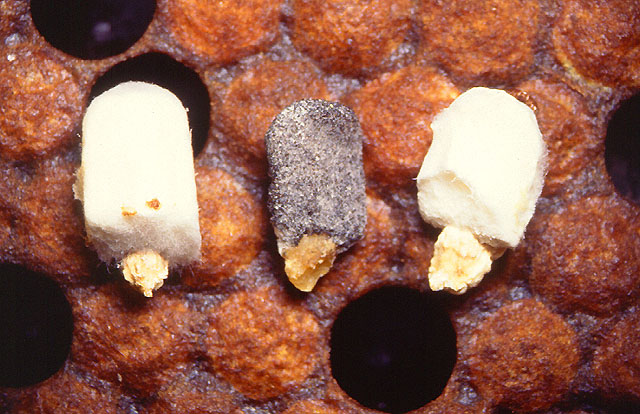
- White mummies: dried, hard, chalky larvae, invaded by a single mating type, with no fruiting bodies2.
- Grey to black or speckled mummies: the fungus has fruited; these are the most infectious2, 8.
- Loose mummies that rattle in the cells when the frame is shaken8.
- Mummies on the floor and in front of the hive: often the first sign noticed.
- Spotty brood, with pierced cappings.
Do not confuse with
| Disease | Appearance of dead larvae | Decisive clue |
|---|---|---|
| Chalkbrood | White or black mummies, chalky, loose | Mummy crumbles between the fingers |
| Stonebrood (Aspergillus) | Very hard mummies, yellow-green, green, brown or black powder | “Stone-like”, powdery mummy |
| American foulbrood | Ropy brown mass, then scale stuck to the cell | Positive matchstick test |
| European foulbrood | Yellowed, slumped, uncapped larvae | Soft larvae |
| Sacbrood | Larva as a fluid-filled sac, head raised | Soft, sac-like larva |
Beware of stonebrood
Stonebrood is caused by Aspergillus species, mainly A. flavus and, less often, A. fumigatus. Its mummies are much harder and become covered in a powder of spores whose colour depends on the species2. Unlike Ascosphaera, these fungi can also infect adult bees2, 7. Stonebrood is probably under-detected, because workers quickly remove affected larvae7.
Health precautions. Aspergillus species are classed as opportunistic human pathogens, their spores become airborne, and A. flavus produces aflatoxins, which are carcinogenic2. If you suspect stonebrood, avoid shaking or blowing on the combs, wear a filtering mask and safety glasses2, do not harvest honey from affected combs, and have the diagnosis confirmed by a laboratory.
Diagnosis
A field diagnosis is almost always enough.
- Check the entrance and floor: whole white and black mummies.
- Examine a brood frame: spotty pattern, mummies at the edge, sometimes larvae covered in white fluff.
- Shake the frame: dry mummies rattle in the cells.
- Crush a mummy between gloved fingers: a chalkbrood mummy crumbles; a very hard, powdery one should make you think of stonebrood.
- If in doubt (foulbrood, stonebrood), send a sample to a laboratory through your bee health organisation: the fungus is identified by microscopy, culture or molecular methods2.
Regulations
In France, chalkbrood is not a notifiable disease. No veterinary medicine is authorised against it in the European Union3, and no effective chemical treatment is recognised to date2. Off-label antifungals and home-made preparations are illegal, can leave residues and do not address the cause. Stonebrood, on the other hand, is regulated in several countries2: rules differ from country to country, so contact the veterinary services if you suspect it.
Prevention and management
Three lines of action: keep the brood warm and dry, reduce the spore load, and breed bees that clean well.
Site and hive. Hives in a dry, sunny, sheltered spot, raised off the ground and tilted slightly forward. An entrance large enough to let damp out, and a hive volume matched to colony strength: enlarging the entrance and reducing the overwintering brood chamber are among the measures described2.
Colony strength. Keep strong colonies with adequate stores, unite weak ones, avoid excessive splitting and long inspections in cold weather8. Keep an eye on varroa too, which weakens colonies and favours brood diseases8.
Reduce spores. Melt down heavily affected combs, renew combs regularly, never move combs from a diseased colony to a healthy one, and disinfect second-hand equipment (see Disinfecting equipment); heat treatment of wax is among the measures cited2.
Genetics: the main lever
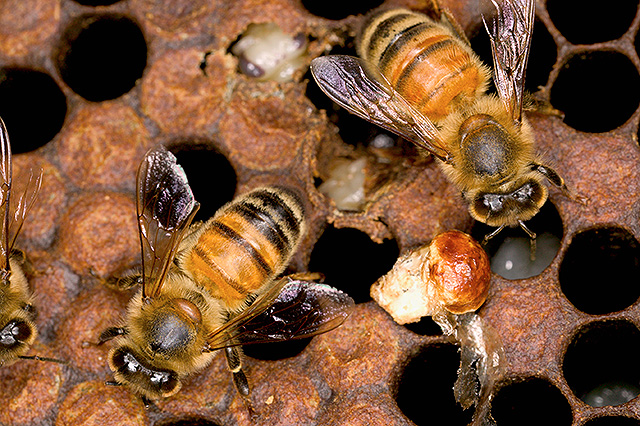
Hygienic behaviour is the workers’ ability to detect, uncap and remove diseased or dead brood. It is the main known mechanism of resistance to chalkbrood2, 4. In a commercial apiary, colonies from a line selected for this trait had significantly less chalkbrood than colonies from an unselected line5. Removing a larva before the fungus fruits prevents new spores from forming. The same trait also protects against American foulbrood and, to some extent, against varroa6.
Measuring hygiene: the killed-brood test
A patch of capped brood is killed and you watch how fast the colony cleans it out2.
- Liquid nitrogen. A cylinder is pushed into capped brood down to the midrib, empty cells are noted, then liquid nitrogen is poured in. The frame goes back to the centre of the nest and the cells still capped are counted after 24 hours. A colony is considered hygienic if it has cleaned out more than 95% of the cells within 24 hours on two consecutive tests9.
- Freezer. Variant: a piece of comb is cut out, frozen and then put back into the frame9.
- Pin. Capped cells are pierced one by one with a fine pin, which kills the pupa; the cleaned cells are then counted2.
Results from these tests correlate well with chalkbrood resistance in most colonies, but not all2: they are an indicator, not a guarantee.
In practice: what beekeepers actually do
Chalkbrood is rarely solved in a single visit. Here are the steps most beekeepers take when mummies appear, and what they do to stop seeing them.
Immediate steps
- Remove the worst-affected combs and replace them with new foundation.
- Close the colony down to the frames it can cover, using a dummy board.
- Clean the floor and the entrance.
Common strategies
1. Move the hives. When a whole apiary is regularly affected, it is common to move it to a drier, sunnier site; a change of location is often enough for the disease to recede.
2. Ventilate without chilling, avoiding any cold draught over the brood.
3. Unite. A weak, affected colony rarely recovers on its own; uniting it with a strong colony is often the best solution.
4. Requeen. A colony affected year after year on a good site almost always has a genetic problem. A queen from a hygienic line is the most lasting fix, and the brood break helps the colony clean up.
5. Select for hygiene. Those who rear their own queens test their colonies with killed brood, breed only from the best and exclude any colony that is regularly affected.
Equipment to have
- New foundation or clean drawn combs, dummy boards.
- For the hygiene test: cylinder and liquid nitrogen with suitable protection, or fine pins.
- Filtering mask and safety glasses if stonebrood is suspected.
Checklist
- Spring: note which colonies show mummies and how many.
- Cool weather: short inspections, brood frames never left out of the hive.
- Season: remove heavily affected combs, unite colonies that fail to build up.
- Before queen rearing: hygiene tests, susceptible colonies excluded.
- Every year: renew part of the combs, requeen repeat offenders.
The most common mistakes
- Looking for a miracle product: none is authorised, and off-label antifungals leave residues.
- Leaving hives in a damp hollow or in shade and hoping it will pass.
- Keeping weak colonies in boxes that are too big.
- Swapping combs from diseased colonies to healthy ones, or keeping old combs.
- Breeding from a colony that is regularly affected.
Frequently asked questions
Can chalkbrood kill a colony? Rarely. A colony that collapses with chalkbrood usually has another problem: varroa, a failing queen or a lack of stores.
Is honey from an affected colony safe to eat? Chalkbrood has no known risk for humans and the honey remains fit to eat. It may contain spores, though: do not use it to feed other colonies.
Why is only one colony affected in the apiary? All are exposed to the spores. If only one shows the disease, the cause is most often its genetics or its weakness: a strong argument for requeening it.
Should I worry if the mummies are yellow-green and very hard? Yes, that may point to stonebrood. Protect yourself from the spores, isolate the comb and have the diagnosis confirmed by a laboratory.
References
- Aronstein K.A., Murray K.D. (2010). Chalkbrood disease in honey bees. Journal of Invertebrate Pathology 103: S20-S29. doi.org
- Jensen A.B., Aronstein K., Flores J.M., Vojvodic S., Palacio M.A., Spivak M. (2013). Standard methods for fungal brood disease research. The COLOSS BEEBOOK, Vol. II. Journal of Apicultural Research 52(1): 1-20. doi.org
- FAO, IZSLT, Apimondia, CAAS (2021). Good beekeeping practices for sustainable apiculture. FAO Animal Production and Health Guidelines No. 25.
- Gilliam M., Taber S. III, Richardson G.V. (1983). Hygienic behavior of honey bees in relation to chalkbrood disease. Apidologie 14(1): 29-39. doi.org
- Spivak M., Reuter G.S. (1998). Performance of hygienic honey bee colonies in a commercial apiary. Apidologie 29(3): 291-302. doi.org
- Spivak M., Gilliam M. (1998). Hygienic behaviour of honey bees and its application for control of brood diseases and varroa. Part I. Hygienic behaviour and resistance to American foulbrood. Bee World 79(3): 124-134. doi.org
- Foley K., Fazio G., Jensen A.B., Hughes W.O.H. (2014). The distribution of Aspergillus spp. opportunistic parasites in hives and their pathogenicity to honey bees. Veterinary Microbiology 169(3-4): 203-210. doi.org
- Hemmerlé J. (2015). Le point sur l'ascosphérose. Abeille de France No. 1025: 21-24 (in French). apiservices.biz
- SARE (Sustainable Agriculture Research and Education). Testing honey bee colonies for hygienic behavior (liquid nitrogen freeze-killed brood method). sare.org
- Bee Health, eXtension. What is the basic life cycle of the fungus Ascosphaera apis that causes chalkbrood disease in honey bee colonies? bee-health.extension.org
- USDA ARS Image Gallery. Chalkbrood mummies of varying colours, photo K8144-3 (Jeff Pettis, public domain). ars.usda.gov
- USDA ARS Image Gallery. Worker bees removing chalkbrood mummies, photo D007-1 (Stephen Ausmus, public domain). ars.usda.gov