Key points
- Chilled brood is not a disease: there is no pathogen, only a shortage of bees to cover and warm the brood.
- Brood is kept at roughly 32 to 36 °C; a few degrees less is enough to kill or weaken the future bees.
- Typical sign: brood of all ages dead at the same time, at the edge or bottom of the brood nest, often after a cold snap or a loss of bees.
- It can resemble European foulbrood: the rope test remains negative, but any doubt justifies a laboratory analysis.
- Prevention relies on strong colonies, short inspections in cool weather and a brood nest that is never too large for the colony.
Chilled brood is brood killed by cold: eggs, larvae and pupae that are no longer covered and warmed by the bees and die in their cells. It is not a contagious disease. No pathogen is involved: the problem comes from an imbalance between the area of brood and the number of bees able to keep it warm12. It appears mainly in spring, when the queen lays more than the colony can cover, and during cold snaps that force the cluster to contract13.
What is at stake is twofold: chilled brood resembles certain diseases, European foulbrood in particular, and chilling that does not kill still leaves its mark, because bees reared too cool live shorter lives and learn less well.
How the colony heats its brood
A stable temperature between 32 and 36 °C
A brood-rearing colony keeps its brood nest within a narrow range, roughly 32 to 36 °C, whatever the outside temperature1, 2. In observation colonies, brood cells stayed on average between 33.6 and 35.1 °C and never fell below 32.6 °C1. Pupae are the stage most sensitive to chilling2.
Heater bees
Some workers exercise their flight muscles without moving their wings. Some press themselves onto the cappings, others enter empty cells in the middle of the brood and stay there for several minutes, with their thorax raised to about 40 °C. A single one of these bees can warm the neighbouring cells by 2.5 °C in half an hour1. The colder it gets, the more the bees heat: at an air temperature of 15 °C, nearly half of the workers older than two days present on the brood were actively producing heat, compared with almost none at 34 °C2. Very young bees, on the other hand, hardly heat at all: instead, they seek out warm spots2.
Brood temperature control also depends on genetic diversity: colonies headed by a queen mated with many drones keep a more stable brood temperature than those with a single father10.
Drone brood, less well protected
Colonies do not regulate all brood with the same precision. At the pupal stage, the temperature of drone brood is held less tightly than that of worker brood11. Often located at the edge of the nest, it is the first to be left uncovered when the cluster contracts.
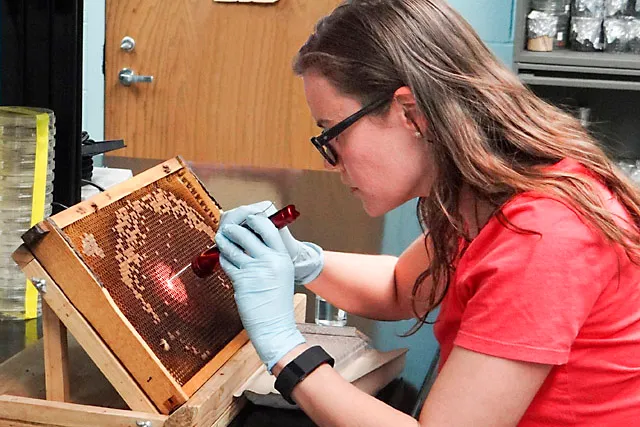
Why brood gets chilled
Brood becomes chilled as soon as its area exceeds what the bees can cover.
- The spring cold snap. The colony has expanded its brood during a mild spell, then a cold night forces the cluster to contract: the outer brood is abandoned13.
- A shrinking population. At the end of winter, the winter bees die off just as the queen steps up her laying. If their replacements are slow to emerge, there are not enough bees to cover the brood13.
- A sudden loss of bees. A poisoning that kills foragers, nosema, a heavy varroa infestation, robbing or swarming leave brood that is too large for the remaining population.
- Beekeeper handling. An inspection that lasts too long in cool weather, brood frames left out of the hive, an empty frame inserted in the middle of the nest to “spread” the brood, a split with too few bees, or a brood frame given to a colony that does not have enough bees to cover it.
- Isolated brood. A brood frame separated from the cluster, for example above a queen excluder or in a super, may be neglected by the bees12.
In every case, the brood dies from a combination of prolonged cold and lack of food, since it is no longer tended by the nurse bees12.
What cold does to brood
Death of larvae and pupae
In one study, capped brood was placed at 20 °C for 12 to 96 hours before being returned to 35 °C. Prepupae proved the most fragile: half died after about 19 hours of cold, and all of them beyond 48 hours. Older pupae were more resistant3. In another study, pupae capped for four days and exposed to 20 °C died at a rate of about 8% after 12 hours, 33% after 24 hours and 70% after 48 hours, compared with less than 3% in the controls4.
Misoriented larvae
Just after capping, the larva turns round to place its head towards the capping. Cold disrupts this movement. In the 2016 study, two hours at 20 °C were enough to misorient about 10% of larvae capped for 24 hours, and 36 hours misoriented more than 40%. These bees, with their heads at the bottom of the cell, cannot get out and die in their cells3.
Weakened bees, even when they survive
Workers exposed to cold at the capped stage lived markedly shorter lives than the controls3. Pupae reared at a constant temperature slightly too low produce adults that dance less precisely and are less good at learning an association between an odour and a reward5. The brain is the likely cause: the organisation of synapses in the mushroom bodies, the learning centres, changes with rearing temperature6, and prolonged cold early in the pupal stage strongly slows their development4. Other work has also found effects of rearing temperature on developmental stability and on memory7.
Even a difference of two degrees matters. Larvae reared at 33 °C instead of 35 °C did not die in greater numbers, but the resulting adults were more sensitive to an insecticide and died sooner8. Chilling is therefore also a hidden stress factor, which adds to the others.
An open door to chalkbrood
Cold favours chalkbrood. Larvae contaminated with Ascosphaera apis spores and chilled for 24 hours, just before or just after capping, turned into mummies in more than half of cases; the same chilling applied to older brood had much less effect9. Mummies can therefore follow a cold episode.
Recognising chilled brood
Signs on the frame
- Brood of all ages dead at the same time: eggs, open larvae and capped pupae, sometimes over a large area12.
- A typical location: at the edge of the brood nest, on the outer frames and at the bottom of the frames, where the cluster has withdrawn. The centre of the nest stays healthy13.
- The colour: larvae lose their pearly white, turn yellowish white then brown, with a black tinge at the edges of the segments13. Over time, dead open brood becomes very dark brown to black12.
- The cappings: those over dead brood may be perforated by house bees cleaning the cells13.
- No ropy mass in the rope test13.
The context that points the way
A recent cold snap, a loss of bees, a split, a prolonged inspection or a frame inserted in the middle of the brood make the diagnosis very likely. Often, only the weakest colonies are affected. As the colony grows stronger, the house bees quickly remove the dead brood and the queen lays again in the vacated cells.
Do not confuse with
| Criterion | Chilled brood | European foulbrood | American foulbrood | Chalkbrood | Sacbrood |
|---|---|---|---|---|---|
| Stages affected | All, at the same time | Open larvae, mostly young | Capped larvae and pupae | Larvae, just before or after capping | Capped prepupae |
| Location | Edge and bottom of the nest | Scattered through the brood | Scattered, spotty brood | Often at the edge | Scattered |
| Appearance | Yellowish white to brown, then black | Twisted, yellowish larvae, looking melted | Brown mass, then a firmly stuck scale | Hard mummies, white to black | Larva in a fluid-filled sac, head raised |
| Rope test | Negative | Negative or barely ropy | Clearly ropy | Not applicable | Negative |
| Context | Cold snap, loss of bees | Spring, rapid build-up | Any season | Cool, damp spring | Spring |
For details of the diseases, see the European foulbrood, American foulbrood and Sacbrood factsheets. Two other situations can be misleading. Starved brood also affects all of the brood, but the frames are empty of stores. Poisoning tends to kill adults and often affects several colonies at once: see the Pesticide poisoning factsheet. When the brood is full of gaps with no visible dead larvae, the Spotty brood factsheet helps to sort out the causes.
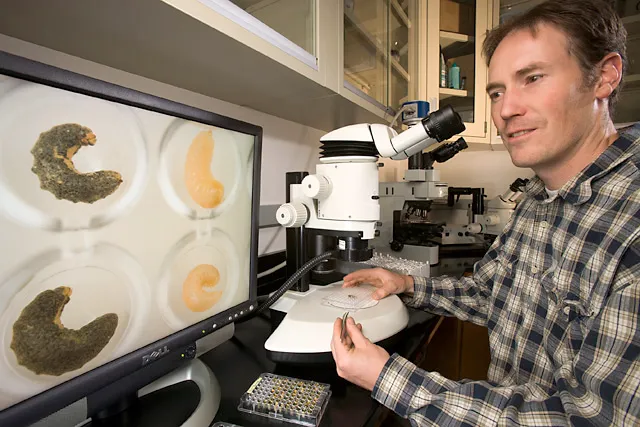
Step-by-step diagnosis
- Note the position of the dead cells: edge, bottom of the frames, outer frames, or centre of the nest.
- Look at the stages: all ages dead at the same time point to cold.
- Do the rope test on several brown larvae: push a matchstick or twig into the cell and withdraw it slowly. If the mass stretches into a thread, suspect American foulbrood.
- Assess the population: number of frames covered with bees compared with the number of brood frames.
- Reconstruct the previous days: weather, inspections, splits, frame transfers, stores.
- Check the colony again one to two weeks later, in mild weather: in a case of chilled brood, the dead brood has been cleaned out and laying resumes in the vacated cells.
Laboratory analysis
Chilled brood cannot be confirmed in the laboratory: analysis serves to rule out diseases. If dead larvae persist, if several colonies are affected for no obvious reason or if the rope test is doubtful, send a piece of suspect comb; your vet, your bee health organisation or the DDPP (local veterinary services) will tell you which laboratory to use.
Regulations
What follows applies to France; rules vary between countries, so check those that apply where you keep bees.
- Chilled brood is not a disease: it is not reported.
- Any suspicion of American foulbrood must be reported without delay to the DDPP, directly or through your vet. When in doubt between chilled brood and foulbrood, the precautionary rule applies.
Preventing chilled brood
Prevention comes down to one idea: a strong colony, with brood to match its size12.
- Overwinter strong colonies, with healthy winter bees: varroa management in late summer is the foundation (see Winter losses).
- Unite colonies that are too weak rather than leaving them to struggle alone in spring.
- Match the hive volume to the population, for example with a dummy board, so that the colony does not have to heat unused space.
- Make splits with enough bees, when the nights are mild, and do not give brood to a colony that lacks the bees to cover it.
- Ensure stores close to the brood: heating consumes honey.
In practice: what beekeepers actually do
Chilled brood is above all a matter of timing and common sense in the apiary. Most beekeepers avoid it by fitting their inspections to the weather and the size of the brood nest to the strength of the colony.
Practical habits
- Choose when to inspect: in spring, many beekeepers only open hives on mild days, around midday, and postpone inspections when the weather turns cold.
- Work quickly: take out a brood frame, examine it and put it back straight away, without leaving it in the open air.
- Keep the frames in order so as not to split the brood nest in two.
Common strategies
- In spring, foundation frames or empty frames are added at the edge of the nest, not in the middle, while the nights are still cold.
- Colonies that are too weak are united or strengthened with bees, not just with brood.
- After a cold snap, most beekeepers wait for a few days of fine weather before drawing conclusions: a strong colony cleans out its dead brood by itself.
Kit to keep ready
- Dummy boards to reduce the volume of weak hives.
- Matchsticks or twigs for the rope test.
- An inspection record to note the weather, the brood area and the number of frames of bees.
Checklist
- Is the dead brood at the edge or bottom of the frames?
- Are all stages dead at the same time?
- Is the rope test negative?
- Has there been a cold snap, a loss of bees or recent handling?
- Does the colony have enough bees and stores for its brood?
The most common mistakes
- Spreading the brood too early to “get the queen laying”: the colony cannot heat an oversized nest at the first cold snap.
- Concluding too quickly that it is chilled brood without a rope test, and missing foulbrood.
- Blaming the queen when it is the population that is lacking.
Frequently asked questions
Is chilled brood contagious? No. No pathogen is involved: the brood dies because it is not warmed and fed. It does not spread from one colony to another.
How can I tell chilled brood from European foulbrood? Chilled brood affects all stages at the same time, at the edge of the nest, after a cold snap or a loss of bees. European foulbrood mainly affects young open larvae, twisted and yellowish, scattered through the brood. When in doubt, a laboratory analysis settles the question.
What should I do with a frame of chilled brood? In a strong colony, nothing: the bees clean out the cells. In a weak colony, reduce the hive volume or unite it with another one. Do not move any frames if you suspect a disease.
At what temperature does honey bee brood die of cold? There is no single threshold: it all depends on the stage and the duration. Brood is normally kept at roughly 32 to 36 °C. In the laboratory, 20 °C for a day kills a large proportion of prepupae, and a few degrees below the optimum is enough to weaken the future bees.
References
- Kleinhenz M., Bujok B., Fuchs S., Tautz J. (2003). Hot bees in empty broodnest cells: heating from within. Journal of Experimental Biology 206: 4217-4231.
- Stabentheiner A., Kovac H., Brodschneider R. (2010). Honeybee colony thermoregulation – regulatory mechanisms and contribution of individuals in dependence on age, location and thermal stress. PLoS ONE 5(1): e8967. doi.org
- Wang Q., Xu X., Zhu X., Chen L., Zhou S., Huang Z.Y., Zhou B. (2016). Low-temperature stress during capped brood stage increases pupal mortality, misorientation and adult mortality in honey bees. PLoS ONE 11(5): e0154547. doi.org
- Zhu C. et al. (2023). The mushroom body development and learning ability of adult honeybees are influenced by cold exposure during their early pupal stage. Frontiers in Physiology 14: 1173808. doi.org
- Tautz J., Maier S., Groh C., Rössler W., Brockmann A. (2003). Behavioral performance in adult honey bees is influenced by the temperature experienced during their pupal development. Proceedings of the National Academy of Sciences USA 100(12): 7343-7347.
- Groh C., Tautz J., Rössler W. (2004). Synaptic organization in the adult honey bee brain is influenced by brood-temperature control during pupal development. Proceedings of the National Academy of Sciences USA 101(12): 4268-4273. doi.org
- Jones J.C., Helliwell P., Beekman M., Maleszka R., Oldroyd B.P. (2005). The effects of rearing temperature on developmental stability and learning and memory in the honey bee, Apis mellifera. Journal of Comparative Physiology A 191(12): 1121-1129. doi.org
- Medrzycki P., Sgolastra F., Bortolotti L., Bogo G., Tosi S., Padovani E., Porrini C., Sabatini A.G. (2010). Influence of brood rearing temperature on honey bee development and susceptibility to poisoning by pesticides. Journal of Apicultural Research 49(1): 52-59. doi.org
- Puerta F., Flores J.M., Bustos M., Padilla F., Campano F. (1994). Chalkbrood development in honeybee brood under controlled conditions. Apidologie 25(6): 540-546. doi.org
- Jones J.C., Myerscough M.R., Graham S., Oldroyd B.P. (2004). Honey bee nest thermoregulation: diversity promotes stability. Science 305(5682): 402-404. doi.org
- Li Z., Huang Z.Y., Sharma D.B., Xue Y., Wang Z., Ren B. (2016). Drone and worker brood microclimates are regulated differentially in honey bees, Apis mellifera. PLoS ONE 11(2): e0148740. doi.org
- Defra, National Bee Unit (2007). Foul brood disease of honey bees: recognition and control (leaflet PB 11753).
- University of Georgia, CAES Bee Program. Honey bee disorders: non-infectious diseases and pests. bees.caes.uga.edu
- Public domain photographs: USDA ARS, Peggy Greb (image D1043-1) and Vanessa Corby-Harris (image D3413-1), ARS Image Gallery. ars.usda.gov