Key points
- Robbing breaks out mainly when the nectar flow stops: late summer, autumn, dry spells.
- Targets are weak colonies, nucs, queenless or diseased colonies, and dead hives left open.
- Fighting at the entrance, wax debris under the hive and frantic comings and goings: act within the hour, not the next day.
- Robbing a collapsed colony carries varroa mites and American foulbrood spores to neighbouring hives.
- Reduced entrances, short inspections, evening feeding and nothing sweet left in the open prevent most cases.
Honey bee robbing happens when workers from one colony force their way into another hive to carry off its honey, nectar or syrup. Pollen and brood are generally left alone3. A few bees probing a poorly guarded entrance can, within a few hours, turn into a full-scale attack involving several hives in the apiary. A weak colony can be stripped of its stores in a few hours or a few days, because the robbers keep going as long as there is anything left to take3.
Robbing is not a disease, but it is a major health problem: it starves the robbed colony, makes the whole apiary aggressive and carries varroa mites, viruses and American foulbrood spores from one colony to another. This factsheet explains why it starts, how to recognise it, and how to prevent and stop it.
Why bees rob
A risky foraging strategy
For a colony, robbing is a form of foraging: a very rich source of sugar, concentrated in a single spot. It is also a high-risk tactic, since robbers have to fight the guards of the colony under attack and many die in the fighting1. In honey bees living in natural conditions, this behaviour remains occasional. Researchers suggest that beekeeping practices, with many hives packed closely together, syrup feeding and open hives, make it far more frequent, and sometimes harmful even to the robbing colony itself1.
The main trigger: dearth
Robbing breaks out mainly when the nectar flow drops sharply or stops. Foragers no longer have flowers to visit, but they are still numerous and active. In the northern hemisphere, robbing peaks in late summer and autumn. It can also appear during a long hot, dry spell, or in spring when a late cold snap delays flowering1, 2.
What sets it off
Most often, the spark comes from the apiary itself:
- hives left open for a long time, or several hives open at once during an inspection3;
- spilt syrup, leaking feeders, feeding in broad daylight;
- honey frames, supers or cappings left in the open;
- a dead hive or dying colony left open in the apiary;
- cracks, ill-fitting supers or warped crown boards that provide a second entrance.
The targets
Robbers go for colonies that defend themselves poorly. Free had already observed this in the 1950s: a colony’s vigilance depends partly on its size, and a small colony puts up little resistance4. Particularly at risk are nucs and mating nucs, newly hived swarms, queenless colonies, colonies weakened by varroa, nosema or foulbrood, and any hive that is too big for the population it houses.
What happens at the hive entrance
The robbers
Robbers are not a separate caste: they come from the forager population2. A Polish study showed that they live shorter lives than ordinary foragers in the same conditions, and that they are more often and more heavily infected with Nosema: 98.5% of robbers carried it, against 88% of foragers, with markedly higher spore loads6. The most dangerous tasks would thus fall to the workers with the least life expectancy left to lose.
In a colony that is robbing, foraging activity rises markedly, and so does nest defence7. That is why, during a bout of robbing, the whole apiary becomes more aggressive, including towards the beekeeper.
The guards
On the other side, the colony under attack reacts quickly. In a British experiment, a sudden influx of intruders changed guard behaviour in less than 15 minutes: the number of guards at the entrance rose on average from 1.9 to 2.3, and the proportion of foreign bees accepted fell from 59% to 30%. The guards also became more suspicious of their own nestmates, whose acceptance fell from 74% to 52%5. A strong colony can therefore repel most attempts. A weak colony does not have enough guards.
Consequences for the colony and the apiary
For the robbed colony
It loses its stores, often all of them. The fighting kills workers, the brood can be damaged and the queen killed. The colony may then abscond from the hive or starve2.
For the neighbours: a disease shuttle
This is the most underestimated danger.
Varroa. In the United States, colonies almost free of varroa mites were set up around heavily infested colonies. When the latter collapsed and were robbed, large numbers of mites moved into the neighbouring colonies, both near and far. The authors suggest calling collapsing colonies “robber lures” rather than “mite bombs”8. Other studies show that infestation can rise sharply in autumn because of mites arriving from other colonies, and not just through their own reproduction11, 12. In Arizona, this influx coincided, from November onwards, with increases of 227 to 336% in mite populations13.
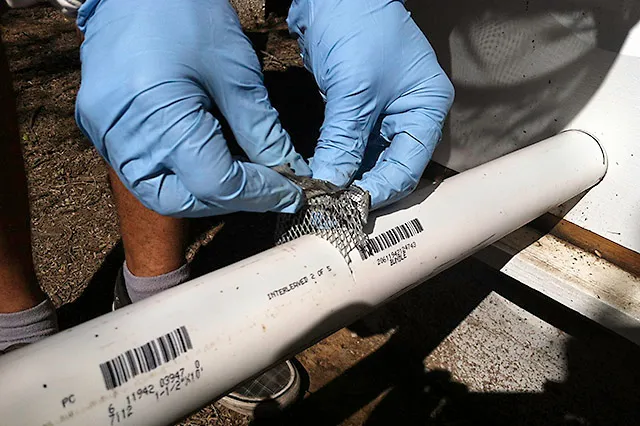
The exact share of robbing and drifting is still debated. An American study linked varroa growth to visits by bees from outside the colony, without confirming that these visitors came mainly from heavily infested colonies. Colonies fitted with a robbing screen showed slower varroa growth than their unequipped neighbours10. Either way, the practical conclusion is the same: a collapsing colony that is left to be robbed reinfests its neighbours, even after a good treatment.
American foulbrood. In Sweden, transmission of Paenibacillus larvae spores between apiaries, through the robbing of colonies that had died of the disease, was seen mainly within a radius of one kilometre; it was markedly lower at two kilometres or more. Colonies can carry many spores on their adult bees without showing symptoms9. See the American foulbrood factsheet.
Other agents. Viruses and Nosema also spread through robbing and drifting, which is why apiary biosecurity stresses closing up dead hives immediately.
Recognising honey bee robbing
Signs of robbing in progress
- Unusual agitation: far more bees flying around the apiary, inspecting the outside of the hives3.
- Hesitant flight in front of the entrance: robbers sway from side to side, facing the hive, as if waiting for the moment to slip in without being intercepted4.
- Fighting at the entrance, bees rolling on the ground locked together, and more dead bees than usual in front of the hive3.
- Attempts to get in through gaps between supers, under the roof or through the floor3.
- Wax debris: shredded wax and torn cappings on the landing board or under the hive3.
- Bees going in light and coming out heavy, with swollen abdomens, struggling to take off2.
- Worn-looking robbers: many have lost their hair and have shiny black abdomens2.
A hive found empty, with no dead bees and no stores, and with shredded combs, has often been robbed after becoming weak: see Winter losses.
Do not confuse
| Observation | Robbing | Orientation flights | Strong nectar flow |
|---|---|---|---|
| Timing | Period without a flow, often after an inspection | Warm, sunny afternoon | During abundant flowering |
| Flight in front of the entrance | Hesitant, swaying, bees looking for a weak spot | Young bees facing the hive, calm circling flight | Direct flight paths, entering without hesitation |
| Fighting | Yes, dead bees in front of the hive | No | No |
| Wax debris | Yes, torn cappings | No | No |
| Duration | Continuous and building up | Short, then activity calms down again | All day, without aggression |
| Pollen loads | Rare or absent on incoming bees | Absent | Frequent |
Wasps and hornets also rob weak hives, and a hornet hawking in front of a hive can weaken it to the point where it becomes vulnerable to robbing by bees. See the Asian hornet and European hornet factsheets. Ants, too, can empty a feeder or the stores of a weak colony: see Ants and beehives.
Identifying the robbing colony
Dusting the bees leaving the robbed hive with flour lets you spot, a few minutes later, the entrance where the whitened bees are arriving2. A robbing hive can also be recognised by unusual activity at its entrance, starting earlier and ending later than at the other hives2.
Regulations
In France, robbing itself does not have to be reported, but it can reveal a regulated problem. A dead or robbed colony whose brood shows signs of American foulbrood must be reported to the departmental veterinary services (DDPP); in the meantime, close the hive and do not move any colonies or equipment. These rules apply to France: check the rules in your own country, as they vary.
Preventing robbing
Prevention is far simpler than stopping robbing once it has taken hold.
- Reduce entrances during periods without a flow and at the end of the season, especially on weak colonies and nucs3.
- Inspect quickly, one hive at a time, preferably late in the day, and cover any supers set down beside the hive3.
- Remove supers or honey frames that the colony cannot defend3.
- Feed in the evening, inside the hive, and feed every colony in the apiary at the same time, so that the syrup is taken down before morning2.
- Never leave anything sweet in the open: spilt syrup, leaking feeders, frames, cappings, wax. Clean up or put everything away immediately3.
- Keep colonies of even strength, and unite colonies that are too weak or move them to another apiary3.
- Maintain your hives: seal cracks and replace equipment that no longer closes properly2.
- Close up any dead hive immediately, then remove it from the apiary the same day.
- Do not use repellents at the entrance: they drive away the colony’s own bees too3.
What to do during robbing
- Stop working the bees: close all open hives, and cover or bring in supers, frames and feeders3.
- Reduce the robbed colony’s entrance to a gap for one to five bees, and block all other openings with tape, grass or foam3.
- Do not rely on the smoker: smoke does not stop robbing effectively3.
- Disorient the robbers: many beekeepers put a wet sheet or branches in front of the robbed hive, or use a fine mist spray2, 3.
- If robbing continues, move the robbed colony to another apiary several kilometres away until it is strong enough to defend itself again2, 3.
- The next day, inspect the robbed colony: queen, brood, stores. Feed if necessary, unite it if it is too weak, and examine the brood to rule out disease.
In practice: what beekeepers actually do
Most robbing starts during an inspection or a feed. Here are the habits beekeepers adopt to avoid triggering it and to react quickly.
Practical steps
- Entrance reducers are kept within reach in the toolbox, and fitted on weak colonies and nucs as soon as the last flow ends.
- A box or a tarpaulin is used to cover supers and frames removed during the inspection.
- Feeding is done in the evening, with contact or in-hive feeders, never with an open communal feeder outside.
- The harvest is done quickly, with clearer boards put in the day before.
- Extracted supers are only returned to the colonies in the evening, to be licked clean overnight.
Common strategies
During a dearth, inspect late in the day, and never leave one hive open while inspecting another.
Robbing screens move the real entrance while leaving the old one visible: the colony’s own bees learn the new way in, while the robbers crowd around the old one. They are mainly used on nucs and mating nucs.
The kit to have
- Entrance reducers or adjustable entrance discs.
- Robbing screens for small colonies.
- In-hive feeders that do not leak.
- Tape and foam for sealing gaps.
- A sheet or floor cloth to wet in an emergency.
Late-summer checklist
- Entrances reduced on weak colonies and nucs.
- Supers removed quickly, nothing left lying around the apiary.
- Evening feeding, for the whole apiary at the same time.
- Dead hives closed and removed the same day.
- Colonies that are too weak united before winter.
The most common mistakes
- Feeding in broad daylight or outside the hives.
- Leaving honey frames, cappings or supers in the open, even for a few minutes.
- Opening several hives at once during a dearth.
- Leaving a dead hive open until the next inspection.
- Waiting until the next day: robbing is best stopped within the hour.
Frequently asked questions
How can you tell if a hive is being robbed? The typical signs are fighting at the entrance, dead bees in front of the hive, wax and capping debris on the landing board, and hesitant, swaying flight in front of the entrance. Bees going in are light; those coming out are heavy.
How do you stop honey bee robbing? Close all open hives, put away anything sweet, reduce the robbed colony’s entrance to one or two bee spaces and block the other openings. A wet sheet in front of the hive often helps. If robbing starts again, move the robbed colony several kilometres away.
Can a robbed colony recover? Yes, if the queen has survived and the attack is stopped early. The colony must then be fed and protected with a reduced entrance. A badly weakened colony at the end of the season is often united with another colony.
Can robbing spread diseases? Yes. Robbing a collapsed colony carries large numbers of varroa mites to neighbouring colonies, and robbing a colony that died of American foulbrood spreads the spores, mainly within a radius of one kilometre. Always close up a dead hive without delay.
References
- Rittschof C.C., Nieh J.C. (2021). Honey robbing: could human changes to the environment transform a rare foraging tactic into a maladaptive behavior? Current Opinion in Insect Science 45: 84-90. doi.org
- Wang X., Huang T., Ji Q., Guo J., Zhao Y. (2025). Honey robbing: causes, impacts and preventive measures. Insects 16(1): 15. doi.org
- Willingham R., Klopchin J., Ellis J.D. (2015). Robbing behavior in honey bees. EDIS ENY-163 (IN1064), University of Florida IFAS Extension. doi.org
- Free J.B. (1955). The behaviour of robber honeybees. Behaviour 7: 233-240. repository.rothamsted.ac.uk
- Couvillon M.J., Robinson E.J.H., Atkinson B., Child L., Dent K.R., Ratnieks F.L.W. (2008). En garde: rapid shifts in honeybee, Apis mellifera, guarding behaviour are triggered by onslaught of conspecific intruders. Animal Behaviour 76(5): 1653-1658. doi.org
- Kuszewska K., Woyciechowski M. (2014). Risky robbing is a job for short-lived and infected worker honeybees. Apidologie 45(5): 537-544. doi.org
- Grume G.J., Biedenbender S.P., Rittschof C.C. (2021). Honey robbing causes coordinated changes in foraging and nest defence in the honey bee, Apis mellifera. Animal Behaviour 173: 53-65.
- Peck D.T., Seeley T.D. (2019). Mite bombs or robber lures? The roles of drifting and robbing in Varroa destructor transmission from collapsing honey bee colonies to their neighbors. PLoS ONE 14(6): e0218392. doi.org
- Lindström A., Korpela S., Fries I. (2008). Horizontal transmission of Paenibacillus larvae spores between honey bee (Apis mellifera) colonies through robbing. Apidologie 39(5): 515-522. doi.org
- Kulhanek K., Garavito A., vanEngelsdorp D. (2021). Accelerated Varroa destructor population growth in honey bee (Apis mellifera) colonies is associated with visitation from non-natal bees. Scientific Reports 11: 7092. doi.org
- DeGrandi-Hoffman G., Ahumada F., Zazueta V., Chambers M., Hidalgo G., Watkins deJong E. (2016). Population growth of Varroa destructor (Acari: Varroidae) in honey bee colonies is affected by the number of foragers with mites. Experimental and Applied Acarology 69(1): 21-34. doi.org
- Frey E., Rosenkranz P. (2014). Autumn invasion rates of Varroa destructor (Mesostigmata: Varroidae) into honey bee (Hymenoptera: Apidae) colonies and the resulting increase in mite populations. Journal of Economic Entomology 107(2): 508-515. doi.org
- USDA Agricultural Research Service (2016). Science detectives investigate a "mitey" big problem. ars.usda.gov
- USDA ARS, image gallery. Photo D3706-1: screened entrance tube separating incoming and outgoing bees (public domain). ars.usda.gov