Key points
- Wax acts as a sponge for fat-soluble molecules: almost all wax tested in Europe and North America contains residues.
- Coumaphos and tau-fluvalinate, two miticides used against varroa, are the most common residues; melting and recycling do not remove them.
- Residues can slow larval development, shorten worker lifespan and impair queen rearing.
- Commercial wax may also be adulterated: stearin is highly toxic to brood, and paraffin weakens combs.
- The best safeguards: recycle your own cappings wax, renew brood frames, choose medicines that persist little in wax and have bought wax tested.
Pesticide residues in beeswax are one of the most constant chemical exposures a colony faces. Unlike acute poisoning, they cause neither heaps of dead bees nor sudden collapse. They settle into the combs, build up year after year and stay in direct contact with the brood, the stores and queens being reared. Almost all wax tested in North America and Europe contains them1, 11.
These residues come from two main sources: miticides used against varroa, which are placed directly in the hive, and agricultural pesticides brought back by foragers. A separate but related problem adds to this: the adulteration of commercial wax with paraffin or stearin. This article explains how residues build up, what they do to bees, how to detect them and how to limit the risk in the apiary.
Why wax retains pesticides
A sponge for fat-soluble molecules
Beeswax is a mixture of fatty substances: esters, hydrocarbons and fatty acids. Fat-soluble (lipophilic) molecules dissolve in it easily and leave it only very slowly. This is the case for many insecticides and several synthetic miticides3, 4.
Lipophilic, non-volatile miticides such as bromopropylate, coumaphos and fluvalinate accumulate in wax with each treatment and can reach concentrations in the range of milligrams per kilo. Some of this can then diffuse from the wax into the honey stored in the combs3.
Not all molecules are equal
- Coumaphos and tau-fluvalinate are very stable in wax. They are the miticide residues found most often1, 2.
- Amitraz is unstable: it breaks down quickly and is not a major residue in its original form3.
- Organic acids and essential oil components such as thymol are considered contaminants of little concern4. The Belgian consumer risk assessment does not even propose an action limit for thymol7.
This is why Anses (the French agency for food, environmental and occupational health and safety) recommends favouring the medicines least likely to accumulate in wax, that is, hydrophilic molecules10.
Recycling keeps residues in circulation
Melting wax does not destroy these molecules. Contaminated wax that is remelted and then rolled into foundation sheets carries its residues into new frames, often in other apiaries and other countries. Repeatedly reusing the same wax therefore encourages residues to build up7, 10.
What testing shows
In North America
A landmark study analysed 259 wax samples, including 238 from brood combs and 21 from foundation. It detected 87 pesticides and metabolites. Tau-fluvalinate and coumaphos were present in 98.1% of samples, with up to 39 different residues in a single wax sample. According to the authors, almost all comb wax and foundation was contaminated1.
In France
As early as 2002-2003, a survey at five sites in mainland France analysed 47 wax samples. Of the 18 molecules looked for, 14 were found. Tau-fluvalinate was present in 61.9% of samples and coumaphos in 52.2%; coumaphos reached the highest average levels. The authors attributed the contamination mainly to hive treatments and, to a lesser extent, to plant protection products2.
Interim results from the Cimeqa project, run by Itsap (the French technical institute for beekeeping and pollination) and the network of ADAs (regional beekeeping development associations) on 180 wax samples from beekeepers, point the same way: 95% of samples contain at least one residue, 4 on average and up to 19. In total, 69 different residues were identified: fungicides, insecticides, miticides and herbicides. Coumaphos and tau-fluvalinate are among the most frequent, alongside agricultural fungicides such as boscalid and fluopyram11.
The 2025 Anses opinion
In December 2025, Anses published an assessment of the risks associated with contaminated or adulterated wax. Its main findings10:
- pyrethroids are the substances of greatest concern; they are present in more than 40% of commercial foundation samples;
- piperonyl butoxide, which boosts the action of pyrethroid insecticides, is found in more than 50% of these samples;
- substances banned in France for several years are still detected, because wax can come from anywhere in the world;
- varroa treatments used according to the label account for only a small share of the overall toxicological risk;
- wax produced by the colonies themselves as they renew their combs carries the lowest risk, with cappings wax the least risky of all.
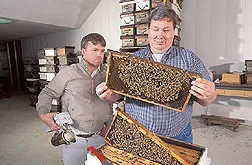
Effects on the colony
Brood
Larvae grow in a wax cell and spend their entire pupal stage there. One study compared workers reared in combs heavily loaded with residues with workers reared in clean combs. The former developed more slowly and, as adults, lived on average 4 days less. Residues also migrated from the old combs into the clean combs over successive brood cycles, and these then showed higher larval mortality5.
These effects are sublethal: they do not kill the colony, but they weaken it, especially when they add to varroa, viruses or a nectar dearth.
Queens
Queen rearing is particularly sensitive. In queen cups containing coumaphos at 100 mg/kg, more than half of the queen cells were rejected, and the queens that survived weighed less; at 1,000 mg/kg, no queens developed6. These concentrations are high, but some comb wax has come close to the same order of magnitude1.
Wax adulteration
Adulterated wax is wax to which other, cheaper fatty substances have been added, deliberately or not. The two main adulterants are paraffin, derived from petroleum, and stearin or stearic acid, of animal or plant origin9.
- Stearin is highly toxic to brood. A Polish study showed that foundation containing 10% stearin reduced brood survival by 67% compared with the control. Queen cells built on cups adulterated with stearin succeeded in only 11.11% of cases, compared with 88.89% on pure wax8.
- Paraffin did not reduce brood survival in the same study8. In large amounts, however, it can cause new foundation to melt or make it unusable10.
In France, Anses found paraffin in 70% of samples, usually at less than 1%, which it attributes mainly to repeated recycling. Stearic acid was found in fewer than 4% of samples10.
Recognising a wax problem
There is no symptom specific to residues. Some signs should nevertheless make you think of the wax, especially when they appear right after new frames have been put in:
| Observation | Possible wax cause | Other causes to rule out |
|---|---|---|
| Patchy brood on new frames only | Adulterated wax, especially with stearin | Spotty brood from another cause, failing queen, foulbrood |
| Foundation sheets that sag or warp in the heat | Large amounts of paraffin | Fitted too early, frame poorly wired |
| Queen cells rejected one after another in a rearing batch | Miticide residues in the cups | Rearing conditions, cell-builder colony too weak |
| Colonies that stall for no obvious reason | Old, heavily loaded wax | Varroa, nosema, dearth, pesticide poisoning |
Testing wax
The two types of analysis
- Residue testing identifies and measures a list of pesticides and veterinary medicines.
- Adulteration testing checks the purity of the wax. The recommended methods combine several physico-chemical parameters with more advanced analytical techniques9.
Sampling step by step
- Take 50 to 100 g of wax in total, from at least 10 different points in the batch12.
- For melted wax, take samples at the beginning, middle and end of the pour12.
- Use a clean tool for each batch to avoid cross-contamination.
- Pack the sample in a clean, labelled container, protected from light.
- Send it to a laboratory that specialises in hive products; in France, Itsap keeps a directory of these laboratories12.
A residue and adulteration analysis costs in the region of €250 to €300, according to the Belgian QualiWax guide12.
Interpreting the result
A lab report often lists several molecules, whose effects add up. BeeToxWax, a free tool developed by the University of Liège, turns them into an overall hazard quotient. The QualiWax guide proposes three classes: below 250, low hazard and recycling possible; between 250 and 5,000, significant toxicity and recycling not advised; above 5,000, wax that should not be recycled for beekeeping12. Anses recommends adopting a quotient below 5,000 as the toxicological threshold10.
Regulation
In France, the composition of wax foundation for beekeeping is not regulated: there is no legal definition, no maximum residue level and no mandatory purity criterion. Anses recommends giving beekeeping wax a legal definition, setting a toxicological threshold, making approval of wax processors compulsory and requiring traceability of the wax sold10.
Organic beekeeping is the exception. During conversion, the wax must be replaced with wax from organic production. Non-organic wax may be used only if it has been established that it is not contaminated: it must be cappings wax, accompanied by a residue analysis, plus an adulteration analysis for imported or blended wax. The note from INAO (the French national institute for origin and quality) sets rejection thresholds of more than 1% adulteration and more than 0.1 ppm of substances not authorised in organic production13.
These rules vary from one country to another: check with your certification body or the competent authorities in your country.
Prevention and what to do
Choosing your wax
- Recycle your own cappings wax first, possibly pooling it with other beekeepers10.
- Buy good-quality wax, preferably cappings wax of known origin, from a wax processor who provides the origin and test results10, 12.
- Be wary of cheap wax of unknown origin: according to Anses, French wax statistically carries less risk than wax from other countries10.
Renewing frames
Old black frames concentrate residues. Regularly renewing some of the brood frames, retiring the darkest ones first, reduces the colony’s load2, 12. Practices that let you recover wax recently secreted by the bees work in the same direction10. See also How to clean and disinfect hives and equipment.
Treating varroa without loading the wax
- Use only authorised medicines, according to the label, and remove strips on the scheduled date.
- Where appropriate, favour substances that persist little in wax10.
In practice: what beekeepers actually do
Residues in wax cannot be seen. Most beekeepers manage them through simple habits: controlling where their wax comes from, renewing frames and choosing their treatments with the combs in mind as well.
Practical steps
- Keep wax separate when melting: cappings on one side, old brood frames on the other.
- Have your own cappings wax made into foundation rather than trading it for wax of unknown origin.
- Ask the wax processor for the origin of the wax and the test reports before buying.
- Mark the year on the top bar of frames so you know which ones to retire.
Common strategies
- Retire part of the brood frames every year, starting with the darkest.
- Install swarms and new colonies on new wax of known quality.
- For queen rearing, use cups made of clean, recent wax.
- Keep wax from old, heavily loaded frames out of beekeeping recycling and put it to use outside the hive.
Equipment to have
- A wax melter and moulds to cast blocks of wax kept separate by origin.
- Labels or a marker to date frames.
- Clean bags to send a sample to the laboratory.
- A notebook to record where wax came from and the test results.
Checklist
- Winter: sort melted wax, prepare orders for tested wax foundation.
- Spring: replace the oldest brood frames, keep an eye on brood on new frames.
- Harvest: collect and melt cappings wax separately.
- Late summer: treat varroa with an authorised medicine, remove strips on the scheduled date.
- If in doubt about a batch: have it tested for residues and adulteration before using it.
Most common mistakes
- Believing that melting purifies wax: lipophilic residues stay in it.
- Buying the cheapest foundation without knowing its origin or composition.
- Keeping the same brood frames indefinitely, so that residues build up over the years.
- Using unauthorised products against varroa, which contaminate the wax for a long time.
- Blaming the wax without testing: patchy brood has many other possible causes.
Frequently asked questions
Which pesticides are found in beeswax? Mainly miticides used against varroa, in particular coumaphos and tau-fluvalinate, as well as agricultural pesticides: fungicides, insecticides such as pyrethroids, and sometimes herbicides. Molecules banned long ago are also found, because wax circulates and is recycled.
Does melting wax remove residues? No. Lipophilic residues stay in the melted wax and pass into the foundation sheets made from it. Only the choice of starting wax and the renewal of combs genuinely reduce contamination.
Is honey contaminated by residues in the wax? Some miticides can diffuse from the wax into the honey, but in small amounts. A Belgian assessment concludes that eating honey and wax containing these residues does not endanger consumer health as long as the proposed action limits are respected, with zero tolerance recommended for flumethrin.
How can I tell whether my foundation is adulterated? Only a laboratory analysis can tell. Sheets that sag in the heat or abnormal brood on new frames are warning signs, but not proof.
Is organic wax free of residues? Not necessarily. In the Cimeqa project, 91% of organic wax samples contained at least one residue, but on average half as many residues and a total concentration about 13 times lower than conventional wax.
References
- Mullin C.A., Frazier M., Frazier J.L., Ashcraft S., Simonds R., vanEngelsdorp D., Pettis J.S. (2010). High levels of miticides and agrochemicals in North American apiaries: implications for honey bee health. PLoS ONE 5(3): e9754. doi.org
- Chauzat M.-P., Faucon J.-P. (2007). Pesticide residues in beeswax samples collected from honey bee colonies (Apis mellifera L.) in France. Pest Management Science 63: 1100-1106. doi.org
- Wallner K. (1999). Varroacides and their residues in bee products. Apidologie 30(2-3): 235-248. doi.org
- Bogdanov S. (2006). Contaminants of bee products. Apidologie 37(1): 1-18. doi.org
- Wu J.Y., Anelli C.M., Sheppard W.S. (2011). Sub-lethal effects of pesticide residues in brood comb on worker honey bee (Apis mellifera) development and longevity. PLoS ONE 6(2): e14720. doi.org
- Pettis J.S., Collins A.M., Wilbanks R., Feldlaufer M.F. (2004). Effects of coumaphos on queen rearing in the honey bee, Apis mellifera. Apidologie 35(6): 605-610. doi.org
- Wilmart O., Legrève A., Scippo M.-L., Reybroeck W., Urbain B., de Graaf D.C., Steurbaut W., Delahaut P., Gustin P., Nguyen B.K., Saegerman C. (2016). Residues in beeswax: a health risk for the consumer of honey and beeswax? Journal of Agricultural and Food Chemistry 64(44): 8425-8434. doi.org
- Chęć M., Olszewski K., Dziechciarz P., Skowronek P., Pietrow M., Borsuk G., Bednarczyk M., Jasina G., Jasina J., Gagoś M. (2021). Effect of stearin and paraffin adulteration of beeswax on brood survival. Apidologie 52(2): 432-446. doi.org
- EFSA (2020). Risk assessment of beeswax adulterated with paraffin and/or stearin/stearic acid when used in apiculture and as food (honeycomb). EFSA Supporting Publications EN-1859. efsa.europa.eu
- Anses (2025). Réduire la contamination des cires utilisées en apiculture pour améliorer la santé des abeilles (opinion and report SABA 2022-AUTO-0050). anses.fr
- Moreau S., Fourrier J. (Itsap) (2024). La cire, première source d'exposition des abeilles aux pesticides ? Résultats intermédiaires du projet Cimeqa. Réussir Apiculture. reussir.fr
- Université de Liège (2025). Guide de bonnes pratiques en matière de recyclage de la cire à usage apicole, fiche 2 : qualité et analyses de la cire d'abeille (QualiWax). beetools.uliege.be
- INAO. Note sur les conditions d'utilisation de cire non biologique en apiculture biologique. extranet.inao.gouv.fr
- USDA ARS. Photo K11142-1, examining a frame of bees, Stephen Ausmus (public domain). ars.usda.gov