Key points
- The honey house is a health crossroads: supers, frames, honey and wax from several apiaries pass through it.
- Honey from a diseased colony may contain American foulbrood spores: never feed it back to bees.
- Honey with less than 18% water keeps with almost no risk of fermentation; the legal limit is 20% for most honeys.
- Wet supers go back on their colony of origin, never out in the open for the whole apiary to clean.
- Stored frames are sorted, high-risk frames go through the freezer, then everything is put away in closed stacks.
Honey house hygiene is not only about honey quality. It is also a matter of bee health: the extraction room and the storage area are where supers, frames, wax and honey from several apiaries cross paths. A single contaminated frame or an open bucket of honey is enough to carry a disease from one colony to the next.
This page looks at honey house hygiene and frame storage from a bee health point of view: keeping extraction from spreading American foulbrood, stopping honey from fermenting, and keeping drawn comb safe from pests.
Why the honey house is a weak spot
A crossroads between apiaries
In the honey house, everything gets mixed up: supers are spun in the same extractor, then often handed back out with no regard for which hive they came from. Yet super frames can transmit diseases, though generally less than brood frames3. That is why the UK bee health services recommend, ideally, using the frames from a super on a single colony3.
Honey can carry spores
Honey from a colony with American foulbrood contains spores of Paenibacillus larvae. In a Swedish experiment, colonies given a comb of contaminated honey reached spore levels comparable to those given diseased brood, but with a delay: the spores only showed up when the bees consumed that honey, at the end of the season. The spores then built up in adult bees over winter, which may raise the risk of infection in spring2. The authors suggest that fewer spores may be needed in honey than in diseased brood to trigger the disease2.
Robbing spreads whatever is left lying around
Anything that smells of honey attracts bees: wet supers, buckets of cappings, half-open drums, dead colonies. The same team showed that, when colonies that died of foulbrood are left open to robbing, American foulbrood is transmitted mainly within one kilometre of diseased colonies, and much less at two kilometres or more1. Colonies can also carry large numbers of spores without any visible symptoms1. A honey house that is not properly closed thus becomes a source of contamination for the whole neighbourhood.
Before the harvest: bring in only healthy supers
Honey house hygiene starts in the apiary. A diseased colony must not supply supers that will be extracted with all the others.
- Check the brood of weak or suspect colonies before harvesting.
- Label supers by apiary, or even by colony, so they can be put back in place and traced if a problem arises.
- Do not set supers down on the ground. Place them on an upturned roof or a stand, so they do not get soiled with earth3.
- Set doubtful colonies aside: their honey is extracted separately, last, or not at all.
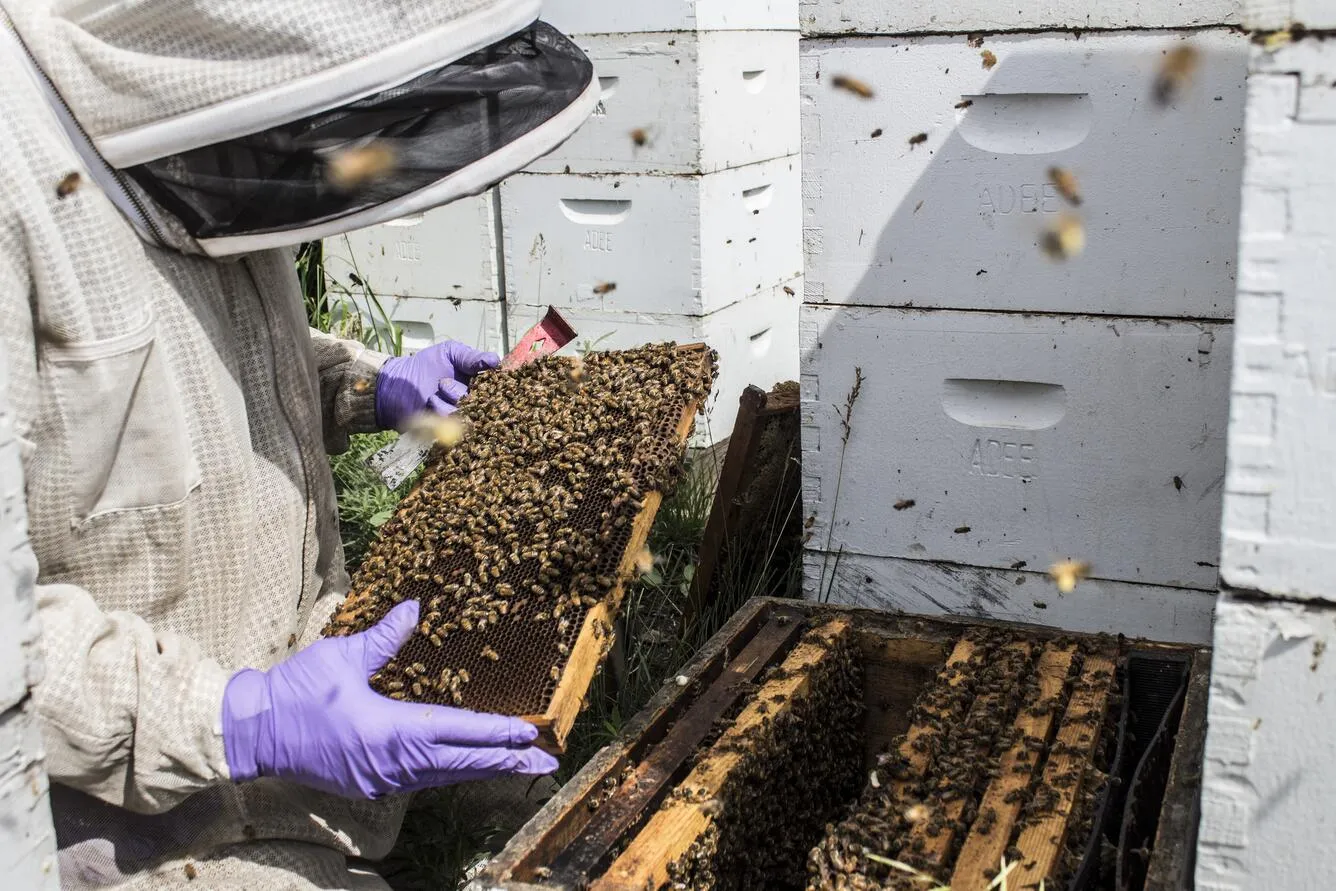
The extraction room: food hygiene
Honey is a food
In the European Union, beekeeping and honey production are considered primary production11. The general hygiene provisions for primary production therefore apply: clean facilities, disinfected after cleaning where necessary; potable or clean water wherever needed to prevent contamination; prevention of contamination by animals and pests; storage of waste and hazardous substances apart; and records of the measures taken to control hazards10.
Where honey contamination comes from
Honey naturally contains microorganisms brought in by pollen, the bees’ digestive tract, dust, air, soil and nectar. After harvest, others are added from the air, hands, equipment and premises, along with cross-contamination12. Bacteria do not multiply in honey, but most honeys contain yeasts that can proliferate if conditions allow. Clostridium botulinum spores are also found in some samples, generally at low levels12: this is why honey is not recommended for children under one year of age.
The principles of a clean honey house
- Washable surfaces and food-grade equipment (stainless steel, food-grade plastics).
- A room closed to insects: an open honey house attracts bees and wasps and sets off robbing.
- A one-way flow: full supers come in on one side, packed honey goes out on the other.
- No hive cleaning in the extraction room. Scraping and disinfecting beekeeping equipment is done elsewhere: see how to clean and disinfect hives and equipment.
- Food-safe cleaning products, followed by rinsing with potable water and quick drying of the equipment.
Controlling moisture: preventing fermentation
Water content, the first criterion
Fermentation is the main storage failure. According to the FAO, only honeys with less than 18% water keep with little or no risk of fermentation7. The Swiss bee research centre ideally aims for less than 17.5%, so that honey sold will not ferment once bought8. EU rules set a general limit of 20% water, raised to 23% for heather honey and baker’s honey9. A refractometer measures water content before extraction or in the settling tank.
Honey absorbs moisture from the air
Honey is hygroscopic: a honey with 18.3% water starts taking up water as soon as relative humidity exceeds 60%7. A damp room or an open settling tank can therefore push up the water content of well-ripened honey.
| Relative humidity of the air | Equilibrium water content of honey |
|---|---|
| 50% | 15.9% |
| 60% | 18.3% |
| 65% | 20.9% |
| 70% | 24.2% |
Source: FAO7.
Granulation releases water
When honey granulates, water is released into the remaining liquid phase, which raises the risk of fermentation7. Granulation is fastest at around 14 °C; it practically stops above 25 °C and below 5 °C7.
Feeding can bring in yeasts
Agroscope found baker’s yeast in all the honeys harvested five weeks after feeding with sugar fondants that contained it, even though the supers were not on during feeding8.
Heating and storing honey
Honey must not be heated to the point where its natural enzymes are destroyed or significantly inactivated, and it must not have begun to ferment9. Its hydroxymethylfurfural (HMF) content, a compound formed by the breakdown of fructose during storage or heating, must not exceed 40 mg/kg as a general rule7, 9.
- Heat gently, in a water bath. Honey conducts heat poorly and is viscous: a localised heat source overheats it in spots7. To liquefy it, Agroscope preferably recommends 40 to 45 °C and advises against the microwave8.
- Store cool and away from light. Above 25 °C, most honeys lose much of their aroma within a few months7. Prolonged heat and sunlight also strip honey of most of its antibacterial activity7.
- Seal tightly. Buckets, drums and jars stay closed: against moisture, and so as not to attract bees.
After extraction: wet supers, cappings and waste
Wet supers
Wet supers left outside very quickly attract robbers. The UK bee health services recommend putting them straight back on their hive of origin3. Leaving them out in the open in the apiary for the bees to clean mixes bees from every colony, and any spores along with them.
Cappings, wax and waste
- Cappings are rendered quickly. Where the small hive beetle is present, it is recommended to extract within two to three days and to render the cappings as soon as possible6.
- Buckets of wax and honey waste are kept closed with a lid, because they contain traces of honey that attract bees3. In the apiary, a closed container collects wax scrapings4.
- Empty jars and buckets are never left outside for the bees to clean.
Never feed honey back to bees without precautions
The UK recommendations are clear: never feed bees bought honey, and avoid feeding them honey or pollen from other colonies. Sugar syrup and pollen substitutes are safer alternatives4. The reason lies in the Swedish experiment mentioned above: contaminated honey is enough to load a colony with foulbrood spores2.
Storing frames
Drawn comb is valuable capital, and a target for several pests.
Sort before storing
- Set aside frames of unknown or suspect origin. Frames from a dead colony are only reused once the cause of death is understood: see winter losses: why did my hive die?. The UK bee health services advise against buying second-hand drawn comb4.
- Cull old brood frames. It is recommended to replace brood frames at least every three years4. Super frames are renewed less often, unless they have held brood or there is a health problem3. Old wax also concentrates pesticide and miticide residues.
- Spot high-risk frames. Frames with pollen or brood, frames from weak colonies: these are the most exposed to pests.
Pests of stored frames
- Wax moth. Its larvae mainly attack stored frames that have held brood or pollen13. Freezing at -20 °C for at least 24 hours kills all its stages, but does not replace cleaning or disinfection5. Details are given in the wax moth page.
- Small hive beetle. Where it is present, the honey house must be kept clean and tidy; frames with pollen and brood, the main protein sources for its reproduction, are kept in the freezer6. In France, any suspicion of small hive beetle must be reported.
- Rodents. Poorly closed stacks attract mice.
Acetic acid fumigation: limited scope
Acetic acid is used to treat stored frames. It kills wax moth and is only effective against chalkbrood and Nosema apis. It is ineffective against American foulbrood, European foulbrood and viruses5. It is therefore not a universal disinfection method, and its use falls under biocide regulations: check the product’s status in your country.
Regulations
In France, as in the rest of the European Union, honey is a food. Its composition is governed by Directive 2001/110/EC (water content, HMF, enzyme activity, absence of fermentation and foreign tastes)9, and its production by Regulation (EC) No 852/2004 on the hygiene of foodstuffs10. Direct sale of small quantities may fall under specific national measures11: before selling, check with the DDPP, the French departmental service responsible for veterinary and food safety matters.
From a bee health standpoint, American foulbrood is a notifiable disease in France: in the event of an outbreak, the veterinary services decide what happens to the frames, equipment and honey. These rules vary from country to country; check those that apply where you live.
In practice: what beekeepers actually do
A healthy honey house relies on a few simple habits, repeated at every harvest. Here are the ones found among most beekeepers who pay attention to the health of their colonies.
Practical steps
- Mark supers with the apiary name and put them back on their hive of origin after extraction.
- Extract promptly, in a room closed to insects, with no supers waiting outside.
- Measure water content with a refractometer when supers are poorly capped.
- Wash equipment with hot water as soon as extraction is finished.
Common strategies
1. Traceability by apiary. Supers only move within the same apiary. If disease appears, the investigation is limited to that apiary.
2. “Freeze, then seal” storage. High-risk frames go through the freezer, then are stored in stacks closed to moths.
3. A honey house separate from the workshop. Scraping, scorching and rendering old frames are done outside the extraction room.
Useful equipment
- A refractometer and lidded settling tanks.
- A dehumidifier and insect screens.
- A chest freezer, pallets and boards to close the stacks.
The seasonal checklist
- Before the harvest: health check, supers labelled.
- In the honey house: room closed, prompt extraction, settling tanks covered.
- After extraction: supers returned to their colony, cappings rendered, buckets closed.
- In autumn: sorting, freezing of high-risk frames, closed stacks.
The most common mistakes
- Leaving wet supers out in the open in the apiary for the bees to clean, which encourages robbing and mixes bees.
- Feeding bees honey of unknown origin, including shop-bought honey.
- Redistributing supers at random between apiaries after extraction.
- Storing supers in a damp room, where honey takes up water and ferments.
- Overheating honey to liquefy it, on a hotplate or in the microwave.
- Relying on acetic acid to disinfect frames suspected of foulbrood.
Frequently asked questions
Can you feed bees the honey left in the extractor or in the cappings? Only if it comes from healthy colonies in the same apiary, and inside the hive, never out in the open. Bought honey or honey of unknown origin is never fed to bees: it may contain American foulbrood spores.
What water content prevents honey from fermenting? Below 18% water, the risk is low or nil; ideally it should be below 17.5%. The legal limit is 20% for most honeys. The room must be kept dry.
How should drawn comb be stored over winter? Set aside old frames and those of doubtful origin, freeze frames with pollen or brood, then store everything in closed stacks, dry and safe from mice.
Do you need a fully compliant honey house to extract your own honey? The general hygiene rules for primary production apply: clean premises, potable or clean water, protection against pests, waste management. The precise requirements depend on the country and how the honey is sold: check with the DDPP before selling.
References
- Lindström A., Korpela S., Fries I. (2008). Horizontal transmission of Paenibacillus larvae spores between honey bee (Apis mellifera) colonies through robbing. Apidologie 39(5): 515-522. doi.org
- Lindström A., Korpela S., Fries I. (2008). The distribution of Paenibacillus larvae spores in adult bees and honey and larval mortality, following the addition of American foulbrood diseased brood or spore-contaminated honey in honey bee (Apis mellifera) colonies. Journal of Invertebrate Pathology 99(1): 82-86. doi.org
- National Bee Unit (APHA, UK). Apiary hygiene and quarantine. Fact sheet, 2026. nationalbeeunit.com
- National Bee Unit (APHA, UK). Apiary and hive hygiene. Best Practice Guideline No. 3, 2025. sruc.ac.uk
- National Bee Unit (APHA, UK). Disinfecting a hive after disease. Fact sheet, 2026. nationalbeeunit.com
- de Guzman L.I., Frake A.M., Rinderer T.E. (USDA-ARS), Pollet D.K. (LSU AgCenter) (2009). Small hive beetles (SHB), Aethina tumida. Louisiana Cooperative Extension Service, publication 3135. ars.usda.gov
- Krell R. (1996). Value-added products from beekeeping, chapter 2: Honey. FAO Agricultural Services Bulletin No. 124. fao.org
- Agroscope, Swiss Bee Research Centre (Switzerland). Honey quality: water content, storage and liquefaction. agroscope.admin.ch
- Council Directive 2001/110/EC of 20 December 2001 relating to honey, Annex II (composition criteria). legislation.gov.uk
- Regulation (EC) No 852/2004 of the European Parliament and of the Council of 29 April 2004 on the hygiene of foodstuffs, Annex I, Part A. eur-lex.europa.eu
- European Commission (2010). Understanding of certain provisions on flexibility provided in the Hygiene Package: FAQ, guidelines for food business operators. SEC(2010) 985, section 2.4 (honey). fsai.ie
- Snowdon J.A., Cliver D.O. (1996). Microorganisms in honey. International Journal of Food Microbiology 31(1-3): 1-26. doi.org
- Kwadha C.A., Ong'amo G.O., Ndegwa P.N., Raina S.K., Fombong A.T. (2017). The biology and control of the greater wax moth, Galleria mellonella. Insects 8(2): 61. doi.org
- USGS Eastern Ecological Science Center. Honey bees (photo Sarah Scott, public domain). usgs.gov