Key points
- Pollen is the honey bee's only natural source of protein: without it, brood rearing slows down and then stops.
- A poor or monotonous diet weakens immunity and tolerance to parasites such as Nosema.
- Sucrose (white sugar) remains the reference sugar for feeding; some sugars are toxic to bees.
- Syrup that has been heated or poorly stored can build up HMF, which is toxic to bees.
- Feeding must never end with syrup in the harvested honey: no feeding with honey supers on.
Feeding honey bees is common practice, but it is rarely a trivial act. A well-fed colony rears healthy brood, produces nurse bees with well-developed glands and winter bees able to live for several months. A poorly fed colony, short of sugars or protein, becomes more vulnerable to varroa, viruses and Nosema. Nutrition is therefore a pillar of colony health, just as much as parasite control1.
This factsheet explains what bees need, how to recognise a deficiency and how to feed without harming the colony or the honey.
The nutritional needs of the honey bee
Sugars: energy
Nectar and honeydew, turned into honey, supply carbohydrates. They are the fuel for flight, wax production and heating the nest. An adult worker needs about 4 mg of usable sugars per day to survive1. Larvae receive sugars too: the jelly they are fed becomes markedly richer in sugars during the last days of their development1.
Glucose, fructose and sucrose are the sugars bees digest best10. Others, on the other hand, are toxic to them: galactose, mannose, arabinose, xylose, melibiose, raffinose, stachyose and lactose1. This is a major reason never to improvise a syrup from just any sweet product.
Protein: pollen
Pollen is the honey bee’s only natural source of protein1. It also provides lipids, sterols, vitamins and minerals. A colony usually collects 10 to 26 kg of pollen a year, and protein content varies enormously from one plant to another, from 2.5% to over 60%1.
It is mainly young nurse bees that eat it, in the first days of their adult life7. They turn it into brood food using their hypopharyngeal glands. Royal jelly and the other glandular secretions are the main food of the larvae and the queen2. It is estimated that 125 to 187.5 mg of pollen are needed to rear a single worker larva1.
Bees also regulate their intake around precise nutrient ratios, both at individual and at colony level2.
Why nutrition matters for health
Brood first
Larvae depend heavily on protein, and brood rearing is badly affected when protein is short1. The colony then prefers to reduce or stop rearing rather than produce poorly fed pupae. The result shows on the frame: few young larvae, patchy brood, sometimes spotty brood.
Nurse bees and longevity
Without pollen, nurse bees’ hypopharyngeal glands develop poorly and their jelly production falls1, 7. Bees with access to pollen also live longer1. In winter bees, longevity depends on a well-stocked fat body and on vitellogenin, a storage protein made from protein intake in late summer8, 9. A pollen dearth in August and September can therefore jeopardise overwintering, even with enough honey stores. See Dead hive in winter and winter losses.
Immunity and disease
A study carried out in France on caged bees showed that eating pollen increases the fat body and the activity of glucose oxidase, an enzyme that helps keep brood food sterile. Strikingly, pollen mixes from several plants gave higher activity than single-species pollens, even those richer in protein3.
A second study clarified the role of pollen quality. Nurse bee physiology, including gland development and vitellogenin levels, as well as their tolerance to Nosema ceranae, depended on the quality of the pollen eaten. Among infected bees, those fed a mix lived longer than those fed single-plant pollens, except against the single pollen richest in protein4. In practice, an environment rich in varied flowers throughout the season remains the best protection.
Recognising a poorly fed colony
Starvation
This is a lack of sugars. It strikes mainly in late winter, when brood rearing resumes, and during summer nectar dearths, often in the most populous colonies.
- No capped honey or fresh nectar left around the brood.
- Sluggish bees, many dead bees head-first in the cells.
- Larvae discarded, brood abandoned, sometimes dried-up larvae removed by the workers.
- Colony defensive or tempted to rob neighbouring hives.
Protein deficiency
More discreet, it shows in the brood and in the absence of pollen.
- Little or no pollen stored around the brood.
- Eggs present but few young larvae, patchy brood.
- Spring build-up that stalls despite a laying queen.
- Colony that stays weak in autumn, with a small cluster.
Do not confuse
| What you see | Nutritional lead | Other causes to rule out |
|---|---|---|
| Patchy brood, few young larvae | Pollen deficiency | Failing queen, inbreeding, foulbrood, varroa |
| Dead bees head-first in cells | Starvation | Rarely anything else: it is a typical sign |
| Heavy soiling on the hive front | Unsuitable feed, fermented syrup | Nosema, dysentery |
| Dead larvae, brood abandoned at the edges | Starvation, lack of nurse bees | Chilled brood, brood diseases |
| Bees crawling in front of the hive after feeding | Spoiled syrup (HMF, fermentation) | Poisoning, viruses, paralysis |
If the brood looks suspicious (ropy larvae, smell, scales), it is no longer a nutrition issue: do the matchstick test and have a sample analysed. See American foulbrood.
Assessing stores
- Open the hive and look at the frames rather than just hefting it: where the honey sits relative to the brood matters as much as the amount.
- Estimate capped honey frame by frame. A well-filled Dadant brood frame holds roughly 4 to 5 kg of stores10.
- Look at the pollen: the band around the brood, cells of bee bread, pollen loads brought in by foragers at the entrance.
- Take season and climate into account: winter needs vary with region, bee strain and the length of the cold season; no universal figure applies.
Regulation
In France, starvation and deficiencies are not regulated diseases and are not notifiable. Feeding is, however, governed by two general rules.
- Honey quality. Honey must contain no added ingredients12. Any syrup or fondant that is moved up into the supers risks ending up in the harvest, which amounts to adulteration10.
- Organic beekeeping. Feeding is only authorised when the survival of colonies is threatened by climatic conditions, using organic honey, pollen, sugar or sugar syrups. Yeasts, spirulina and downgraded honey are not allowed, these restrictions do not apply to developing swarms, and every feed must be recorded (feed, date, quantity, hives)11.
Rules differ between countries and certification schemes: check those that apply to your own beekeeping.
Feeding: what to give, what to avoid
Sugars
Refined sucrose, that is, white beet or cane sugar, remains the best source of sugars apart from nectar and honeydew10. In cages, bees fed sucrose lived longer than bees fed honey or high-fructose corn syrup1. Semi-refined brown beet sugars are poorly digested10.
Commercial syrups are made from maize, wheat or other cereal starch. When well hydrolysed, they are readily taken and do not crystallise; when poorly hydrolysed, they still contain complex sugars, which are not recommended in large amounts10. Choose a syrup by its declared composition (sucrose, glucose, fructose, maltose, complex sugars).
Fondant (candy), a solid sugar paste, is mainly an emergency feed in winter, placed above the cluster. It does not replace adequate autumn feeding10.
To avoid:
- Honey of unknown origin, even from your own honey house if it comes from diseased colonies: it can spread brood diseases, notably American foulbrood, and it triggers robbing10.
- Syrups that have been heated, acidified or stored somewhere warm. Heat produces hydroxymethylfurfural (HMF), the best-known dietary toxin for honey bees5. In cages, a syrup containing 150 ppm of HMF killed 58.7% of bees within 20 days, whereas 30 ppm is considered safe. High-fructose corn syrup stored for 69 days at 40 °C can exceed 250 ppm1.
- Cappings wash water and fermenting syrups10.
- Grape syrup, which causes dysentery and shortens lifespan1.
- Products containing lactose or other toxic sugars (milk, whey, some industrial sugars)1, 6.
Protein: pollen and substitutes
When pollen is short, you can provide protein patties. Commercial substitutes are often based on soya, yeast, wheat, lentils or milk proteins, and some are nutritionally deficient13. Soya also contains a significant share of sugars that are toxic to bees1.
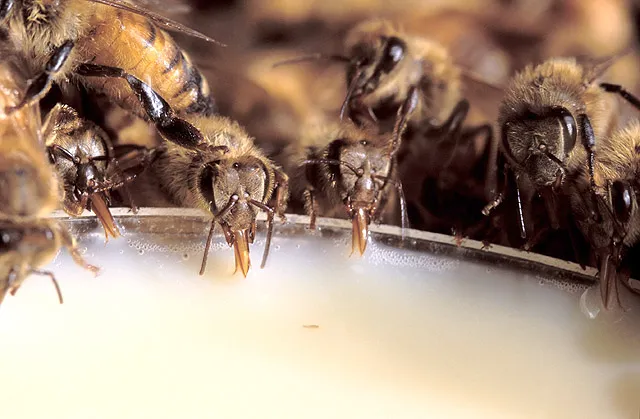
A review of the literature concludes that the effects of substitutes on colony health are variable: positive, neutral or negative depending on the study. None fully replaces pollen, and bees generally eat more natural pollen or bee bread than substitute6. Research is exploring new options, such as a microalga, spirulina, whose nutritional profile is close to that of pollen13.
Trapped pollen from another apiary can carry pathogens: only use pollen from your own healthy colonies.
Feeding at the right time
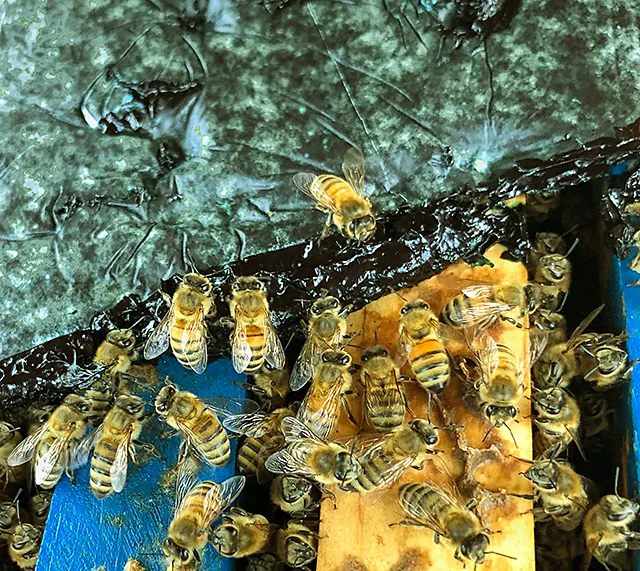
- Feeding for winter stores: after the last harvest, in late summer, to top up winter stores. It is done with thick syrup, in a few large feeds, early enough for the bees to cap it before the cold10.
- Stimulative feeding: small, regular feeds of thinner syrup to support laying, pointless during a nectar flow10.
- Emergency feeding: a colony that is genuinely starving, at any time, including during the season. Hives in production only receive sugar in this case10.
In practice: what beekeepers actually do
Biology tells us what bees need. Here is how beekeepers actually manage their colonies' feeding through the season.
Routine tasks
- Check stores at every inspection, noting the honey and pollen you can see, rather than feeding “as a matter of principle”.
- Feed in the evening, inside the hive, with a hive-top feeder or a frame feeder, never in the open: an open feeder attracts robbing and wasps.
- Feed a whole apiary at the same time, so as not to single out one hive to robbers.
- Make homemade syrup with white sugar and clean water, without acidifying it or heating it strongly; make only the amount you need.
The most common strategies
1. Autumn stores with thick syrup. This is the most common practice in temperate climates: a few large feeds right after the harvest and the varroa treatment, then a check of stores before the cold sets in.
2. Emergency fondant in winter. It is placed directly above the cluster of colonies judged light when hefted, without taking the hive apart.
3. Targeted protein support. Protein patties during pollen dearths, especially for queen rearing; many beekeepers prefer to move their apiaries to richer forage.
Equipment to have
- Hive-top feeders or frame feeders, clean and leak-free.
- White sugar or commercial syrup with declared composition, stored somewhere cool and sheltered.
- Fondant for winter emergencies.
- Entrance reducers.
- Your apiary register or a notebook, to record feeds.
The yearly checklist
- Late winter: heft hives, check light colonies, fondant if needed.
- Spring: check pollen around the brood; keep an eye on prolonged rainy spells.
- Summer: spot nectar dearths, especially in strong colonies; feed only colonies at risk and never with honey supers in production.
- After the last harvest: remove supers, treat for varroa, then feed for winter stores.
- Before the cold: final check of capped stores and uniting of colonies that are too weak.
The most common mistakes
- Feeding with supers on outside a genuine starvation situation: the syrup ends up in the honey.
- Feeding too late in autumn, with syrup the bees no longer have time to process and cap.
- Giving bought honey or honey of unknown origin, with a risk of foulbrood and robbing.
- Heating syrup or storing it warm for a long time, which encourages HMF.
- Relying on weight alone without looking at where the stores are.
- Believing a substitute replaces pollen: it helps out, but it does not replace varied forage.
Frequently asked questions
What sugar should I give my bees? Refined white sugar, from beet or cane, dissolved in clean water, remains the reference. Commercial syrups are suitable if they are well hydrolysed and their composition is known. Avoid brown beet sugars, heated or fermented syrups, honey of unknown origin and any product containing lactose.
Should I give syrup or fondant in winter? Syrup is given in late summer and early autumn, while bees can still store and cap it. Later on, fondant placed above the cluster serves as an emergency feed. It does not replace adequate autumn stores.
Are pollen substitutes useful? They can help during a marked pollen dearth, better than no protein at all. But their effects vary between studies and none fully replaces natural pollen. Varied forage around the apiary remains the best long-term solution.
Can I feed during a nectar flow? Only to save a starving colony. Syrup given with supers on risks ending up in the harvested honey, which is adulteration.
References
- Brodschneider R., Crailsheim K. (2010). Nutrition and health in honey bees. Apidologie 41(3): 278-294. doi.org
- Wright G.A., Nicolson S.W., Shafir S. (2018). Nutritional physiology and ecology of honey bees. Annual Review of Entomology 63: 327-344. doi.org
- Alaux C., Ducloz F., Crauser D., Le Conte Y. (2010). Diet effects on honeybee immunocompetence. Biology Letters 6(4): 562-565. doi.org
- Di Pasquale G., Salignon M., Le Conte Y., Belzunces L.P., Decourtye A., Kretzschmar A., Suchail S., Brunet J.-L., Alaux C. (2013). Influence of pollen nutrition on honey bee health: do pollen quality and diversity matter? PLoS ONE 8(8): e72016. doi.org
- LeBlanc B.W., Eggleston G., Sammataro D., Cornett C., Dufault R., Deeby T., St. Cyr E. (2009). Formation of hydroxymethylfurfural in domestic high-fructose corn syrup and its toxicity to the honey bee (Apis mellifera). Journal of Agricultural and Food Chemistry 57(16): 7369-7376. doi.org
- Noordyke E.R., Ellis J.D. (2021). Reviewing the efficacy of pollen substitutes as a management tool for improving the health and productivity of western honey bee (Apis mellifera) colonies. Frontiers in Sustainable Food Systems 5: 772897. doi.org
- Corby-Harris V. et al. (2019). Emerging themes from the ESA symposium entitled "Pollinator nutrition: lessons from bees at individual to landscape levels". Bee World 96(1): 3-9. doi.org
- Amdam G.V., Omholt S.W. (2002). The regulatory anatomy of honeybee lifespan. Journal of Theoretical Biology 216: 209-228. doi.org
- Döke M.A., Frazier M., Grozinger C.M. (2015). Overwintering honey bees: biology and management. Current Opinion in Insect Science 10: 185-193. doi.org
- Ballis A. (2025). L'essentiel sur les suppléments glucidiques (in French). Réussir Apiculture, 29 June 2025. reussir.fr
- Certipaq Bio (2026). Guide sur l'apiculture biologique, DT138 version 8 (Regulations (EU) 2018/848 and 2020/2146) (in French). certipaq.com
- Council Directive 2001/110/EC of 20 December 2001 relating to honey.
- USDA ARS (2020). Microalgae food for honey bees (K. Kaplan). Photo D4345-1, Vincent Ricigliano (public domain). ars.usda.gov
- USDA ARS, photo gallery. Honey bees consuming a nutrient-rich artificial diet, photo K10288-1, Stephen Ausmus (public domain). ars.usda.gov