Key points
- Senotainia tricuspis is a fly of the family Sarcophagidae that deposits its larvae on foragers in flight; the larva develops in the thorax and kills the bee within a few days.
- The disease, known as senotainiosis, is mainly reported in the Mediterranean basin, with wide variations from one apiary and one year to the next.
- Diagnosis relies on keeping foragers in a jar for 72 hours, examining the thorax or PCR; seeing flies lying in wait on the hives is a first clue.
- Conopid flies, or thick-headed flies, mainly parasitise bumblebees; in the honey bee, cases are rare and anecdotal.
- There is no treatment: prevention relies on strong colonies, monitoring during the season and managing the ground of the apiary.
Senotainia tricuspis is a parasitic fly of the honey bee, little known outside the Mediterranean basin. The female lies in wait for foragers near the hive and, in mid-flight, deposits a live larva on them; the larva enters the thorax and kills the bee within a few days4. This myiasis, known as senotainiosis, has been reported in several countries of Southern Europe, North Africa and the Middle East1.
Other flies attack adult bees. Conopid flies, or thick-headed flies, lay their eggs in the abdomen of bumblebees and, much more rarely, of the honey bee8. This article describes these parasitic flies, their life cycle, their real impact on colonies, the diagnostic methods available to beekeepers and the ways to limit the damage. The zombie fly Apocephalus borealis, of the family Phoridae, is covered in a separate article.
Senotainia tricuspis: a larviparous fly
Identity
Senotainia tricuspis (Meigen, 1838) belongs to the Sarcophagidae, the family of flesh flies. The adult measures 5 to 8 mm3. It looks like a small grey house fly, with a pale, silky band between the eyes4. Reliable identification requires a stereo microscope and an entomologist, or DNA analysis.
Like other sarcophagids, the female is larviparous: the eggs hatch inside her body and she deposits larvae directly. A female carries several hundred larvae, 600 to 800 depending on the author3, 4.
Hosts
The fly mainly attacks foragers and drones of the honey bee. It also occasionally parasitises bumblebees and solitary bees4, 8. Only the larva is parasitic; the adult feeds on flowers.
Distribution
Senotainiosis is more common in sunny, warm regions. It has been described in Spain, Romania, Italy and Tunisia4. A survey carried out in seven Mediterranean countries found the fly in Algeria, Egypt, Jordan and Italy, but not in the samples from Iraq, Lebanon and Palestine3. It has also been reported in Oman5 and Kosovo2. Few published data concern France.
A climate model published in 2025 predicts a high probability of presence in Southern Europe, in North Africa from Morocco to Egypt, and in the Levant, both today and by 2050 and 20707.
The life cycle of Senotainia tricuspis
- Lying in wait. The female settles on a sunny spot, often the roof of a hive or near the entrance, and waits for bees taking off or returning2, 4.
- The attack in flight. She swoops on a bee and deposits one or two larvae. The contact lasts at least a sixth of a second1. Attacks can be repeated every 6 to 10 seconds during sunny hours4.
- Entry of the larva. The young larva enters the thorax. Measurements of first-instar larvae suggest that it passes through the prothoracic spiracle1.
- Development in the living bee. The larva settles in the thoracic muscles, then feeds on haemolymph for as long as the bee is alive. The bee generally dies 2 to 4 days after the attack4.
- Completing development in the dead bee. The larva then devours the thoracic muscles and the tissues of the head. It reaches 8 to 9 mm, leaves the body and burrows into the soil to pupate4.
- Pupation. Adults emerge in roughly one to two weeks in summer. Late-season larvae enter diapause and overwinter in the soil4, 5.
In central Italy, adults emerge in late spring and begin parasitising bees at the end of May; a second generation can appear in the same year2. In the laboratory, third-instar larvae pupate successfully when they can burrow into loose or clay soil, and die in large numbers when they cannot1.
Impact of senotainiosis on the colony
A loss of foragers
Each larva kills one forager. When flies are numerous, the colony loses part of its foraging force every day, just when it needs it most. The consequences depend on the infestation rate: according to Italian studies, an infestation above 70% can lead to colony collapse2.
Highly variable pressure
Published figures range from almost nothing to very high levels:
- in southern Spain, examination of the thorax of 5,050 bees collected between 1990 and 1992 revealed only 24 larvae, or 0.48%, mostly in July6;
- in central Italy, in June and July 2021, the fly was detected in 31% of bee samples from 16 apiaries2;
- in Oman, very high rates were measured in spring, around 90% in March, with no infestation at all from June to January, the hottest period5.
The 2015 Mediterranean survey noted a marked difference between the north and the south of the basin. Its authors put forward two hypotheses: a preference of the fly for more humid areas, or a greater susceptibility of the Italian bee, Apis mellifera ligustica3.
A very active fly
In an apiary in Tuscany, four days of direct observation recorded 1,633 attacks. They peaked in late morning, between 10 and 11 am, then in the afternoon, between 3 and 5 pm1.
A possible vector of other diseases
The 2024 Italian study detected Nosema ceranae, an agent of nosema disease, at a low level in one sample of adult flies. The authors consider that these flies could help spread pathogens between apiaries2. This role has yet to be demonstrated in the field.
Conopid flies, parasites of bumblebees
Flies that mimic wasps
The Conopidae, or thick-headed flies, measure 4 to 18 mm. Many mimic wasps, with a long, narrow-waisted abdomen, long antennae and a slender proboscis bent forward. The family includes about 830 species worldwide12. The adults visit flowers.
A life cycle inside the abdomen
The female intercepts a bee in flight and inserts an egg into its abdomen12. Several eggs may be laid, but only one larva develops per host. It feeds first on haemolymph, then on the fat body, ovaries and other organs, and kills the host as it reaches maturity. Pupation takes place inside the dead body8. In the buff-tailed bumblebee, the parasite’s development usually takes 10 to 12 days9.
These parasites alter their host’s behaviour. Parasitised bumblebees spend the night outside, in the cold, which slows the larva’s development9. Just before the parasite pupates, others bury themselves in the soil, which protects the future pupa10.
What about the honey bee?
Conopid flies mainly affect bumblebees: in Canada, 0 to 15% of workers of four species were parasitised8, 11. In the honey bee, there are only a few observations: in North America, Physocephala texana and Physocephala marginata have been reared from honey bees8. No study shows any significant effect on colonies.
Recognising senotainiosis
Signs in the apiary
- Small grey flies resting in the sun on hive roofs or near entrances, darting out at bees in flight.
- A colony weakening in hot weather, with fewer foragers than expected, for no obvious reason.
- Dead bees whose thorax contains a white larva, or from which a larva emerges in the following days.
These signs are subtle: parasitised bees often die in the field.
Do not confuse
| Observation | Senotainiosis | Other possible cause |
|---|---|---|
| Larva in a dead bee | Larva in the thorax, recently dead forager | Larvae of scavenging phorids (Megaselia), which only develop in bees that are already dead4 |
| Larvae emerging between the head and the thorax, bees active at night beneath lights | No | Zombie fly, absent from Europe to date |
| Larva or pupa in the abdomen of a bumblebee or bee | No | Conopid flies |
| Small reddish-brown insect on the thorax of live bees | No | Bee louse (Braula), a commensal of no real danger |
| Many dead bees in front of the hive | Rarely: the bees mostly die in the field | Poisoning, viruses, starvation: see dead bees in front of the hive |
| Colony weakening in summer | Possible in Mediterranean areas | Varroa, viruses, hornet predation |
Diagnosis
The jar method
This is the method used in the Mediterranean surveys3, 5:
- Collect live foragers at the hive entrance, at least 50 per sample, from several colonies in the apiary if possible.
- Place them in a ventilated jar, in the shade and at room temperature.
- Wait 72 hours, then count the larvae that have emerged from the dead bees.
- Calculate the infestation rate: number of larvae divided by the number of bees, multiplied by 100.
House bees are much less affected than foragers: sampling foragers avoids underestimating the problem5.
Examining the thorax
On dead or sacrificed bees, the thorax can be opened and crushed to look for the larva, which sits at the front and on top5, 6. This method is quicker, but it requires a magnifier and some practice.
The laboratory
A quantitative PCR, developed in 2024, detects the DNA of Senotainia tricuspis in bees or in hive debris2. It remains a research tool. For formal identification, adults must be reared from the pupae and sent to an entomologist.
Regulation
Senotainiosis is not among the regulated bee diseases in France or in the European Union, which cover in particular American foulbrood, the small hive beetle and Tropilaelaps. There is therefore no compulsory notification. However, movements of live bees between Member States and their entry into the Union are subject to health rules13.
In the event of unexplained mortality, it is still worth contacting your veterinarian or the local beekeeping health organisation, who can advise on testing. Rules vary between countries.
Prevention and control
There is no authorised medicine against Senotainia tricuspis. Control relies on apiary management.
Keep strong colonies
A populous colony copes better with the loss of foragers. Controlling varroa, ensuring sufficient stores and a young queen all limit the effect of senotainiosis.
Monitor during the season
In Mediterranean areas, watching hive roofs during the hot hours, from late spring to summer, makes it possible to spot flies lying in wait. A jar test confirms or rules out infestation.
Work on the apiary ground
Pupation takes place in the soil. Italian researchers suggest using mulch and minimal tillage around the hives to prevent severe infestations1. This approach has yet to be validated in the field.
Avoid insecticides on hives
Older books advised painting hive roofs with a contact insecticide4. This practice exposes bees, wax and honey to residues and should not be followed: see the article on pesticide residues in beeswax.
Limit the spread of parasites
The pupae overwinter in the soil, and adult flies can carry pathogens2. The rules of apiary biosecurity apply: buying bees from identified suppliers, health monitoring of colonies, well-chosen apiary sites.
In practice: what beekeepers actually do
In regions where senotainiosis is known, most beekeepers deal with it through observation and the jar test, without chemical treatment.
Routine habits
- Look at hive roofs during the hot hours and spot grey flies sitting motionless facing the entrances.
- Carry out a jar test on colonies that weaken in summer.
- Note the dates, the colonies affected and the rates measured.
Strategies by situation
- A few flies, strong colonies: simple monitoring.
- High infestation rate: strengthen weak colonies, check stores and varroa, seek advice from a veterinarian or the beekeeping health organisation.
- Apiaries on bare, compacted ground: consider mulching or grassing around the hives.
- Unknown larvae in dead bees: keep the larvae and pupae in alcohol for identification.
Equipment
- Glass jars with mesh lids, labels.
- Hand lens or stereo microscope, fine forceps.
- Small tubes of alcohol to preserve larvae and flies.
- Apiary notebook.
Checklist
- Have I seen flies lying in wait on the hive roofs?
- Have I carried out a jar test on the foragers of a suspect colony?
- Is varroa under control in this apiary?
- Do my colonies have sufficient stores and population?
- Have I kept specimens for identification?
The most common mistakes
- Taking every larva found in a dead bee for Senotainia: scavenging flies lay their eggs on dead bodies.
- Looking for the disease in front of the hive: parasitised foragers mostly die in the field.
- Sampling house bees for the jar test: they are rarely parasitised.
- Treating hives with an insecticide: ineffective in the long term and a source of residues.
- Overlooking other causes of summer weakening, such as varroa or hornets.
Frequently asked questions
What is senotainiosis? It is a myiasis of the adult bee caused by the larva of the fly Senotainia tricuspis. The larva, deposited on a forager in flight, develops in the thorax and kills the bee within 2 to 4 days4.
Is Senotainia tricuspis present in France? The fly is mainly reported in the Mediterranean basin, notably in Spain and Italy, and climate models place Southern Europe within its suitable range4, 7. Few published data concern France: if in doubt, a jar test lets you check.
How can I tell whether my bees are parasitised by a fly? Place at least 50 foragers in a ventilated jar for 72 hours, then count the larvae that emerge from the dead bees3. Identifying the species requires rearing the pupae or DNA analysis.
Are conopid flies dangerous for hives? No. These thick-headed flies mainly parasitise bumblebees; in the honey bee, known cases are rare and have no demonstrated effect on colonies8.
Is there a treatment against the parasitic flies of honey bees? No. Prevention relies on strong colonies, monitoring during the season and, according to Italian research, managing the apiary ground to hinder pupation1.
References
- Bedini G., Boni C.B., Coppola F., Sagona S., Giusti M., Pinzauti M., Felicioli A. (2023). Host-parasitoid relationship between Apis mellifera (Linnaeus, 1758) and Senotainia tricuspis (Meigen, 1838) (Diptera, Sarcophagidae) : fly aggression behavior and infestation rates of senotainiosis. Insects 14(5) : 415. doi.org
- Rossi F., Iannitto M., Hulaj B., Manocchio P., Gentile F., Del Matto I., Paoletti M., Marino L., Ricchiuti L. (2024). Megaselia scalaris and Senotainia tricuspis infesting Apis mellifera : genotyping, detection by quantitative PCR, and involvement in the transmission of microbial pathogens. Insects 15(10) : 786. doi.org
- Haddad N., Adjlane N., Loucif Ayad W., Shebl M.A., Saba M., Albaba I., El Obeid D., Sabah M., Giusti M., Felicioli A. (2015). Presence and infestation rate of Senotainia tricuspis (Meigen) (Diptera, Sarcophagidae) on honey bees in the Mediterranean region. Journal of Apicultural Research 54(2) : 121-122. doi.org
- Ben Hamida T. (1999). Enemies of bees. In : Colin M.E., Ball B.V., Kilani M. (eds.), Bee disease diagnosis. Options Méditerranéennes, Series B, No. 25 : 147-165. CIHEAM, Zaragoza. om.ciheam.org
- Eshbah H.M., Mohamed A.A., Al Shmmaki Q.R. (2016). Presence and infestation of the parasitoid fly, Senotainia tricuspis (Meigen) (Diptera, Sarcophagidae) of honey bees in Sultanate of Oman. Minia Journal of Agricultural Research and Development 36(4) : 673-681. agr.minia.edu.eg
- Orantes Bermejo F.J., González Megías A., García Fernández P. (1996). Prevalence of parasitization by Diptera in Apis mellifera L in southern Spain. Apidologie 27(6) : 467-471. doi.org
- Abou-Shaara H., Al-Khalaf A.A. (2025). Potential alterations in the spread of the honey bee pest, Senotainia tricuspis, across the Mediterranean region and Africa in response to shifting climatic conditions. Journal of the Entomological Research Society 27(1) : 163-174. doi.org
- Evans E.C., Strange J.P., Sadd B.M., Tripodi A.D., Figueroa L.L., Adams L.D., Colla S.R. et al. (2023). Parasites, parasitoids, and hive products that are potentially deleterious to wild and commercially raised bumble bees (Bombus spp.) in North America. Journal of Pollination Ecology 33(3) : 37-53. doi.org
- Müller C.B., Schmid-Hempel P. (1993). Exploitation of cold temperature as defence against parasitoids in bumblebees. Nature 363 : 65-67. doi.org
- Malfi R.L., Davis S.E., Roulston T.H. (2014). Parasitoid fly induces manipulative grave-digging behaviour differentially across its bumblebee hosts. Animal Behaviour 92 : 213-220.
- Otterstatter M.C., Whidden T.L., Owen R.E. (2002). Contrasting frequencies of parasitism and host mortality among phorid and conopid parasitoids of bumble-bees. Ecological Entomology 27 : 229-237.
- BugGuide, Iowa State University. Family Conopidae – Thick-headed flies. bugguide.net
- European Commission, DG SANTE. Honey bees : movements between Member States and entry into the Union. food.ec.europa.eu
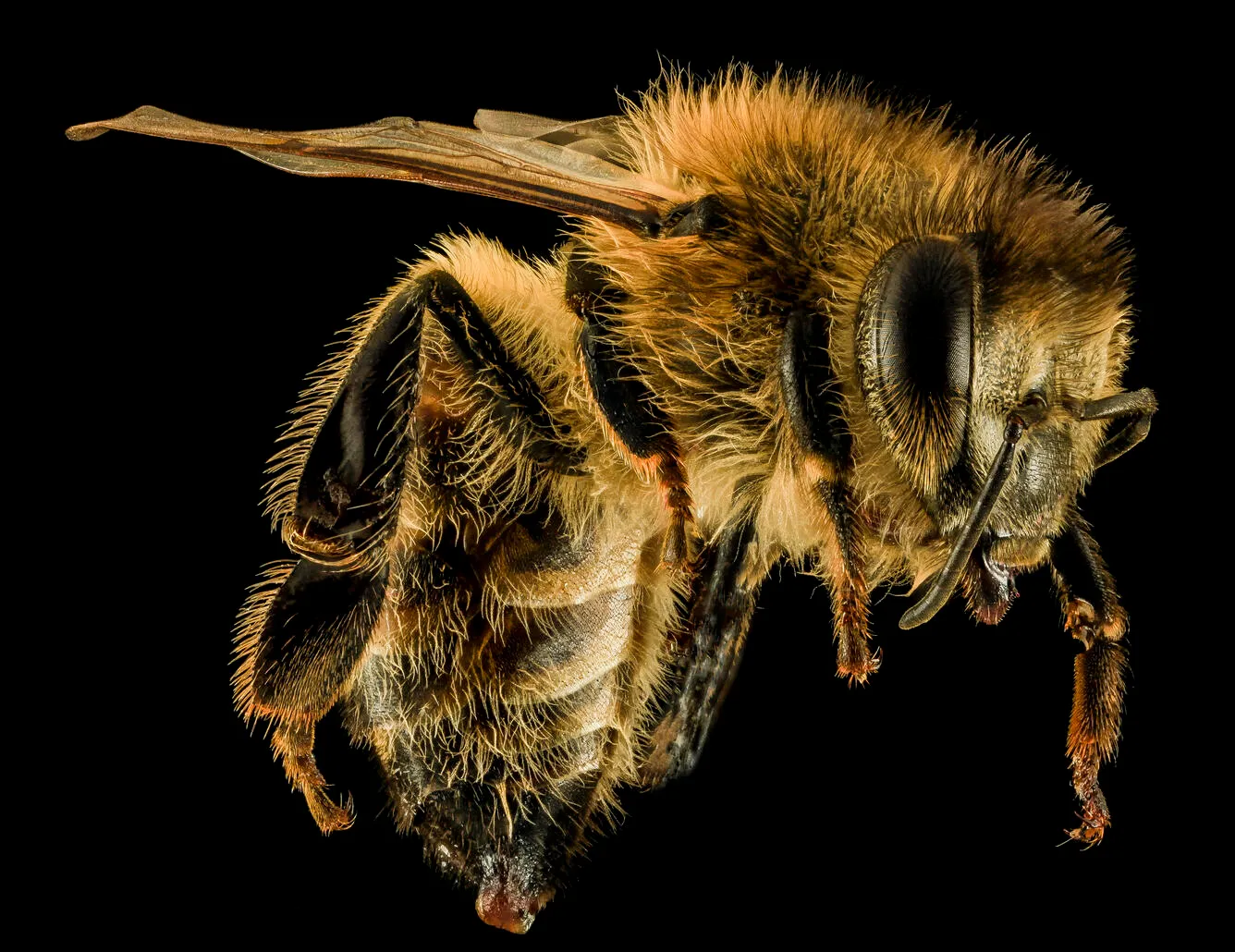
- USGS Bee Inventory and Monitoring Lab. Apis mellifera, F, side, MD, Granite (public domain). usgs.gov