Key points
- The bee louse is neither a louse nor a mite: it is a tiny wingless fly with six legs that lives clinging to adult bees.
- It parasitises neither brood nor bees: it takes food straight from their mouths, with a strong preference for the queen.
- Its larvae dig fine tunnels under honey cappings, which mainly spoils the look of comb honey.
- It is often mistaken for varroa: six legs and a round body for the louse, eight legs and a body wider than long for varroa.
- It usually needs no treatment; some varroa medicines have made it decline in many apiaries.
The bee louse, Braula coeca, is badly named: it is neither a louse nor a mite, but a tiny wingless fly that spends its adult life clinging to honey bees. It feeds by stealing a little of the food bees pass from mouth to mouth, and its larvae dig fine tunnels under honey cappings1. No significant economic damage has been attributed to it, and it is classed as a minor hive pest1, 11.
It is still worth knowing. First, because it is very often mistaken for varroa, which skews mite counts. Second, because it gathers on the queen. Finally, because it has declined in some regions with varroa treatments, and its return can come as a surprise.
A wingless fly, not a louse
What the adult looks like
The adult measures about 1.5 mm long and 0.9 mm wide. It is reddish brown, with a rounded body covered in stiff bristles1, 12. It has neither wings nor halteres, so it cannot fly. Its eyes are greatly reduced, hence its Latin name coeca, “blind”. The thorax, less than half the length of the head, is easily taken for an abdominal segment1.
Its six legs are sturdy. The last segment of each leg carries a comb-like structure that grips the bee’s hairs1. The grip is so firm that the louse is hard to dislodge in an alcohol wash13.
A family of its own, related to fruit flies
Braula coeca was described by Christian Ludwig Nitzsch in 1818. It belongs to the small family Braulidae, with seven known species: five in the genus Braula live on the western honey bee, and two in the genus Megabraula on the Himalayan giant honey bee, Apis laboriosa5. B. coeca is the most widespread: it lives on all honey bee subspecies13 and has been reported on every continent where bees are kept1, 3.
Sequencing of its genome, published in 2024, showed that this louse is a fly closely related to Drosophila, so much so that the authors propose merging the Braulidae into the Drosophilidae. The genome has lost many bitter taste receptors and part of the odorant receptors; this way of life is thought to have arisen about 6 to 17 million years ago5.
The life cycle: tunnels under the cappings
The female lays eggs in many places in the hive, but only eggs laid on the cappings of honey cells hatch. The egg is white, oval and measures about 0.84 mm by 0.42 mm1, 11.
| Stage | Where? | Approximate duration |
|---|---|---|
| Egg | On the capping of a honey cell | About 2 to 7 days, depending on season |
| Larva (3 instars) | In a tunnel dug under the capping | About 7 to 11 days |
| Pupa | Location still poorly documented | 1 to 3 days |
| Adult | On adult bees | Overwinters on the bees |
Sources: 1, 11. Full development from egg to adult takes from 10 days to just over three weeks, depending on temperature and the amount of capped honey available11.
The larva digs a tunnel about 1 mm wide under the capping, often branched, and feeds on the honey and pollen residues it comes across1, 12. This is why tunnels are more numerous during nectar flows: the reference study carried out in Maryland found them mostly from May to August, and saw the adult population rise again from July2.
The adult does not survive long away from bees: less than a day without a host, according to Australian authorities12. It overwinters on adult bees and resumes egg-laying when conditions become favourable again11, 12.
A food thief drawn to the queen
At the bees’ mouths
The adult louse sits on the bee’s thorax or abdomen12. To feed, it moves up to the head and takes a droplet while bees are exchanging food. It may even trigger this regurgitation by stroking the edge of its host’s upper lip1. It does not bite and does not attack brood: it is a kleptoparasite, a food thief5, 11.
A marked preference for the queen
The queen, constantly fed by her retinue, is the favourite host. In the colonies followed in Maryland, 62% of queens carried lice from June onwards, while the vast majority of worker carriers had only one2. Old accounts report dozens, and even more than a hundred lice on a single queen13. Australian authorities note that lice are seen on the queen mainly when the colony is broodless, has a small population, or the queen is old11.
A study published in 2024 explains part of this choice: the louse is guided by the scent of mandibular gland pheromones, especially queen substance. In the laboratory, it responded very strongly to the main queen pheromone, and the workers carrying it held about twice as much of these substances as the others7.
The louse also carries on its surface a blend of waxy compounds similar to that of the bees of its colony: this chemical camouflage would explain why workers tolerate it6, 7.
What impact on the colony?
In the vast majority of cases, the colony does not suffer from the louse. As early as 1925, a US Department of Agriculture report judged strong colonies unaffected13. Possible effects:
- Damaged comb honey. The tunnels give the cappings a cracked look that lowers the value of honey sold as comb or sections. Extracted honey is not affected11, 12.
- A hampered queen. A heavy load of lice on the queen could reduce the food she receives and therefore her laying, and encourage her supersedure9, 12. This effect has, however, never been measured in a formal study13.
- A possible role in virus spread. In 2019, acute bee paralysis virus (ABPV) was detected in a related species, Braula schmitzi. It is not yet known whether the virus multiplies in the louse or whether the louse merely carries particles from one bee to another8.
The louse is therefore an indicator more than a threat: a queen covered in lice is a prompt to find out why the colony is weak or broodless.
Recognising the bee louse and telling it apart from varroa
This is the most common confusion. In Libya, a survey of beekeepers showed that 72% of them could not tell the louse from varroa10. Both are reddish brown, of similar size, and move about on adult bees12, but a hand lens is enough to separate them.
| Feature | Bee louse (Braula coeca) | Varroa (Varroa destructor, female) |
|---|---|---|
| Nature | Insect (wingless fly) | Mite |
| Legs | 6, long and visible | 8, short, hidden under the shield |
| Shape | Round, domed, hairy | Oval, flattened, wider than long |
| Size | About 1.5 mm long and 0.9 mm wide | About 1.1 mm long and 1.6 mm wide |
| Position on the bee | Thorax, abdomen, head; very often on the queen | Under the abdominal plates, on the thorax |
| Brood | Never parasitised | Reproduces in capped brood |
| Sign in the hive | Tunnels under honey cappings | Patchy brood, deformed wings |
Sources: 1, 12; for varroa, see the Varroa page.
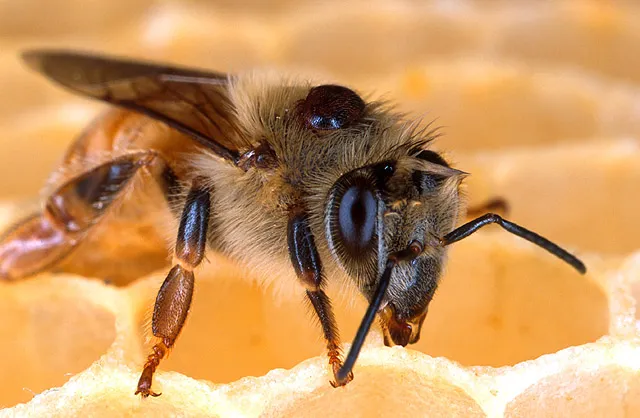
Pollen mites, smaller and paler, are another source of confusion. In Europe, keep Tropilaelaps in mind too: an elongated, very fast mite, any suspicion of which must be reported.
Detecting and assessing the louse
- Look at the queen. This is where adult lice are easiest to find: check her thorax and head whenever you see her during an inspection12.
- Observe the workers on a frame with a hand lens, especially on the thorax.
- Inspect capped honey in raking light: the tunnels form fine, branching lines under the cappings12.
- Use your varroa counts. An alcohol wash or sugar roll on about 300 bees can reveal lice11. Count them separately, checking the number of legs, so as not to overestimate the varroa infestation.
- Remember that counts are underestimates. In the Maryland study, visual observation detected only about half of the lice actually present2. Sticky boards also collect fallen lice, but it takes about a week to see enough of them13.
If in doubt, keep the specimen in alcohol and have it examined by your local bee health organisation or a laboratory.
Regulations
The following applies to France; rules vary between countries.
- The bee louse is not a regulated animal health hazard, in France or in the European Union: its presence does not have to be reported.
- No veterinary medicine is authorised specifically against it. Reminder: only veterinary medicines authorised for honey bees may be used in a hive, according to their leaflet and for their indication.
- Elsewhere, the status differs. In Australia, the louse is established in Tasmania, Victoria and New South Wales; elsewhere on the mainland, any suspicion must be reported to the authorities11, 12.
The bee louse and varroa treatments
In many apiaries, the louse has declined with varroa control, because some acaricides kill it too. In a study carried out in Yugoslavia, tau-fluvalinate killed lice in large numbers, while amitraz did not appear to affect them4. Coumaphos also had an effect on the louse13.
The example of Libya is telling: the louse disappeared there around 1990 with the regular use of fluvalinate, then reappeared in 2009, when beekeepers cut back on synthetic acaricides10. The effect of other treatments, such as organic acids or thymol, is poorly documented13. Seeing lice in a treated apiary is therefore nothing unusual.
This link is never a reason to treat: an acaricide is used only against varroa, according to its authorisation.
Preventing and limiting the bee louse
The louse travels with bees: swarms, drifting, package bees and purchased queens. Its larvae travel with capped honeycomb11. Prevention therefore rests on simple steps:
- Buy queens and colonies from reliable sources and examine every new queen on arrival12.
- Keep colonies strong, with a young queen: a queen covered in lice often signals a colony in difficulty.
- Uncap for extraction: uncapping removes the larvae with the cappings and lowers the population for a while11, 12.
- Freeze comb honey: at least 48 hours in the freezer kills all stages, and the same step also protects against wax moth and the small hive beetle11.
In practice: what beekeepers actually do
The bee louse is not something you "treat". Most beekeepers simply learn to recognise it, tell it apart from varroa and protect their comb honey.
Practical steps
- Identify before counting: during an alcohol wash or sugar roll, every reddish-brown specimen is checked with a hand lens; lice are recorded separately.
- Remove lice from the queen: some gently lift them off with a fine brush when there are many.
- Read the cappings: at harvest time, a glance at capped combs in raking light reveals the tunnels.
Common strategies
- Producers of comb honey or sections freeze their combs straight after harvest, before storage or sale.
- An old queen covered in lice is often replaced, especially if the colony stays weak.
Useful equipment
- A pocket hand lens or a head-mounted magnifier.
- A wash jar and sieve, already used for varroa.
- A small vial of alcohol to keep a specimen for identification.
- A freezer for comb honey.
Checklist
- Does the specimen have six visible legs and a round body? It is a louse.
- Does it have eight short legs and a body wider than long? It is varroa.
- Is it elongated and very fast? Suspected Tropilaelaps: report it.
- Do the honey cappings show fine, branching tunnels?
- Is the queen loaded with lice, and is the colony weak or broodless?
The most common mistakes
- Counting lice as varroa mites and overestimating the infestation, with the risk of treating unnecessarily.
- Mistaking a varroa mite for a louse and believing the colony is free of varroa.
- Using an acaricide to get rid of the louse: no medicine is authorised for this use.
- Blaming the louse for a weakness whose cause lies elsewhere: old queen, varroa, disease, starvation.
Frequently asked questions
Is the bee louse dangerous to the colony? Very rarely. It parasitises neither brood nor bees and only steals a little food. A heavy load on the queen could reduce her laying, but this effect has not been measured. The main damage concerns the appearance of comb honey.
How do you tell the bee louse from varroa? Count the legs with a hand lens: six long, visible legs for the louse, eight short, hidden legs for varroa. The louse is round and domed; varroa is oval, flattened and wider than long. The louse likes to sit on the queen and on the thorax of workers.
Should I treat for Braula coeca? Generally not. No medicine is authorised against it. Uncapping at extraction and freezing comb honey for at least 48 hours are enough to limit the damage. Some varroa acaricides make it decline, but that is never a reason to treat.
References
- Ellis J.D., Mortensen A.N., Zettel Nalen C.M. (2019, revised 2025). Bee louse, bee fly, braulid, Braula coeca Nitzsch (Insecta: Diptera: Braulidae). University of Florida, IFAS Extension, Featured Creatures, publication EENY472/IN845. ask.ifas.ufl.edu
- Smith I.B. Jr. (1978). The bee louse, Braula coeca Nitzsch, its distribution and biology on honey bees. Thesis, University of Maryland. drum.lib.umd.edu
- Smith I.B. Jr., Caron D.M. (1985). Distribution of the bee louse Braula coeca Nitzsch in Maryland and worldwide. American Bee Journal 125: 294-296.
- Kulinčević J.M., Rinderer T.E., Mladjan V.J. (1991). Effects of fluvalinate and amitraz on bee lice (Braula coeca Nitzsch) in honey bee (Apis mellifera L) colonies in Yugoslavia. Apidologie 22(1): 43-47. doi.org
- Bastide H., Legout H., Dogbo N., Ogereau D., Prediger C., Carcaud J., Filée J., Garnery L., Gilbert C., Marion-Poll F., Requier F., Sandoz J.-C., Yassin A. (2024). The genome of the blind bee louse fly reveals deep convergences with its social host and illuminates Drosophila origins. Current Biology (bioRxiv preprint, 2022). doi.org
- Martin S.J., Bayfield J. (2014). Is the bee louse Braula coeca (Diptera) using chemical camouflage to survive within honeybee colonies? Chemoecology 24(4): 165-169.
- Yusuf A.A., Pirk C.W.W., Crewe R.M. (2024). A hitchhiker's ride: the honey bee louse Braula coeca (Diptera: Braulidae) selects its host by eavesdropping. Journal of Chemical Ecology 50(5): 214-221. doi.org
- Avalos J., Rosero Mayanquer H.P., Maldonado G., Reynaldi F.J. (2019). Honey bee louse (Braula schmitzi) as a honey bee virus vector? Journal of Apicultural Research 58(3): 427-429. doi.org
- Strauss U., Pirk C.W.W., Dietemann V., Crewe R.M., Human H. (2014). Infestation rates of Varroa destructor and Braula coeca in the savannah honey bee (Apis mellifera scutellata). Journal of Apicultural Research 53(4): 475-477. doi.org
- Alfallah H.M., Mirwan H.B. (2018). The story of Braula coeca (bee lice) in honeybee colonies Apis mellifera L. in Libya. International Journal of Research in Agricultural Sciences 5(1): 34-36.
- Frost E. (2024). Braula fly. NSW Department of Primary Industries, Primefact 31566, 2nd edition. dpi.nsw.gov.au
- Plant Health Australia, BeeAware. Braula fly (pest fact sheet). beeaware.org.au
- McAfee A. (2022). Science Insider: Braula basics, a pest worth worrying about? American Bee Journal 162(9). americanbeejournal.mydigitalpublication.com
- USDA ARS, Image Gallery. Photo K9544-1: honey bee with a varroa mite on its back (Scott Bauer, public domain). ars.usda.gov