Key points
- A drone-laying colony rears nothing but drones: without intervention, it is doomed.
- Several eggs per cell, stuck to the walls: laying workers. One centred egg but drone brood in worker cells: a drone-laying queen.
- Laying workers appear after several weeks without a queen or young brood, once the pheromones that suppress their ovaries have gone.
- A drone-laying queen is fairly easy to replace; a colony with laying workers often rejects a new queen.
- The best prevention: check for eggs at every inspection and act as soon as a colony is queenless.
A colony with laying workers or a drone-laying queen is a colony that rears nothing but drones. The worker brood disappears, replaced by scattered domed cappings, and the population ages without being renewed. Two very different situations lead to this picture: laying workers, which start laying after a long period without a queen, or a drone-laying queen, present but unable to lay fertilised eggs.
It is not a disease, but without intervention the colony is doomed. This factsheet explains how to tell the two cases apart on a frame and which solution to choose depending on the season.
Why only fertilised eggs produce workers
In the honey bee, sex depends on fertilisation. A fertilised egg produces a female, which becomes a worker or a queen depending on the food it receives. An unfertilised egg produces a drone. Early in life the queen mates with many drones, in the order of 10 to 203, and stores their sperm in her spermatheca for the rest of her life. She never mates again afterwards.
Workers, for their part, do not mate. They do, however, have ovaries, reduced but functional. If these ovaries develop, they lay unfertilised eggs, and therefore only drones. A colony whose entire egg-laying comes from workers or from a queen with no sperm can thus no longer produce either workers or queens.
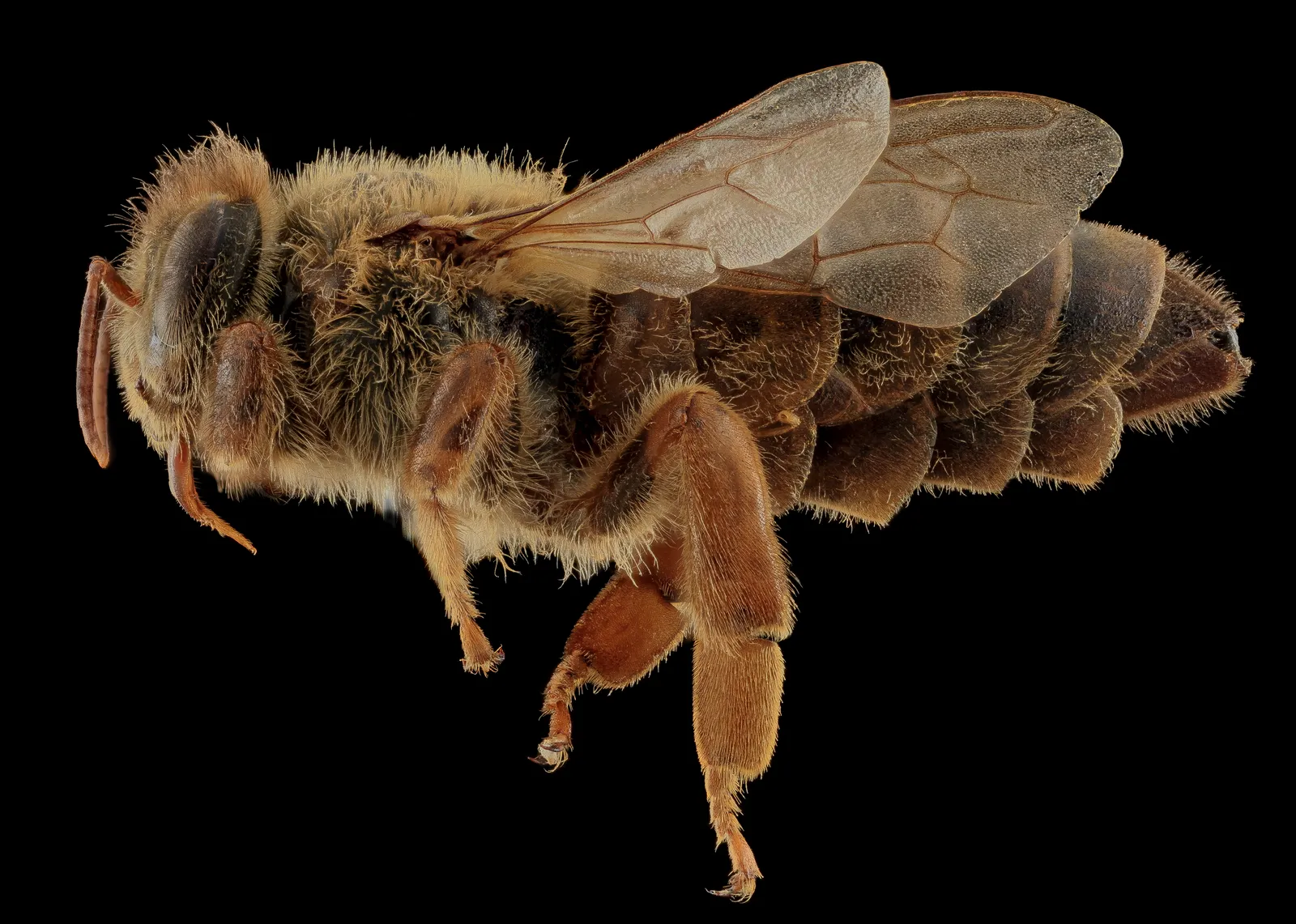
Laying workers
What normally keeps their ovaries in check
In a normal colony, the development of the workers’ ovaries is suppressed by chemical signals. The main one is queen mandibular pheromone, spread throughout the hive by the bees that touch her1. Young brood also plays a part: larvae give off volatile substances, including E-β-ocimene, which also inhibit the development of the workers’ ovaries2.
There is a second safeguard: worker policing. Even when the queen is present, a few workers lay, but the others detect and eat the eggs they have laid. In the honey bee, this control is very effective: only a tiny fraction of the drones in a normal colony come from workers3.
How they appear
When the queen disappears, the colony starts emergency queen cells within a few hours from young worker larvae12. If this rearing fails, for lack of young larvae or because the young queen was lost on her mating flight, the colony becomes hopelessly queenless.
The remaining brood eventually emerges. There is no longer a queen or young brood, and therefore no chemical brake at all. The ovaries of some of the workers develop, and egg policing breaks down as worker laying increases4. In practice, beekeeping guides place the first laying a few weeks after the loss of the queen, often two to three. The delay varies with the colony and the season.
Often numerous, laying workers prefer drone cells but also lay in worker cells, and the colony can produce a large number of drones before it dies5.
“Rebel workers”
Workers reared just after a swarm, during the short period without a laying queen, develop more ovarioles and lay more, even once the new queen is in place6.
The special case of the Cape honey bee
In the Cape honey bee (Apis mellifera capensis), in South Africa, laying workers produce females by parthenogenesis. Some invade other colonies and replace the queen there7. This case does not concern the bees kept in Europe.
The drone-laying queen
A drone-laying queen is present and laying, but her eggs are not fertilised. There are several possible causes.
- A queen that never mated. Prolonged bad weather, a lack of drones in the area, damaged wings: the young queen was unable to make her mating flights. Beyond a certain age, she can no longer mate and ends up laying unfertilised eggs.
- A poorly mated queen. She received too little sperm and quickly exhausts her supply.
- An old queen. After several seasons of laying, the spermatheca gradually empties. The queen lays more and more drones, at first mixed in with the worker brood, then almost exclusively.
- Sperm damaged by temperature. A US study linked colony failure to low sperm viability in queens, and showed that a cold shock during transport could impair it8. Another established that above 38 °C viability drops, and that the outer frames of a hive can exceed this temperature during heatwaves9. The authors consider the range from 15 to 38 °C safe for a queen.
The first sign of a failing queen is often spotty brood dotted with drone cappings. A queen can also stop laying without running out of sperm, because of ovary damage: see Queen melanosis. Be careful, though: an irregular brood pattern is not a reliable indicator of queen quality10, and brood diseases must be ruled out first.
Impact on the colony
A drone-laying colony dwindles: the workers die without being replaced, and the drones, which do not forage, consume stores. It becomes weak, irritable and poorly defended, which makes it a target for robbing and wax moth.
The abundance of drone brood has another effect: varroa reproduces markedly better in drone cells than in worker cells11. A drone-laying colony that collapses and is then robbed can thus spread mites to neighbouring colonies.
Recognising laying workers and a drone-laying queen
General signs
- No worker brood, or worker brood becoming increasingly scarce.
- Domed, bullet-shaped cappings scattered across worker cells.
- Numerous drones, often small, because they were reared in cells that are too narrow.
- A restless colony, noisy when opened, with a falling population.
- Sometimes queen cells built over drone larvae, which will never succeed.

Laying workers or drone-laying queen: the comparison table
| Observation | Laying workers | Drone-laying queen |
|---|---|---|
| Eggs per cell | Often several, sometimes a dozen or so | Just one |
| Position of eggs | Stuck to the walls, poorly placed | Centred at the bottom of the cell |
| Laying pattern | Disorderly, very scattered | Fairly even patch |
| Queen | Absent, cannot be found | Present, often easy to spot |
| Worker brood | None | Absent or mixed with drones |
| Acceptance of a new queen | Difficult, often rejected | Fairly good once the old one is removed |
Laying workers have a shorter abdomen than the queen: they cannot reach the bottom of the cells and deposit their eggs on the walls.
Do not confuse with
- A young queen just starting out sometimes lays two eggs in a cell during her first days, or when she is short of free cells. The eggs stay centred at the bottom, and the laying quickly becomes regular.
- Normal drone brood is found in spring at the edges of the frames and in drone cells, next to abundant worker brood.
- A colony that is simply queenless has no laying yet: this is the point at which it is easiest to save.
Step-by-step diagnosis
- Examine the central frames in full daylight, with your back to the sun, to see the bottom of the cells clearly.
- Count the eggs per cell and note their position.
- Look for the queen if the laying is regular, with one egg per cell.
- Look at the cappings: domed in worker cells, they are the mark of drone laying.
- Do the test frame: introduce a frame of young worker brood (eggs and young larvae) from a healthy colony. If the colony raises queen cells on it, it has no functional queen and will still accept requeening. If it does not, a queen, even a drone-laying one, is probably present, or the laying workers are well established.
- Compare with the history: date of the last swarm, of the last requeening, the last time eggs were seen.
No laboratory examination is needed. If you find dead or discoloured larvae, look for a brood disease first.
Regulations
What follows applies to France; rules vary between countries, so check those that apply where you keep bees.
- A drone-laying colony is not a disease: it is not notifiable.
- The solutions often rely on swapping frames or combining colonies. These operations assume that the colonies involved are healthy: any suspicion of American foulbrood is reported to the DDPP (local veterinary services), and no frames must then be moved.
What to do: solutions for each case
A drone-laying queen
This is the simplest case. If the colony is still strong, find and remove the queen, then introduce a mated queen in a cage, using the usual method. You can also combine it with a colony that has a good queen. If the colony is very weak, combining is preferable: a new queen would not have enough workers to get brood rearing going again.
Laying workers
This case is more difficult, because these colonies often reject a new queen12. Several methods are used, none of which is guaranteed to succeed.
The shake-out. Carry the hive some distance away and shake all the bees onto the ground, then remove the hive. The bees join the neighbouring colonies. It is often said that the laying workers cannot find their way back to the apiary, but this has not been established. The method is quick, but the colony is lost.
Combining. Place the drone-laying colony above a strong colony, separated by a sheet of newspaper (a newspaper combine). The bees gradually mix. The risk is that the good queen gets killed: many beekeepers only do this with a recipient colony that is clearly stronger.
Frames of open brood. Give the colony a frame of young worker brood every week, for several weeks. The brood pheromones suppress the laying workers2, and the colony often ends up raising its own queen cells or accepting a queen. This is the “gentlest” method, but it takes brood from healthy colonies and is time-consuming.
At the end of the season, a drone-laying colony has little future: its workers are old and will not survive the winter. Combining or shaking out is then almost always preferable. See also the Winter losses factsheet.
Preventing laying workers and drone-laying queens
- Check for eggs at every inspection: fresh eggs, one per cell, prove that a queen was laying less than three days ago.
- Monitor colonies after a swarm or a requeening. A young queen should start laying in the weeks following her emergence; if not, you need to act.
- Keep a reserve. A nuc with a mated queen, or a frame of young brood, makes it possible to save a queenless colony before laying workers appear.
- Replace old queens before they fail.
In practice: what beekeepers actually do
Most beekeepers consider that a drone-laying colony is far easier to prevent than to cure. Their key habit: knowing at every inspection whether a queen is laying.
Practical habits
- Look for eggs before the queen. Most beekeepers do not systematically look for the queen: fresh, well-centred eggs are enough to reassure them.
- Read the cappings. Domed cappings in the middle of a worker frame trigger a careful examination.
- Put in a test frame as soon as a colony seems queenless, rather than waiting for the next inspection.
Common strategies
- Many beekeepers keep a few spare nucs during the season, with mated queens, so they can requeen quickly.
- After a swarm, they note the date and come back to check the young queen’s laying a few weeks later.
- Faced with established laying workers, a large share of them prefer to shake out or combine rather than tie up brood and queens for weeks.
Kit to keep ready
- A torch or magnifying glass to see the bottom of the cells.
- Queen introduction cages and, if possible, a mated queen available.
- Newspaper for combining.
Checklist
- Eggs present, one per cell, well centred?
- Young larvae and capped worker brood?
- Domed cappings in worker cells?
- Date of the last swarm or requeening?
- If in doubt: a test frame of young brood, then a decision based on the colony’s strength and the season.
The most common mistakes
- Introducing a queen directly into a colony with laying workers: she is very often killed.
- Confusing the two cases and searching in vain for a queen that does not exist, or shaking out a colony that only needed a change of queen.
- Waiting too long after a swarm or the loss of a queen: every week lost makes rescue more difficult.
- Combining with a weak colony: the good queen is likely to be killed there.
- Combining colonies or swapping frames without having checked the health status of the colonies.
Frequently asked questions
How can I tell if a hive has laying workers? Several eggs in the same cell, stuck to the walls rather than at the bottom, a disorderly laying pattern and domed drone cappings in worker cells, with no queen to be seen: these are the classic signs. A drone-laying queen, by contrast, lays a single, centred egg, in an even patch.
How long after the loss of the queen do workers start laying? All the young brood must have gone, because it also suppresses their ovaries. Beekeeping guides generally speak of two to three weeks without a queen or young brood, with variations from one colony to another.
Can a drone-laying colony be saved? With a drone-laying queen, yes, fairly easily: replace her or combine the colony. With laying workers, it is less certain: repeated frames of open brood, combining or a shake-out. At the end of the season, combining or shaking out is often the most sensible choice.
Is a drone-laying colony contagious? No, it is not a disease. But a weakening colony attracts robbers, and its abundant drone brood encourages varroa to multiply, which can then spread to neighbouring colonies.
References
- Hoover S.E.R., Keeling C.I., Winston M.L., Slessor K.N. (2003). The effect of queen pheromones on worker honey bee ovary development. Naturwissenschaften 90: 477-480. doi.org
- Maisonnasse A., Lenoir J.-C., Costagliola G., Beslay D., Choteau F., Crauser D., Becard J.-M., Plettner E., Le Conte Y. (2009). A scientific note on E-β-ocimene, a new volatile primer pheromone that inhibits worker ovary development in honey bees. Apidologie 40(5): 562-564. doi.org
- Ratnieks F.L.W., Visscher P.K. (1989). Worker policing in the honeybee. Nature 342: 796-797. doi.org
- Miller D.G. III, Ratnieks F.L.W. (2001). The timing of worker reproduction and breakdown of policing behaviour in queenless honey bee (Apis mellifera L.) societies. Insectes Sociaux 48(2): 178-184. doi.org
- Page R.E., Erickson E.H. (1988). Reproduction by worker honey bees (Apis mellifera L.). Behavioral Ecology and Sociobiology 23(2): 117-126. doi.org
- Woyciechowski M., Kuszewska K. (2012). Swarming generates rebel workers in honeybees. Current Biology 22(8): 707-711. doi.org
- Neumann P., Moritz R.F.A. (2002). The Cape honeybee phenomenon: the sympatric evolution of a social parasite in real time? Behavioral Ecology and Sociobiology 52(4): 271-281. doi.org
- Pettis J.S., Rice N., Joselow K., vanEngelsdorp D., Chaimanee V. (2016). Colony failure linked to low sperm viability in honey bee (Apis mellifera) queens and an exploration of potential causative factors. PLoS ONE 11(2): e0147220. doi.org
- McAfee A., Chapman A., Higo H., Underwood R., Milone J., Foster L.J., Guarna M.M., Tarpy D.R., Pettis J.S. (2020). Vulnerability of honey bee queens to heat-induced loss of fertility. Nature Sustainability 3: 367-376. doi.org
- Lee K.V., Goblirsch M., McDermott E., Tarpy D.R., Spivak M. (2019). Is the brood pattern within a honey bee colony a reliable indicator of queen quality? Insects 10(1): 12. doi.org
- Rosenkranz P., Aumeier P., Ziegelmann B. (2010). Biology and control of Varroa destructor. Journal of Invertebrate Pathology 103: S96-S119. doi.org
- University of Georgia, CAES Bee Program. Honey bee disorders: non-infectious diseases and pests. bees.caes.uga.edu
- USGS Bee Inventory and Monitoring Lab. Apis mellifera, queen, side view (public domain). usgs.gov
- USGS Bee Inventory and Monitoring Lab. Apis mellifera, drone, front view (public domain). usgs.gov