Key points
- In most European apiaries, ants are a nuisance: they settle under the roof and carry off dead bees.
- A strong colony defends itself; ants become dangerous for nucs, swarms and weakened colonies.
- Invasive species (Argentine ant, fire ants) can rob honey, kill brood and bees, and carry honey bee viruses.
- The basic defence is physical: raised hive stands, legs isolated by a barrier, vegetation cut back.
- No insecticide on or near the hive: it kills bees too.
Ants in the hive, under the roof or on the inner cover: it is one of the most ordinary sights in the apiary. Ants are drawn by the sugar in honey and syrup, by the protein in dead bees and brood, and by the dry warmth above the cluster. An extension publication from the University of Florida describes them as one of the beekeeper’s most common pests, both in the apiary and in the honey house1.
In the vast majority of cases in temperate Europe, ants are more of a nuisance than a threat: a populous colony defends its entrance and its combs. The picture changes with weak colonies, nucs and swarms, and above all with certain invasive species, such as the Argentine ant, already established along the Mediterranean coast, or the fire ant, discovered in Sicily in 2023. This article helps you tell the difference and protect your hives without resorting to insecticides.
Which ants are interested in beehives?
Specialists divide them into two groups according to their behaviour, with some genera belonging to both1:
- Honey and nectar thieves, attracted by sugar. They follow trails to the stores, the feeders and poorly defended combs.
- Bee and brood eaters, which are after protein: dead or dying bees, larvae, pupae, and sometimes the larvae of other hive pests.
Common European species
In our climates, most of the ants found in the apiary are native garden species. They readily settle between the inner cover and the roof, where they find warmth and shelter, sometimes together with their brood1. They also collect dead bees in front of the entrance. This scavenging behaviour is harmless.
Carpenter ants (genus Camponotus), found in Europe as elsewhere, behave differently: they excavate soft or damaged wood to nest in. In Florida, the author of the reference guide describes a species of this genus that tunnels into roofs and supers and occupies empty nucs; he adds that these ants generally attack only weakened colonies1.
Invasive species
Some ants, carried by humans outside their native range, form huge populations with no boundaries between nests. These are the ones that cause the most serious problems.
- The Argentine ant (Linepithema humile). Native to South America, it forms continuous “supercolonies”. In southern Europe, the main one stretches for about 6,000 km, from Italy to the Atlantic coast of Spain, by way of the French Mediterranean coast5. Small and strongly attracted to sugar, it forms long columns and can be devastating for hives whose guard bees can no longer cope1. In New Zealand, it has been observed robbing honey and feeding on emerging brood4.
- The fire ant (Solenopsis invicta). Native to South America, it has long been established in the southern United States. In 2023, a team of researchers reported 88 nests over about 4.7 hectares on the outskirts of Syracuse, in Sicily: the first known established population in Europe6, 7. According to the same study, about 7% of the European continent already offers a suitable climate for the species7. In the United States, it prefers dead bees on the ground to healthy colonies, but weakened colonies and swarms in nucs are vulnerable1.
- The little fire ant (Wasmannia auropunctata), about 1.5 mm long, is described as a major problem for beekeepers in Hawaii since its introduction in 19991.
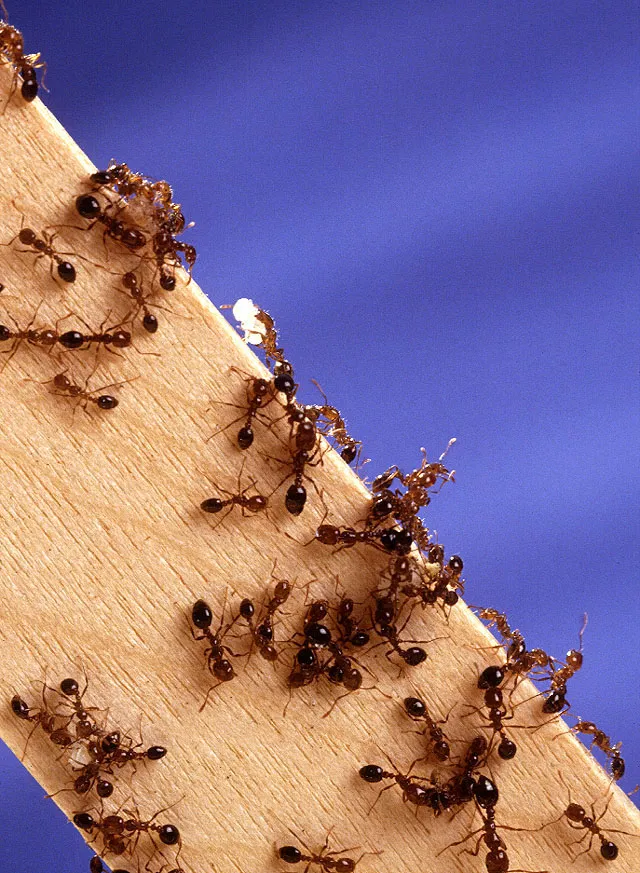
In the tropics
In Africa, ants are among the most feared enemies of bee colonies. In southern Africa, the Argentine ant, aggressive native ants and driver ants, which hunt in columns, are cited as major pests10. A recent study listed the ant species that attack honey bee colonies in Cameroon9.
Impact on the colony
Most of the time, a strong colony lives alongside a few ants with no visible harm. The guard bees block the entrance, and the ants make do with the space under the roof or the dead bees in front of the hive.
Damage appears when the balance of power is reversed:
- Robbing of stores. An ant trail can empty a feeder or poorly defended honey combs. A colony that loses its stores has to forage harder: in an experiment in New Zealand, foraging effort was 1.6 times higher in hives exposed to the Argentine ant, which the authors probably attribute to the lost food3.
- Predation on brood and bees. Predatory species take larvae, pupae and weakened bees, especially in colonies that are already struggling1.
- Disturbance and absconding. A colony under constant harassment becomes agitated and consumes more. Newly hived swarms, still without brood, are the most exposed: the author of the Florida guide reports losing several swarms housed in nucs to fire ants1.
- Damage to woodwork. Carpenter ants tunnel into damaged roofs and hive bodies1.
Ants and honey bee viruses
Ants that frequent hives collect dead bees and visit the same flowers: they can harbour honey bee viruses. In New Zealand, the Argentine ant carries a strain of deformed wing virus (DWV), with signs that the virus is actively replicating in the ant2. In an experiment on 18 hives spread over six sites, with or without Argentine ants, bees at invaded sites had higher loads of DWV and black queen cell virus (BQCV); on the other hand, neither Nosema ceranae nor trypanosomatids were affected, and hive mortality did not differ significantly3. These results, obtained in a single country with a single species, do not make every ant in the apiary a health hazard.
Recognising the problem
The signs
- Ants under the roof or on the inner cover, often with their eggs and white larvae: a nest set up in the warmth.
- A continuous trail of ants climbing a hive stand leg, a tall grass stem or a branch touching the hive.
- Ants carrying dead bees away from the entrance1.
- Ants in the feeder; honey combs emptied on the outer frames, empty brood cells or damaged pupae.
- Nervous bees, unusual agitation at the entrance, a colony weakening with no other apparent cause.
- Sawdust and tunnels in a roof or hive body: carpenter ants.
Do not confuse
| Observation | Ants | Other possible cause |
|---|---|---|
| Dead bees carried away in front of the hive | Ants cleaning up the entrance | Abnormal mortality: see dead bees in front of the hive |
| Stores emptied, agitation at the entrance | Visible ant trail leading to the combs | Foreign bees fighting: robbing |
| Small insects in the combs | Ants, fast-moving, with a narrow waist | Small hive beetle: Aethina tumida (notifiable) |
| Tunnels in wood or wax | Sawdust, no silk | Silken webs and cocoons: wax moth |
| Debris on the floor | Little debris, ants present | Chewed wax and a nest of plant material: mice and rodents |
Diagnosis
Diagnosis is visual and takes four steps.
- Look around the hive: where are the ants coming from? Follow the trail back to its anchor point (leg, grass, wall, branch).
- Lift the roof: is there a nest under the roof, or just ants passing through? A nest with ant brood signals a lasting settlement.
- Inspect the colony: population strength, state of the stores, any damaged brood. A weak colony overrun by ants often has another underlying problem (varroa, failing queen, disease): the ants take advantage of it more than they cause it.
- Identify the species if the behaviour is unusual (massive columns, painful stings): a sharp photo and a few specimens in alcohol allow an entomologist to confirm the species.
Regulation
Ants are not subject to any bee health notification in France. However, four ants have been on the list of invasive alien species of Union concern since Implementing Regulation (EU) 2022/1203: the fire ant (Solenopsis invicta), the tropical fire ant (Solenopsis geminata), the black imported fire ant (Solenopsis richteri) and the little fire ant (Wasmannia auropunctata)8. These species must not be introduced, transported or kept. If you suspect their presence, do not move any hive or equipment standing on the ground out of the area, and report it to the government environmental services. The Argentine ant is not on this list8. Rules and reporting channels vary between countries, so check those that apply where you keep bees.
Prevention and control
Isolate the hive from the ground
This is the basic measure, long recommended in very different settings, from Florida to southern Africa1, 10. The hive sits on a raised stand, each leg of which is cut off from the ground by a barrier that ants cannot cross:
- A water moat: each leg stands in a container of water with a little washing-up liquid added, which breaks the surface tension. In dry climates, a fine powder such as talc can replace the water1.
- A sticky barrier: a band of special sticky compound around the legs. The Florida guide advises against mechanical greases, which contaminate the environment1.
- An ant guard: an upturned dish or recycled tin can around the leg, coated with sticky barrier1.
Cut the bridges
The best stand is useless if a grass stem, a bramble or a branch touches the hive above the barrier1. A single tall grass stem is enough to carry a trail11. Mow regularly around the apiary, and make sure no wall, post or neighbouring hive is acting as a bridge.
Keep colonies strong and hives tight
- Reduce the entrance of weak colonies, nucs and swarms so that the guard bees can hold it, as you would against robbing.
- Unite colonies that are too weak to defend themselves.
- Do not spill syrup or leave honey frames or cappings lying around the apiary.
- Use closed feeders, accessible only from inside the hive.
- Replace roofs and hive bodies with damaged wood, and do not leave empty equipment in the apiary.
Why avoid insecticides
Ants and bees are closely related insects: an insecticide sprayed on the hive or around it also kills bees and can contaminate wax and honey (see pesticide poisoning). Some powders marketed as natural, such as diatomaceous earth, are also deadly to bees11. In the United States, control of invasive ants relies on slow-acting baits placed in closed bait stations that bees and other pollinators cannot get into1. In Europe, the use of such products near hives should remain exceptional, governed by the product label and, for regulated species, by the competent authorities.
In practice: what beekeepers actually do
When dealing with ants, most beekeepers first distinguish mere presence from a real attack, then rely on well-maintained physical barriers rather than on products.
Routine tasks
- Lift the roof at every inspection and brush any ant nest on the inner cover away from the hive.
- Put hives on raised stands, not directly on the ground.
- Mow around the stands before the grass touches the hives.
- Reduce the entrance of nucs and swarms as soon as they are hived.
Strategies by situation
- A few ants under the roof of a strong colony: most beekeepers simply dislodge them at each inspection.
- An ant trail to a weak colony or a feeder: break the trail, put a barrier on the legs, reduce the entrance, use a closed feeder.
- Area invaded by the Argentine ant: permanently isolated stands, regular maintenance of the barriers, apiary sited away from visible trails.
- Suspected fire ants: move nothing, take photos, report.
The kit
- Hive stands with legs, dishes or recycled tin cans.
- Commercial sticky barrier, washing-up liquid.
- Entrance reducers and closed feeders.
- Brush cutter or scythe for keeping the apiary tidy.
The checklist
- Does the hive touch the ground, a grass stem or a branch?
- Are the dishes full and the barriers still sticky?
- Is there a nest under the roof?
- Is the colony strong enough to defend its entrance?
- Are the ants an unusual species, or present in very large numbers?
The most common mistakes
- Using insecticide around or on the hive, at the risk of killing the colony.
- Letting the grass grow up against the hives, which makes any barrier useless.
- Forgetting to maintain the barriers: dry dishes, water full of debris, sticky compound covered in dust.
- Blaming the ants for a colony’s weakness without looking for the root cause.
- Leaving open feeders or spilled syrup in the apiary.
Frequently asked questions
Are ants in the hive dangerous for bees? Usually not: in a strong colony, they make do with the warmth under the roof and the dead bees. They become dangerous for weak colonies, nucs and swarms, and when invasive species such as the Argentine ant or the fire ant are involved1.
Why do ants settle under the hive roof? The space between the inner cover and the roof is warm, dry and out of reach of the guard bees1. Brushing the nest away at each inspection is usually enough.
How do you stop ants getting into the hive? Raise the hive on a stand whose legs are isolated by a moat of soapy water or a sticky barrier, and cut back any vegetation touching the hive1. Reduce the entrance of weak colonies and use closed feeders.
Can you use insecticide against ants in the apiary? It is best avoided: an ant insecticide also kills bees. Physical barriers are enough in most cases. If an invasive species makes chemical control necessary, it is done with baits in closed stations that bees cannot reach, following the product label1.
Do ants transmit diseases to bees? They can carry honey bee viruses. In New Zealand, the Argentine ant harbours deformed wing virus, and bees at invaded sites carry more of it2, 3. The role of native European ants in spreading these viruses remains poorly understood.
References
- Kern W.H. (2017, reviewed 2022). Ant Control in the Apiary. ENY-169, UF/IFAS Extension, University of Florida. edis.ifas.ufl.edu
- Sébastien A., Lester P.J., Hall R.J., Wang J., Moore N.E., Gruber M.A.M. (2015). Invasive ants carry novel viruses in their new range and form reservoirs for a honeybee pathogen. Biology Letters 11(9): 20150610. doi.org
- Dobelmann J., Felden A., Lester P.J. (2023). An invasive ant increases deformed wing virus loads in honey bees. Biology Letters 19(1): 20220416. doi.org
- Jones G., Fenwick S.-J., Lallu U., Fraser D. (2016). Perceptions and Impacts: An Observational Pilot Study of the Effects of Argentine Ants on Honey Bees in New Zealand. Unitec ePress, Perspectives in Biosecurity Research Series (1). unitec.ac.nz
- Giraud T., Pedersen J.S., Keller L. (2002). Evolution of supercolonies: the Argentine ants of southern Europe. PNAS 99(9): 6075-6079. doi.org
- Menchetti M., Schifani E., Alicata A., Cardador L., Sbrega E., Toro-Delgado E., Vila R. (2023). The invasive ant Solenopsis invicta is established in Europe. Current Biology 33(17): R896-R897. doi.org
- CREAF (2023). Red fire ant now established in Europe and could reach Catalonia. creaf.cat
- Centre de ressources Espèces exotiques envahissantes (2022). Liste des espèces exotiques envahissantes préoccupantes pour l'Union, à jour du règlement d'exécution (UE) 2022/1203. especes-exotiques-envahissantes.fr
- Tembong Cham D., Teboh Fombong A., Nduati Ndegwa P., Wachuhi Irungu L., Kumar Raina S. (2024). Ant (Hymenoptera: Formicidae) pests of honey bee colonies in Cameroon. Journal of Apicultural Research. doi.org
- Allsopp M. Predators of bees in Southern Africa. ARC-PPRI, Stellenbosch (presentation, WOAH Regional Representation for Africa). rr-africa.woah.org
- Buffington N. (2014). Ants in the bee yard. Keeping Backyard Bees. keepingbackyardbees.com
- USDA Agricultural Research Service. Image K5388-1: fire ants (photo by Scott Bauer, public domain). ars.usda.gov