Key points
- Europe's largest hornet and a native species: workers 18 to 25 mm, queens up to 35 mm.
- It catches honey bees, but is usually a moderate predator of healthy colonies; weak colonies are the most at risk.
- It also flies at dusk and at night, and is attracted to lights.
- Strong colonies fight back by trapping the hornet in a ball of bees that kills it with heat.
- Legal status varies: not protected in France, strictly protected in Germany.
The European hornet, Vespa crabro, is the largest native social wasp in Central Europe6. Unlike the Asian hornet, it is not an invasive species: it belongs to the local fauna. It catches honey bees to feed its larvae, but mostly hunts other insects, and its impact on healthy colonies is usually moderate1, 9.
For beekeepers the challenge is twofold: protecting weak colonies and nucs at the end of the season, and not mistaking this useful species for the Asian hornet, so that it is not destroyed for no reason.
What is the European hornet?
Size and colours
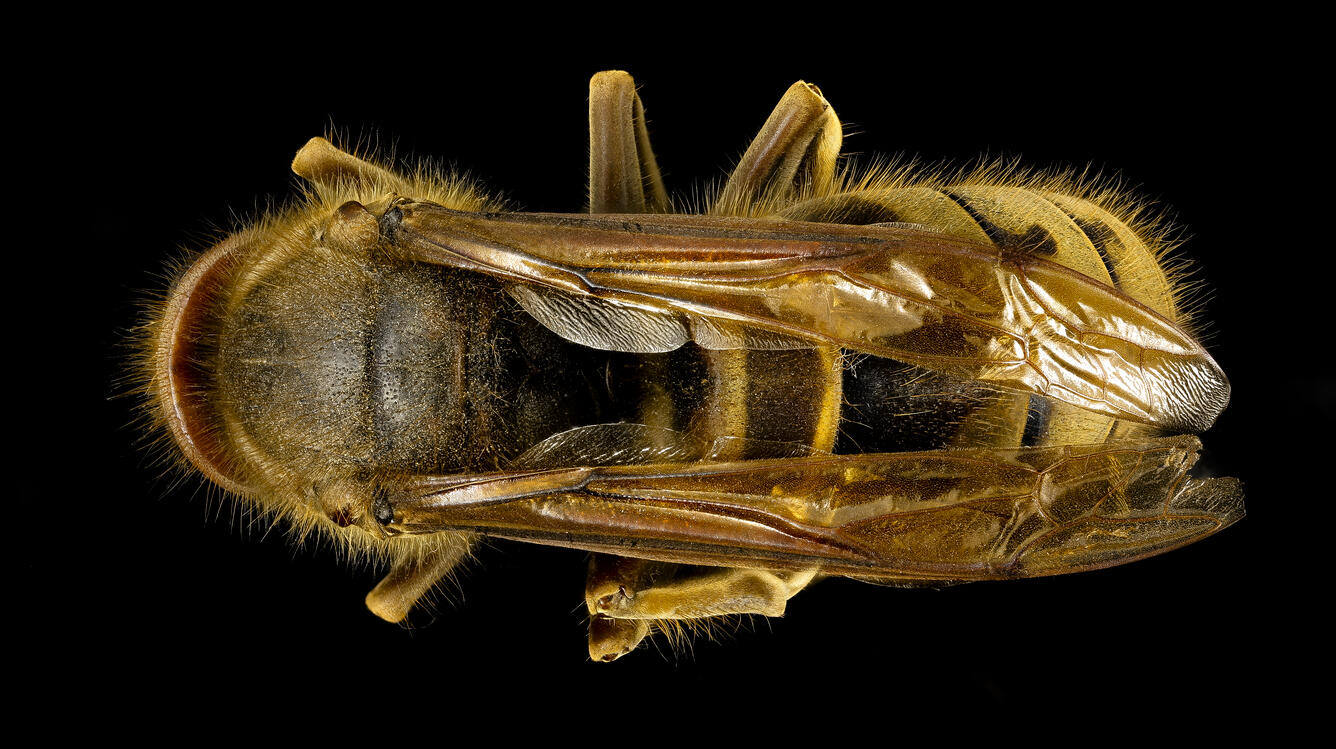
Workers measure 18 to 25 mm and queens up to 35 mm6, 7. The body is stout and hairy. The face is yellow, the thorax dark with reddish-brown markings, the abdomen yellow with black and reddish markings, and the wings are tinted reddish-brown12. Colours vary from one individual to another, even within the same nest.
Distribution
The species is native to Eurasia12. It was introduced to North America, where it has been reported since around 1840 in New York State, and has since spread across much of the eastern United States8. It is absent from Australia, where it is regarded as a pest to watch for and must be reported12.
A yearly cycle with a single founding queen
As in other social wasps of temperate Europe, the colony lives for only one season6, 8.
- Spring. The young mated queen leaves her winter shelter and founds a new nest on her own. She raises the first brood alone.
- Early summer. The first workers take over building, hunting and brood rearing. The queen no longer leaves the nest.
- Late summer. The colony reaches its peak. In the United States, nest size peaks around mid-September, usually with 200 to 400 workers and up to about a thousand in large nests7.
- Autumn. The nest produces males and future queens. After mating, the mated queens leave to overwinter alone. The workers, the males and the old queen die. The nest is never reused8.
So it is in late summer and autumn, when the colony’s protein needs are highest, that pressure on apiaries is greatest1.
The nest: always sheltered
The European hornet nests in dark cavities protected from rain: hollow trees, barns, garden sheds, attics, wall voids, nest boxes8, 11. The nest is often built near the cavity opening. Its brown envelope, made of decayed wood fibres, is thick but very fragile, and the nest is open at the bottom8, 11. It rarely hangs in the open, and is never found high in tall trees like the secondary nests of the Asian hornet11.
What it eats
Adults feed mainly on sap and fallen fruit. The larvae are fed insects: flies, wasps, honey bees, grasshoppers, beetles, caterpillars, dragonflies. A well-developed colony can catch up to half a kilogram of insects a day6. In France it is described as a useful predator that mostly hunts flies, and honey bees much more rarely11.
In the laboratory, however, both the European and the Asian hornet clearly prefer honey bees to the other protein sources offered2. In other words, when an apiary is within reach, it becomes an attractive resource.
Adults also strip bark from the twigs of some shrubs and trees, such as lilac, ash or birch, to feed on the sap. This girdling can kill branches and is sometimes wrongly blamed on squirrels7, 8.
A hunter that also flies at night
Unusually for a social wasp, the European hornet also flies at dusk and at night. A Swedish study observed workers flying in very dim light without finding any special adaptation of their eyes: it is mainly their large size that allows them to see in the dark3. At night, hornets are attracted to outdoor lights and lit windows7, 8.
What happens at the apiary
Hunting at the entrance
A study carried out in October at two apiaries in central Italy, with 27 and 41 colonies, described how the European hornet behaves towards honey bees. The hornet spots returning foragers, then swoops on them1. The bees it catches are used to feed the larvae in the nest6.
A moderate predator, except for weak colonies
The same study concluded that the European hornet is a fairly moderate predator of healthy colonies, but can seriously harm weakened ones1. In the United Kingdom, the bee health service considers that it can prey on colonies, but usually only to a small degree9.
The most exposed are nucs, recent swarms, queenless or diseased colonies, and hives whose entrance is too wide to be guarded.
How honey bees defend themselves
Healthy colonies are not defenceless. Faced with hornets, the bees gather in a dense cluster at the hive entrance, which probably discourages the hornet from getting in. When a hornet comes too close, groups of bees grab it, knock it down and wrap it in a ball of bees. The heat produced raises its body temperature beyond its lethal limit of about 44 °C; carbon dioxide and venom may also contribute to its death1.
This collective defence takes a lot of bees, which helps explain why weakened colonies are more vulnerable.
Viruses: a possible carrier, a role still unknown
The hornet eats honey bees and can therefore ingest their viruses. In Italy, deformed wing virus (DWV) was detected in two young European hornet queens, with signs of viral replication; one of them had deformed wings4. In Hungary, DWV and acute bee paralysis virus (ABPV) were found in European hornet workers that showed no visible abnormality5.
These studies involve very few individuals. Detecting a virus does not prove that it replicates in the hornet, nor that the hornet passes it on to other colonies. The role of the European hornet in the spread of honey bee viruses therefore remains a hypothesis to be tested.
Identification: do not confuse it
At the apiary, the most common confusion is with the Asian hornet. The table below sums up the most useful field criteria.
| Feature | European hornet (V. crabro) | Asian hornet (V. velutina) |
|---|---|---|
| Size | Large: 18 to 25 mm, queen up to 35 mm | Smaller |
| Overall colour | Reddish-brown and yellow | Very dark, brownish-black |
| Abdomen | Mostly yellow with black markings | Dark, with a single broad orange band |
| Legs | Reddish-brown | Yellow tips |
| Hunting at the apiary | Occasional attacks on returning foragers | Repeated hovering in front of the entrance |
| Night activity | Yes, at dusk and at night | Active by day |
| Nest | Sheltered cavity (hollow tree, attic, wall) | Secondary nest often high in trees |
For a detailed comparison with the invasive species, see the Asian hornet factsheet.

Spotting a problem at the apiary
There is no laboratory test to run: diagnosis is a matter of observation. To assess the pressure:
- Watch the hive entrances for a few minutes, at different times of day, in late summer and autumn. Note which species is present and how many hornets there are.
- Identify the hives being targeted and compare their flight activity with that of the other colonies in the apiary.
- Check at dusk whether hornets are still active in front of the hives or around nearby lights.
- Look for the nest if pressure is high, in cavities nearby: hollow trees, buildings, nest boxes.
- Assess the condition of the colonies under attack: population, queen, stores, varroa. A harassed colony is often a weak colony to begin with.
Regulations
The European hornet is not a bee health hazard: there is no compulsory notification as there is for American foulbrood. Its legal status, however, depends on the country.
- France. According to a 2007 ministerial answer, no wasp or hornet species is listed as protected under nature conservation law, so nothing prohibits destroying a nest. When a nest is a public safety problem, the mayor decides what action to take10.
- Germany. The European hornet is a “specially protected” species under federal species protection rules. It is forbidden to catch, injure or kill it or to destroy its nest; any nest removal requires a permit from the local nature conservation authority6.
- United Kingdom. It is the only native hornet species. Only the Asian hornet has to be reported to the authorities9.
- Australia. The species is absent and any sighting must be reported12.
Rules vary from country to country, and sometimes from region to region: check locally before doing anything about a nest.
Protecting colonies without destroying the species
Protection relies on the colonies, not on eliminating hornets. The recommendations of the UK bee health service, which cover wasps and the European hornet, point in this direction9.
Keep colonies strong
A populous colony guards its entrance and can use the balling defence1. In late summer, weak colonies are united, after checking their health status9.
Reduce and protect entrances
- Fit entrance reducers in late summer or as soon as attacks begin. If robbing starts, reduce the entrance to a single bee space9.
- Robbing screens, which move the entrance while leaving the old one visible, also protect nucs9.
Limit attractions
- Feed in the evening, without spilling syrup9.
- Do not leave empty hives with accessible wax combs, which attract predators and risk spreading disease9.
- Near buildings, switch off unnecessary outdoor lights in autumn and pick up fallen fruit7.
Trapping: best avoided
Wasp traps are unlikely to be effective and kill many useful native insects9. Against the European hornet, they have no proven benefit.
The nest: act only when necessary
A nest far from the apiary and from busy areas can usually be left alone: it will die out by itself in autumn and will not be reoccupied8. The European hornet is not aggressive away from its nest; it only defends the area around it6. A dangerous nest, close to a house or a path, is a job for a pest control professional, or in Germany for a relocation authorised by the competent authority6.
In practice: what beekeepers actually do
Studies show a moderate predator for healthy colonies. Here is how beekeepers actually deal with European hornets at the apiary.
The basic habits
- Most beekeepers start by identifying which species is present in front of the hives, before taking any action.
- They keep a close eye on nucs, this year’s swarms and weak colonies in late summer.
- Entrances are reduced as soon as attacks begin, and further as autumn approaches.
The most common strategies
- Strengthen rather than trap: unite weak colonies, replace failing queens, keep populous colonies.
- Protect the entrances of small colonies with a reducer or a robbing screen.
- Leave alone nests that are far from the apiary and from houses; they die out by themselves in autumn.
The kit to have
- Entrance reducers to fit each hive model.
- Robbing screens for nucs.
- A torch and a little patience to watch the hives at dusk.
- A full bee suit in case work near a nest is needed.
The end-of-season checklist
- July-August: identify the hornets present; spot weak colonies.
- August-September: unite weak colonies after a health check; reduce entrances.
- September-October: monitor pressure, including at dusk; protect nucs.
- Autumn: avoid unnecessary lighting near the apiary; check stores before winter.
The most common mistakes
- Mistaking it for the Asian hornet and destroying it for no reason, when it is a native species.
- Setting non-selective traps, which mostly kill other insects and have no proven effect.
- Leaving nucs with an entrance that is too wide at the end of the season.
- Blaming the hornet for the death of a colony already weakened by varroa, a failing queen or a lack of stores (see Winter losses).
- Going near a nest or trying to destroy it yourself, with a risk of multiple stings.
- Ignoring local rules, especially in countries where the species is protected.
Frequently asked questions
Is the European hornet dangerous for honey bees? It catches honey bees, especially in late summer and autumn, but studies describe it as a moderate predator of healthy colonies. Weak colonies and nucs are the most at risk1, 9.
How can you tell a European hornet from an Asian hornet? The European hornet is larger, reddish-brown and yellow, with a mostly yellow abdomen and reddish-brown legs. The Asian hornet is very dark, with a single orange band on the abdomen and yellow leg tips.
Should a European hornet nest be destroyed? Not necessarily. A nest far from houses and from the apiary can be left: the colony dies in autumn and the nest is not reused. In France, destruction is not prohibited; in Germany, it requires a permit6, 8, 10.
Why do European hornets fly at night? It is one of the few social wasps able to fly in very dim light. Hornets are attracted to outdoor lights and lit windows3, 8.
Is a European hornet sting more dangerous than a bee sting? It is about as painful as a honey bee sting, but the hornet can sting several times. A severe reaction, or a sting in someone who is allergic, needs immediate medical attention7.
References
- Baracchi D., Cusseau G., Pradella D., Turillazzi S. (2010). Defence reactions of Apis mellifera ligustica against attacks from the European hornet Vespa crabro. Ethology Ecology & Evolution 22: 281-294. hdl.handle.net
- Cini A., Cappa F., Petrocelli I., Pepiciello I., Bortolotti L., Cervo R. (2018). Competition between the native and the introduced hornets Vespa crabro and Vespa velutina: a comparison of potentially relevant life-history traits. Ecological Entomology 43(3): 351-362. doi.org
- Kelber A., Jonsson F., Wallén R., Warrant E., Kornfeldt T., Baird E. (2011). Hornets can fly at night without obvious adaptations of eyes and ocelli. PLoS ONE 6(7): e21892. doi.org
- Forzan M., Sagona S., Mazzei M., Felicioli A. (2017). Detection of deformed wing virus in Vespa crabro. Bulletin of Insectology 70(2): 261-265. archive.bulletinofinsectology.org
- Gál J., Ziszisz Á., Hoitsy M., Mándoki M., Bali K., Dénes L., Fehér E., Jerzsele Á., Halász G., Kaszab E. (2025). First detection of deformed wing virus (DWV) and acute bee paralysis virus (ABPV) in Central Hungary in European hornet (Vespa crabro Linnaeus, 1758). Animals 15(24): 3565. doi.org
- Umweltbundesamt (German Environment Agency). Wespen und Hornissen (page updated September 2026). umweltbundesamt.de
- Penn State Extension. European hornet (updated July 2024). extension.psu.edu
- Waldvogel M., Bambara S., Bertone M. European hornets. NC State Extension (2011, revised 2020). content.ces.ncsu.edu
- National Bee Unit (APHA, United Kingdom). Fact sheet: Wasps (September 2026). nationalbeeunit.com
- French National Assembly. Written question no. 119884 and answer from the Ministry of Ecology (Journal officiel, 15 May 2007). questions.assemblee-nationale.fr
- GDS Creuse. Guêpes et frelons : la destruction des nids recommandée en cas de problème. Pleinchamp, 29 June 2022. pleinchamp.com
- NSW Department of Primary Industries (Australia). European hornet. dpi.nsw.gov.au
- USGS Bee Inventory and Monitoring Lab. Vespa crabro, female, dorsal view (public domain). usgs.gov
- USGS Bee Inventory and Monitoring Lab. Vespa crabro, female, side view (public domain). usgs.gov