Key points
- Bees that tremble or crawl without being able to fly are a symptom, not a diagnosis: several diseases and poisoning produce the same picture.
- A heap of trembling bees outside a single hive, some black and shiny: think chronic bee paralysis first.
- Several colonies hit suddenly, bees spinning on their backs: think poisoning, take samples and report within 48 hours.
- Crawling bees in late winter: tracheal mite and nosema are possible, but only the laboratory can decide.
- A bee that "trembles" on the combs in the middle of a nectar flow may simply be dancing: the tremble dance is normal behaviour.
Bees trembling on the landing board, crawling in the grass or climbing up blades of grass without managing to take off: this picture almost always signals a problem, but not always the same one. A viral disease, poisoning, a tracheal parasite, nosema or simple starvation can all produce these trembling or crawling bees, and the eye alone is not enough to decide.
This symptom factsheet follows a decision tree: what to observe, the possible causes from the most common to the rarest, how to tell them apart, then what to do. For bees that are already dead, see also Dead bees in front of the hive.
What to observe before drawing conclusions
A few questions are a better guide than the appearance of a single bee.
- How many colonies? A single hive, a few, or the whole apiary at the same time?
- Since when? A sudden onset over one or two days, or a gradual build-up over one to several weeks?
- Where are the bees? In a heap right in front of the entrance, scattered across the apiary, on blades of grass, or on the combs inside?
- What do they look like? Normal bees, or black, shiny and hairless; crumpled wings; wings splayed in a “K”; swollen abdomen; tongue sticking out?
- How do they behave? Trembling of the body and wings, bees spinning on their backs, moving slowly as if numbed, being harassed by their sisters?
- What is the context? Season, weather over the last few days, stores, a recent mite count, farm or veterinary treatments nearby.
Write down the answers, the date and the hive number, and film a few seconds of the trembling.
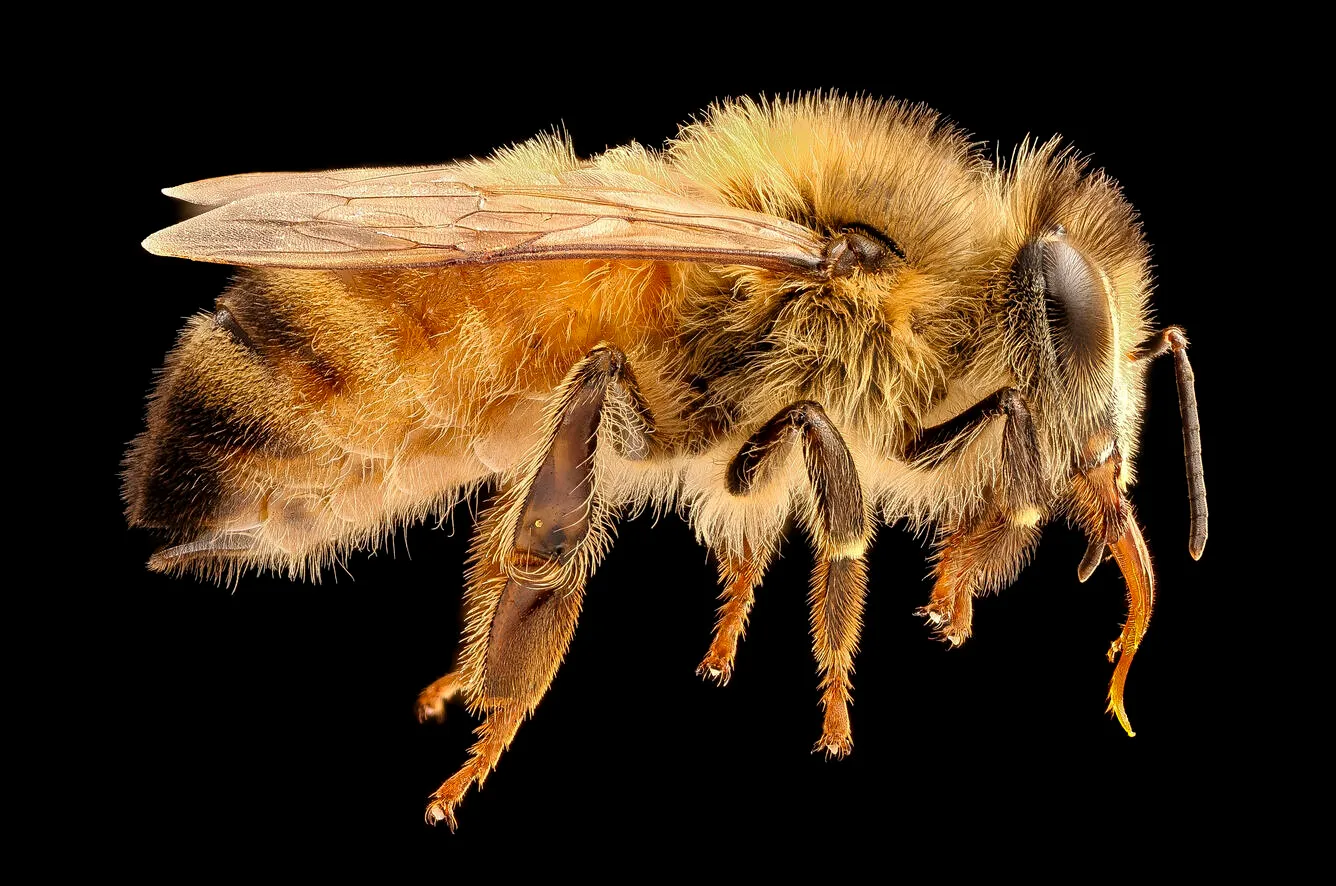
Why bees tremble or crawl: the possible causes
1. Chronic bee paralysis (CBPV)
This is the most typical cause of the picture. Chronic bee paralysis virus causes abnormal trembling of the body and wings in the bee, along with paralysis: affected bees can no longer fly and sometimes crawl on the ground. A second form produces black, hairless, shiny bees, which their sisters nibble and harass1, 2. The two forms often coexist in the same colony.
Two clues distinguish it from poisoning: dying bees pile up in heaps right in front of the entrance, whereas poisoning tends to leave a carpet scattered across the apiary, and bees with chronic bee paralysis do not spin on their backs1. The disease often affects one or a few colonies, particularly very populous colonies and those confined by a long spell of bad weather1.
In France, in the visits carried out between 2017 and 2023 by the Observatory of honey bee mortality and weakening (OMAA) outside acute mass mortalities, CBPV was retained in 24% of cases9. Details in the Chronic bee paralysis factsheet.
2. Varroa and the acute paralysis viruses
The viruses of the acute paralysis complex (ABPV, KBV, IAPV) produce a similar picture. In adults infected with ABPV or IAPV, death is preceded by rapid paralysis: trembling, inability to fly, then darkening and gradual loss of hair on the thorax and abdomen3. Researchers also describe, for IAPV, shivering wings, a sign that the nervous system is affected4. The course is fast: under experimental conditions, nearly 80% of bees infected orally with IAPV die within a week3.
The difference lies mainly in the context: these viruses are closely linked to varroa, which transmits them to pupae and adults, and their loads increase as the season goes on, with ABPV peaking rather in late summer3, 4. A heavily mite-infested colony that dwindles in late summer with trembling bees should make you think of acute bee paralysis.
Varroa can also produce crawling young bees with crumpled wings, unable to fly, thrown out in front of the hive: this is the sign of deformed wing virus, and of an already high infestation.
3. Pesticide poisoning
A reference guide on bee poisoning describes, depending on the insecticide family, bees that are stupefied or paralysed, with jerky, uncoordinated or abnormally fast movements, bees spinning on their backs, regurgitating the contents of their honey stomach with the tongue sticking out, or “crawlers” unable to fly, slow as if they had been chilled7. Fighting or agitation at the entrance is also possible7.
Timing remains the decisive clue: a sudden onset, within hours or days, affecting several colonies at once, often at the time of a nearby spray or sowing. Although feared, poisoning is retained in only 5% of OMAA visits outside acute mass mortalities9. If it is suspected, act fast (see below and the Pesticide poisoning factsheet).
4. Tracheal mite (Acarapis woodi)
The tracheal mite lives and reproduces in the bee’s thoracic tracheae. It has been associated with bees whose wings are dislocated, splayed in a “K”, and, in heavy infestations, with bees crawling in front of the colonies, especially in winter and early spring5. These signs are not reliable: the methodological reference states that crawling bees should not be used as an indicator, because nosema and some viruses produce the same picture5. Only dissection of the tracheae confirms the diagnosis. See Tracheal mite.
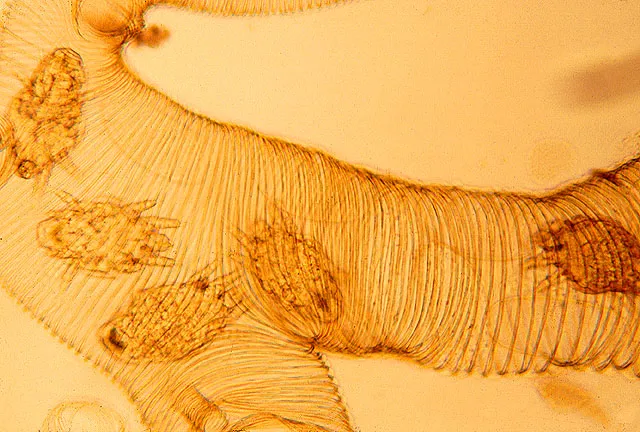
5. Nosema and dysentery
Bees with nosema caused by Nosema apis are sluggish and sometimes crawl in front of the hive, with a swollen abdomen and diarrhoea stains on the hive front and frames, especially in late winter and spring. Dysentery leaves similar soiling without necessarily being infectious. Here again, microscope examination or PCR is needed: spores are looked for in the abdomens of a sample of bees6.
More rarely, bees that tremble and crawl in spring may be infected by bacteria in the haemolymph: see Honey bee spiroplasmosis and bacterial septicemia.
6. Starvation and cold
A colony running out of stores weakens quickly: the bees become lethargic for lack of energy, then bury themselves head-first in the cells; nibbled brood cappings and pupae thrown out complete the picture11. This happens mostly in spring, during a cold or wet spell, when the colony uses up its last stores to rear brood11.
Cold alone can also immobilise foragers caught by a shower: numbed on the ground, they often revive in the sun, and the colony stays active.
7. False alarms: normal behaviour
Not every bee that “trembles” is sick.
- The tremble dance. On the combs, a forager may move slowly while shaking her body in a jerky way. This dance appears when a forager returns from a rich nectar source and struggles to find receiver bees to unload her: it prompts the house bees to start processing nectar and slows the recruitment of new foragers10. It is a sign of a nectar flow, not of disease.
- Old bees with worn wings, or drones driven out in late summer, crawling in front of the entrance in small numbers.
- Bees stuck in syrup or honey after a spilled feed.
- A swarm whose queen has clipped wings: unable to fly, the queen falls near the hive and bees cluster on the ground around her.
In North America, disoriented bees that leave the hive at night and die under lights may also be parasitised by a fly, Apocephalus borealis, the “zombie fly”, which has not been confirmed anywhere in Europe.
How to tell the causes apart
| What you see | Typical context | Most likely cause |
|---|---|---|
| Heap of trembling bees outside a single hive, some black and shiny | Populous colony, period of confinement | Chronic bee paralysis |
| Trembling bees, dwindling colony, many mites | Late summer, autumn | Acute bee paralysis and varroa |
| Crawling young bees with crumpled wings | Late summer | Deformed wing virus |
| Bees spinning on their backs, tongue out, scattered carpet | Sudden, several hives, nearby spraying | Poisoning |
| Crawling bees, K-wings | Late winter, early spring | Tracheal mite (to be confirmed) |
| Sluggish bees, swollen abdomen, diarrhoea | Late winter, spring | Nosema, dysentery |
| Lethargic bees, heads in cells, no stores left | Cold spring | Starvation |
| Numbed foragers on the ground, active colony | Cold snap, shower | Chilling |
| Bee slowly shaking itself on the combs | Peak nectar flow | Tremble dance, normal |
These causes often combine: nearly a third of OMAA visits ended with several associated conclusions9.
Trembling bees in front of the hive: what to do, step by step
- Observe and film, note the number of hives affected and the date of onset.
- Compare with the other colonies: a single hive points to a colony-specific cause, several hives suddenly affected to an external cause.
- Suspected poisoning: go straight to step 6.
- Open the colony if the weather allows: stores, brood, queen, appearance of the bees on the frames, diarrhoea stains.
- Count mites: a high result points to the viruses transmitted by the mite and calls for treatment with an authorised medicine, following the leaflet and the vet’s advice.
- Take samples and report if mortality is massive or poisoning is possible (see below).
- Deal with the identified cause: feed in case of starvation, limit confinement and robbing, unite or replace a colony that is too weak.
- Ask for a test if the picture remains unclear, through a vet or a bee health technician.
Laboratory diagnosis
Depending on the hypothesis, the laboratory looks for:
- viruses (CBPV, ABPV, IAPV, DWV) by PCR, the only method that identifies the virus involved2, 3;
- tracheal mites by dissecting the thorax, on a sample of about fifty bees, preferably collected in winter or early spring5;
- Nosema spores under the microscope, or the species by PCR6;
- pesticide residues, when poisoning is suspected.
For suspected poisoning, the reference French guidance requires sampling within 48 hours, if possible as three identical samples of about 50 g, or around 500 bees, transported chilled and then frozen at about -20 °C. It also recommends sampling separately the bees that show a distinct clinical sign, such as trembling bees8.
Regulations
What follows applies to France; rules vary between countries, so check those that apply where you keep bees.
- Acute mass mortality: a carpet of more than one litre of dead or dying bees per colony, or depopulation not due to swarming, appearing suddenly in under 15 days in at least 20% of the colonies in the apiary (1 colony in an apiary of 2 to 5, 2 colonies in an apiary of 6 to 10)8. It is reported to the DDPP (departmental veterinary services) or, in regions where it operates, to the OMAA single desk.
- Nosema caused by Nosema apis: it is not regulated at European level but appears on the French national list of diseases regulated on a provisional basis (order of 3 May 2022)12. Any suspicion must be reported to the DDPP.
- Viral paralyses, tracheal mite, starvation: no mandatory reporting.
In practice: what beekeepers actually do
Faced with bees that tremble or crawl, most beekeepers start with a simple question: one hive or several? The answer sets the level of urgency.
Practical habits
- Look at the landing board and the grass in front of the hives on every visit.
- Film the suspect bees: trembling is hard to describe but easy to show.
- Compare with neighbouring hives before drawing conclusions.
Common strategies
- Faced with a heap of trembling bees outside a single hive, many beekeepers think of chronic bee paralysis first and ask for a PCR rather than piling up hypotheses.
- A mite count is done almost systematically, because the mite is involved in a large share of these pictures.
- Until a diagnosis is made, equipment from an affected colony is not swapped with other hives.
- When poisoning is in doubt, a sample is frozen straight away.
Kit to keep ready
- New freezer bags, disposable gloves, permanent marker, cool box with ice packs.
- Labelled jars to keep trembling bees and dead bees apart, mite-counting equipment.
- The DDPP or OMAA desk number saved in your phone.
Checklist
- One hive or several? Sudden or gradual?
- Heap in front of the entrance or scattered carpet?
- Black and shiny bees, crumpled wings, K-wings, swollen abdomen, tongue out?
- Stores, brood, queen, mite count.
- Suspected poisoning: video, separate frozen samples, call the same day.
The most common mistakes
- Drawing conclusions from a single sign: crawling bees or K-wings are not enough to diagnose tracheal mite.
- Mistaking the tremble dance for disease: a bee shaking itself on the combs during a nectar flow is healthy.
- Waiting several days when bees are trembling in several hives: the evidence of poisoning disappears quickly.
- Forgetting varroa: without a mite count, a viral disease transmitted by the mite goes unnoticed.
- Treating at random, without a diagnosis or with an unauthorised product: no medicine cures a viral disease.
Frequently asked questions
Why are bees trembling in front of the hive? Most often because of a virus, first and foremost chronic bee paralysis virus, or the acute paralysis viruses transmitted by varroa. Poisoning is possible, especially if several colonies are hit suddenly. Only a laboratory test confirms the cause.
Bees crawling in the grass and no longer flying: is it serious? A few old bees or bees numbed by the cold, no. Large numbers of crawling bees, day after day, signal a problem: viruses, tracheal mite, nosema or starvation. Count the mites, check the stores and ask for a test.
How can I tell poisoning from paralysis? Look at the timing and the distribution. Poisoning often hits several hives at the same time, suddenly, with bees spinning on their backs and a scattered carpet. Chronic bee paralysis tends to affect one or a few colonies, with a heap of bees right in front of the entrance and black, shiny bees.
Is a bee shaking itself on the combs sick? Not necessarily. During a nectar flow, a forager struggling to get unloaded may perform the tremble dance, a normal communication behaviour. A sick bee tends to tremble outside, unable to fly.
References
- Budge G., Stainton K. (2016). Chronic bee paralysis. Bee Craft, September 2016 (article distributed by the National Bee Unit). nationalbeeunit.com
- Ribière M., Olivier V., Blanchard P. (2010). Chronic bee paralysis: a disease and a virus like no other? Journal of Invertebrate Pathology 103 (Suppl. 1): S120-S131. doi.org
- de Miranda J.R., Cordoni G., Budge G. (2010). The Acute bee paralysis virus-Kashmir bee virus-Israeli acute paralysis virus complex. Journal of Invertebrate Pathology 103: S30-S47. doi.org
- Chen Y.P., Pettis J.S., Corona M., Chen W.P., Li C.J., Spivak M. et al. (2014). Israeli acute paralysis virus: epidemiology, pathogenesis and implications for honey bee health. PLoS Pathogens 10(7): e1004261. doi.org
- Sammataro D., de Guzman L., George S., Ochoa R., Otis G. (2013). Standard methods for tracheal mite research. In: The COLOSS BEEBOOK, Vol. II. Journal of Apicultural Research 52(4). doi.org
- Fries I., Chauzat M.-P., Chen Y.-P., Doublet V., Genersch E., Gisder S. et al. (2013). Standard methods for Nosema research. In: The COLOSS BEEBOOK, Vol. II. Journal of Apicultural Research 52(1): 1-28. doi.org
- Hooven L., Sagili R., Johansen E. How to reduce bee poisoning from pesticides. Pacific Northwest Extension, publication PNW 591 (Oregon State University, Washington State University, University of Idaho). s3.wp.wsu.edu
- French Ministry of Agriculture, DGAL (2018). Note de service DGAL/SASPP/2018-444: surveillance des mortalités massives aiguës d'abeilles adultes avec hypothèse d'intoxication. draaf.bretagne.agriculture.gouv.fr
- Plateforme ESA, OMAA, Delmar E. et al. (2025). Analyse des visites « Autres troubles » (2017-2023). plateforme-esa.fr
- Seeley T.D. (1992). The tremble dance of the honey bee: message and meanings. Behavioral Ecology and Sociobiology 31: 375-383. doi.org
- Wilkinson D. National Bee Unit (APHA). Starvation of honey bees: recognition and prevention. nationalbeeunit.com
- Anses, Sophia Antipolis laboratory (2025). Rapport d'activité du laboratoire national de référence Santé des abeilles. anses.fr
- USGS Bee Inventory and Monitoring Lab. Apis mellifera, light body, side, Beltsville, MD (public domain). usgs.gov
- USDA Agricultural Research Service, Image Gallery. Photo K5069-23: tracheal mites in a honey bee trachea (Lila de Guzman). ars.usda.gov