Key points
- Bald brood is a symptom: uncapped pupae, often in lines, with a raised rim of wax around the cells.
- The classic cause is wax moth, whose larvae tunnel just beneath the cappings.
- Pierced or recapped cappings can also reflect the removal of varroa-infested brood: do a mite count.
- Sunken, dark, perforated cappings with a brown ropy larva: suspect American foulbrood and report it to the DDPP.
- Pupae in bald brood caused by wax moth usually emerge normally: look above all for what is weakening the colony.
On a healthy brood frame, the cappings form a continuous surface, beige to brown, slightly domed and free of holes10. Beekeepers speak of bald brood when pupae remain uncapped in their cells and carry on developing in the open, often in small lines or patches, with a raised rim of wax around the cells2. More broadly, beekeepers sometimes come across perforated cappings: pierced with a small hole, nibbled, removed and then rebuilt.
Bald brood and perforated cappings are symptoms, not diseases. They have harmless causes, such as wax moth or efficient removal of parasitised brood, but also serious ones, including American foulbrood. This factsheet follows a decision tree: what you observe, the possible causes, how to tell them apart, then what to do.
What to look for on the frame
With the frame in hand, held flat and in full light, ask yourself a few questions:
- What is the pattern? A line of open cells winding across the comb, a small patch, or isolated cells scattered through the brood?
- What do the open cells contain? A white, smooth pupa with pink or purple eyes that looks alive; or a slumped, yellowed or brown larva, a melted mass, a scale?
- What do the neighbouring cappings look like? Domed and dry, or sunken, dark and greasy-looking?
- What shape are the holes? A small round hole in the centre, a partly chewed capping, an irregular hole at the edge?
- Is there any silk? Fine threads, tunnels, specks of droppings along the line of cells?
- What is the context? Colony strength, season, latest mite count, number of colonies affected.
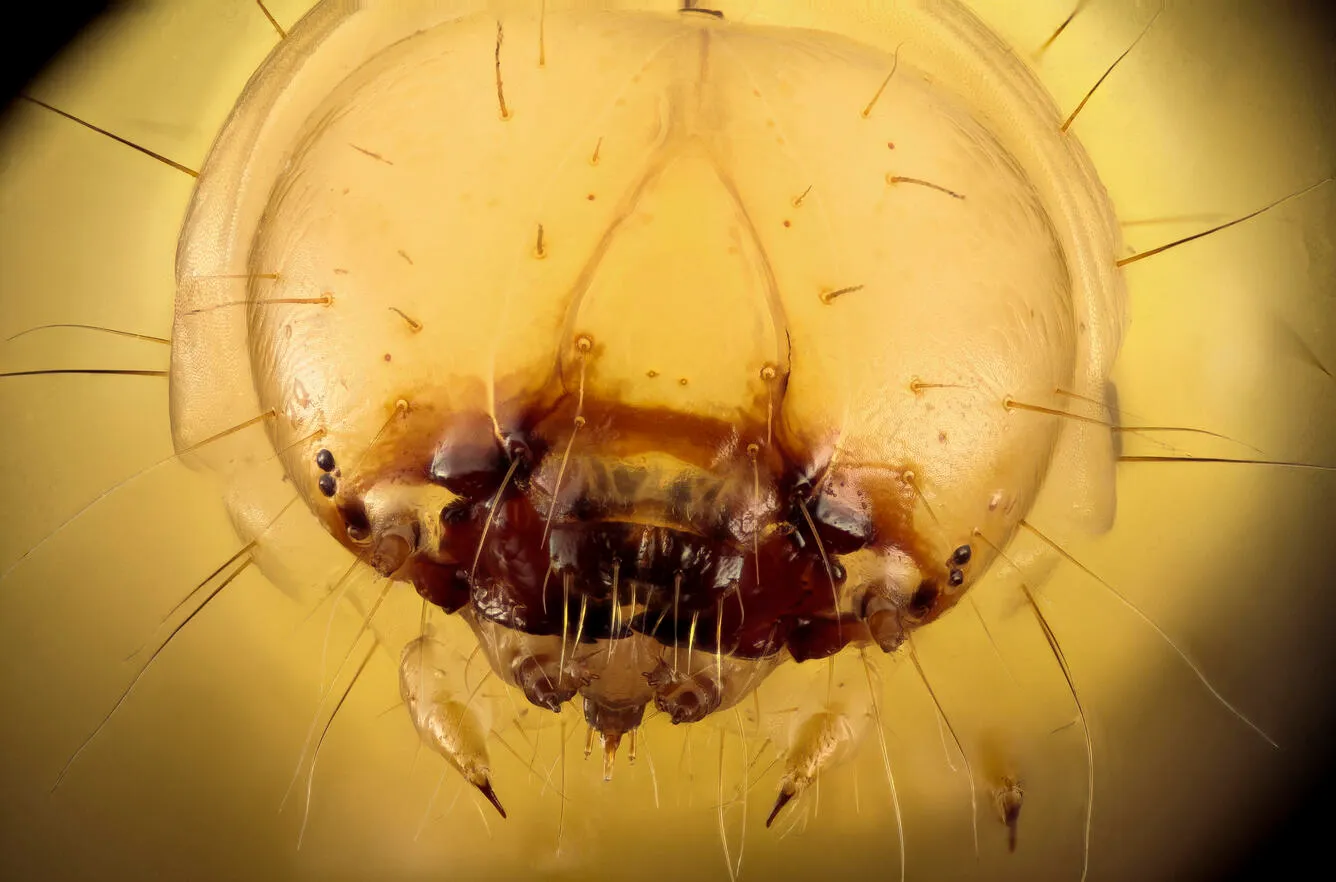
The possible causes, from the most common to the rarest
The order below is only indicative: no statistics allow these causes to be ranked precisely, and several can coexist in the same colony.
1. Wax moth: “classic” bald brood
The most frequently cited cause is wax moth. Its young larvae tunnel through the wax just beneath the brood cappings, damaging several cells along their path2. The workers finish removing the damaged wax: the pupae are left exposed, and the open cells form a line that follows the larva’s route3. The larva’s droppings can soil the pupae3.
Both species can be involved. The British bee health service names the greater wax moth (Galleria mellonella) as the main cause, the lesser wax moth (Achroia grisella) being less common and less destructive2. A University of Florida factsheet, on the other hand, attributes bald brood to the lesser wax moth3.
In most cases, the exposed pupae carry on developing and emerge normally2. A US study observed that where wax moth was present, more than half of the open cells were recapped by the bees within 24 hours, without the pupae being removed1. The danger lies elsewhere: the silk spun by the larvae can trap young bees as they emerge, and they starve to death on the spot, a phenomenon known as galleriasis4.
2. Varroa and the removal of parasitised brood
Many colonies can detect the cells in which varroa is reproducing. The workers open the capping, then either remove the pupa or close the cell again. This second behaviour, called recapping, leaves an irregular capping, sometimes with a hole in the centre. In four honey bee populations that survive varroa without treatment, workers uncap and recap brood more often than neighbouring susceptible colonies, which reduces the mite’s reproduction5. In resistant populations in South Africa and Brazil, recapping is very frequent and mainly targets infested cells, whereas it is rare in populations never exposed to varroa6. Recapped cells form clusters around infested cells, and the holes made in infested cells are larger than those in neighbouring healthy cells7.
When the workers remove the parasitised pupa, empty cells or half-extracted pupae are left behind. Bees selected for VSH behaviour (Varroa Sensitive Hygiene) mainly remove parasitised pupae capped for five days or less8. In the US study already cited, in a colony heavily infested with varroa, about half of the open cells were still open after 24 hours and almost all of the partly removed pupae were eventually taken out1.
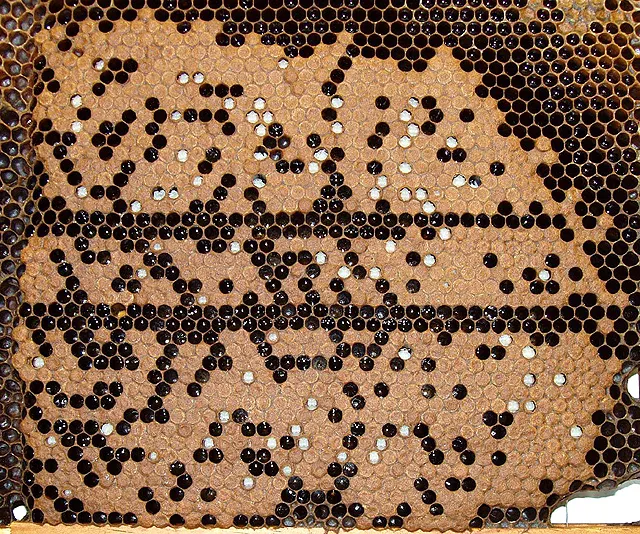
This is a sign of good defence, but also of the presence of varroa: perforated cappings in late summer call for a mite count.
3. American foulbrood
This is the cause never to miss. In American foulbrood, the larva dies after capping and decomposes. The cappings become sunken, concave, dark, sometimes greasy-looking, and the bees pierce them partly or completely10. The holes are often irregular or located at the edge of the capping11. At the bottom, the larva forms a brown mass that stretches into a thread when drawn out with a matchstick, then dries into a dark brown to black scale that sticks firmly to the cell wall11. The causative agent, Paenibacillus larvae, forms extremely resistant spores9.
The difference from bald brood is clear-cut: in American foulbrood, the pierced cell contains a corpse, not a living pupa.
4. Other brood diseases
Other diseases also produce pierced or removed cappings10:
- European foulbrood: larvae usually die before capping; if they die after, the capping may be pierced, sunken and dark.
- Sacbrood: pierced or removed cappings; the larva, lying on its back, forms a fluid-filled sac with a dark, raised head.
- Chalkbrood: pierced or removed cappings; the cell contains a hard mummy, white to black.
5. Tropilaelaps, an exotic mite
Tropilaelaps, a mite from Asia that the European Union is still free of, causes perforated cappings through the workers’ cleaning, irregular brood, dead pupae partly exposed and bees with deformed wings or legs12. These signs closely resemble those of varroa. In France, any suspicion must be reported.
6. Frames spaced too closely
When frames are too close together, the bees lack room to move between the combs and may uncap the brood to clear a passage2.
7. A genetic form
A hereditary form of bald brood has been described, with no wax moth or disease involved. It is rare, poorly documented and is usually resolved by requeening2.
How to tell the causes apart
| What you see | Cell contents | Most likely cause |
|---|---|---|
| Winding line of open cells, raised rim, silk, droppings | White, living pupa | Wax moth |
| Open or recapped cells scattered in small clusters, in late summer | Pupa partly removed, mites visible | Varroa and hygienic behaviour |
| Rebuilt, irregular capping, small central hole | Healthy pupa or mites | Recapping |
| Sunken, dark, greasy cappings, irregular holes | Brown ropy mass or firmly attached scale | American foulbrood |
| Pierced capping, sac-shaped larva, dark head | Fluid inside the larval skin | Sacbrood |
| Pierced or removed capping, hard mummy | White to black mummy | Chalkbrood |
| Perforated cappings, dead pupae, deformed bees, low mite count | Dead pupae, very fast-moving mites | Suspected Tropilaelaps |
| Patch of open cells between two combs that are too close | Healthy pupa | Frames spaced too closely |
Step-by-step diagnosis
- Examine several frames from the centre of the brood nest, not just one frame at the edge.
- Follow the line of open cells: under the neighbouring capping, at the end of the line, you will often find the wax moth larva in its silk tunnel. Fine tweezers or a toothpick are enough to lift the wax.
- Uncap a few pierced cells and look at what they contain.
- Do the rope test on any brown or slumped larva. If the mass stretches into a thread, suspect American foulbrood: do not move any frames and contact the DDPP or your vet.
- Count the mites on adult bees, and open about twenty pupae with tweezers to look for mites.
- Check the frame spacing and the general state of the colony: population, stores, presence of the queen.
- Compare with the other colonies in the apiary.
One confusion to avoid: any larva found under the cappings must be identified. The wax moth larva has prolegs under its abdomen and no spines on its back; the larva of the small hive beetle, Aethina tumida, has no prolegs but rows of dorsal spines2. Any suspicion of Aethina must be reported without delay.
The laboratory
For a suspicion of foulbrood, Tropilaelaps or Aethina, it is the DDPP or your vet who arranges the sampling and dispatch to the laboratory; field signs are only a pointer11. Bald brood caused by wax moth or recapping does not need testing: it can be recognised by eye.
Regulations
What follows applies to France; rules vary between countries, so check those that apply where you keep bees.
- Bald brood is not a disease: it is not reported as such, and wax moth is not regulated.
- Any suspicion of American foulbrood, Tropilaelaps or Aethina tumida must be reported to the DDPP, directly or through your vet.
- Any varroa treatment uses a medicine authorised for bees, following the package leaflet, and is recorded in the apiary medicine register.
What to do depending on the cause
- Wax moth in the brood: strengthen the colony (unite a weak colony, remove frames not covered by bees), replace old combs, regularly clean the floor and the mite-counting boards, remove dead colonies from the apiary without delay2. A heavy wax moth presence in a populous colony often signals another problem: queenlessness, disease, starvation.
- Recapping or emptied cells: count the mites and treat if the threshold is reached. Do not penalise a colony that cleans its brood well: this is a quality worth noting.
- American foulbrood or another brood disease: follow the relevant factsheet and, for American foulbrood, the reporting procedure.
- Frames spaced too closely: restore normal spacing.
- Suspected genetic form: requeen if the problem persists and no other cause is found2.
In practice: what beekeepers actually do
Faced with bald brood, most beekeepers do not worry unduly, but they take a few minutes to check that it really is wax moth and not a brood disease.
Practical habits
- Follow the line of exposed pupae to the end to find the wax moth larva and remove it.
- Open two or three pierced cells to make sure the pupae are alive.
- Do the rope test as soon as a capping looks sunken or dark.
Common strategies
- Many beekeepers note the appearance of the cappings on their inspection record, as well as the brood pattern.
- They pair any perforated brood in late summer with a mite count.
- Every year they replace some of the old brood combs, which are the most attractive to wax moth.
- Some bee selection programmes look out for colonies that frequently uncap and recap their brood, as an indicator of varroa resistance.
Kit to keep ready
- Fine tweezers or toothpicks, a magnifying glass or head torch.
- Matches or small sticks for the rope test.
- Mite-counting equipment.
- A small bottle of alcohol to preserve a larva for identification.
- The DDPP’s and your vet’s phone numbers.
Checklist
- Pattern: line, patch or scattered cells?
- Contents: living pupa or dead larva?
- Neighbouring cappings: domed and dry, or sunken and dark?
- Silk, tunnels, wax moth larva?
- Mite count, colony strength, frame spacing.
The most common mistakes
- Concluding it is wax moth without opening a cell: a pierced capping over a dead larva is anything but harmless.
- Overlooking a sunken, dark capping in the middle of perforated brood: it is the warning sign of American foulbrood.
- Assuming that perforated cappings always mean disease, when they often reflect efficient removal of varroa-infested brood.
- Forgetting the mite count in late summer.
- Mistaking a wax moth larva for an Aethina tumida larva: if in doubt, preserve it in alcohol and have it identified.
Frequently asked questions
What is bald brood? It is brood in which some pupae remain uncapped and develop in the open, often in lines, with a raised rim of wax. The usual cause is wax moth, whose larvae tunnel under the cappings.
Is bald brood serious? Generally not: the pupae usually emerge normally. But it signals wax moth in the colony, often linked to a weakened colony, and you need to check that it is not a brood disease.
Why are the brood cappings perforated? The most common causes are wax moth and the removal of varroa-infested brood. Pierced, sunken and dark cappings over a dead larva suggest American foulbrood, sacbrood or chalkbrood.
How can I tell bald brood from American foulbrood? Open the cell. In bald brood, it contains a white, living pupa. In American foulbrood, the capping is sunken and dark, and the cell contains a brown mass that ropes out on a matchstick or a scale stuck to the cell wall.
Are cappings rebuilt by the bees a good sign? Often, yes. Recapping shows that the workers are inspecting the brood and disrupting varroa reproduction. It also shows that varroa is present: a mite count is still essential.
References
- Villegas A.J., Villa J.D. (2006). Uncapping of pupal cells by European bees in the United States as responses to Varroa destructor and Galleria mellonella. Journal of Apicultural Research 45(3): 203-206. ars.usda.gov
- Ponting S. (2021). Wax moth and bald brood. BBKA News, February 2021: 51-52 (National Bee Unit). nationalbeeunit.com
- Egelie A.A., Mortensen A.N., Barber L., Sullivan J., Ellis J.D. (2022). Lesser wax moth, Achroia grisella Fabricius. UF/IFAS Extension, publication EENY637. edis.ifas.ufl.edu
- Kwadha C.A., Ong'amo G.O., Ndegwa P.N., Raina S.K., Fombong A.T. (2017). The biology and control of the greater wax moth, Galleria mellonella. Insects 8(2): 61. doi.org
- Oddie M., Büchler R., Dahle B., Kovacic M., Le Conte Y., Locke B., de Miranda J.R., Mondet F., Neumann P. (2018). Rapid parallel evolution overcomes global honey bee parasite. Scientific Reports 8: 7704. doi.org
- Martin S.J., Hawkins G.P., Brettell L.E., Reece N., Correia-Oliveira M.E., Allsopp M.H. (2020). Varroa destructor reproduction and cell re-capping in mite-resistant Apis mellifera populations. Apidologie 51(3): 369-381. doi.org
- Grindrod I., Martin S.J. (2021). Spatial distribution of recapping behaviour indicates clustering around Varroa infested cells. Journal of Apicultural Research 60(5): 707-716. doi.org
- Harris J.W. (2007). Bees with Varroa Sensitive Hygiene preferentially remove mite infested pupae aged ≤ five days post capping. Journal of Apicultural Research 46(3): 134-139. ars.usda.gov
- Genersch E. (2010). American Foulbrood in honeybees and its causative agent, Paenibacillus larvae. Journal of Invertebrate Pathology 103: S10-S19. doi.org
- Agriculture Victoria (Australia). Field diagnosis of honey bee brood diseases. agriculture.vic.gov.au
- BeeAware, Plant Health Australia. American foulbrood. beeaware.org.au
- BeeAware, Plant Health Australia. Tropilaelaps mites. beeaware.org.au
- USGS Bee Inventory and Monitoring Lab. Wax worm, U, Maryland, face (public domain). usgs.gov
- USDA ARS, Jeffrey Harris. Image D214-2, VSH behaviour test (ARS Image Gallery). ars.usda.gov